

The AI infrastructure landscape is also shifting from 'ownership' to 'subscription.' Instead of companies directly purchasing and deploying expensive GPU (Graphics Processing Unit) servers, a model in which they use cloud services for only the amount needed is spreading. This indicates that the competition over AI infrastructure is moving from securing GPUs to a stage focused on increasing actual utilization rates.
Samsung SDS is expanding its GPUaaS (GPU as a Service), which provides GPUs in service form through its self-built Samsung Cloud Platform (SCP). This model allows companies to access resources necessary for AI model training and inference without directly purchasing GPU servers or building separate infrastructure.
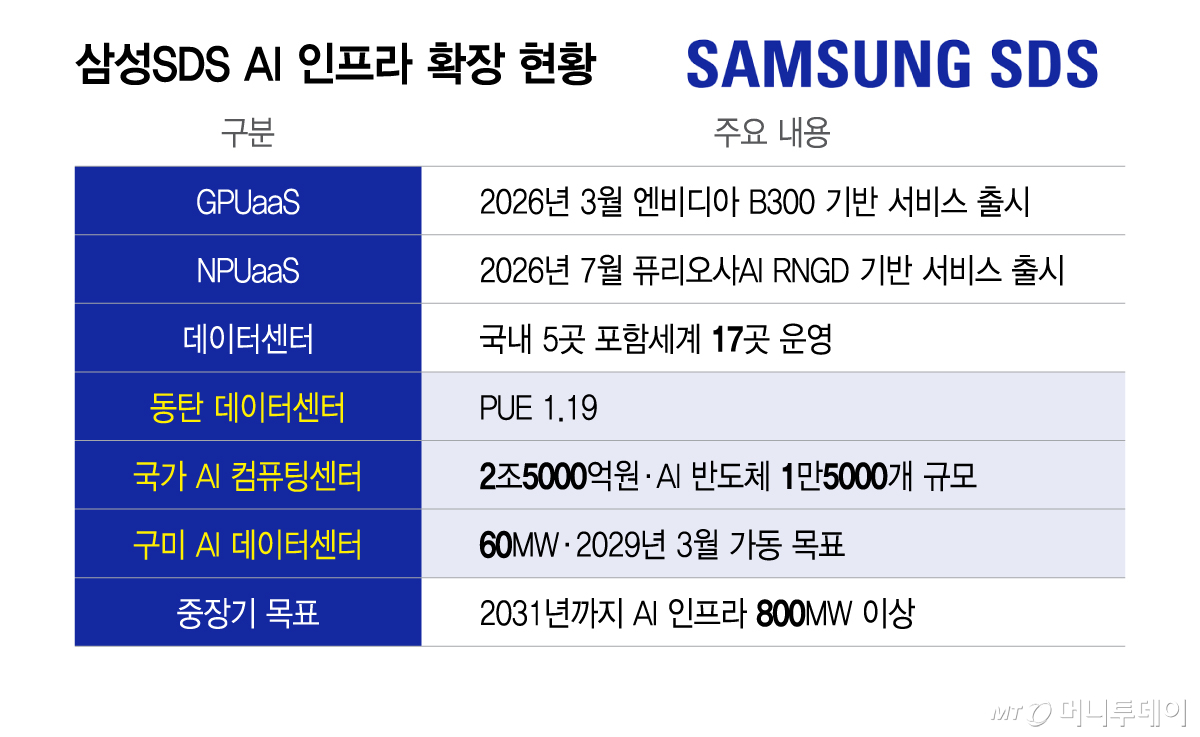
In March, Samsung SDS launched the country's first SCP-based NVIDIA B300 GPUaaS. It provides an AI computing environment utilizing both the existing H100 and the B300. The company was also selected as a supplier for the Ministry of Science and ICT's '2026 AI Research Computing Support Project,' providing GPU resources to universities and research institutions.
The options do not end with GPUs. In July, Samsung SDS also introduced NPUaaS based on FuriosaAI's second-generation NPU (Neural Processing Unit), 'Renegade (RNGD).' This broadens the range of computing resources by allowing users to select GPUs for AI training and NPUs suited to specific tasks such as inference.
As AI is fully integrated into corporate operations, the required infrastructure is becoming more complex. Securing computing resources alone does not complete an AI service. High-speed networks and storage are needed to connect GPUs and NPUs, along with the cloud to operate them, and data centers must support the stable operation of large-scale equipment.
This is the background behind Samsung SDS's expansion of data center investments alongside computing resources. The company currently operates 17 data centers worldwide, including five locations in South Korea: Sangam, Suwon, Gumi, Chuncheon, and Dongtan. The Power Usage Effectiveness (PUE) of the Dongtan data center is at a level of 1.19. PUE is calculated by dividing total data center power consumption by IT equipment power consumption; values closer to 1 indicate higher efficiency.
Large-scale AI infrastructure construction is also underway. A total of 250 trillion won will be invested in the National AI Computing Center in Haenam, South Jeolla Province, where Samsung SDS participates as the consortium leader, by 2028. The facility will be built with a scale of 15,000 AI semiconductors and plans to provide GPU·NPU computing resources to startups, SMEs (small and medium-sized enterprises), universities, and research institutions.
A new 60MW-scale AI data center will be built in Gumi. Targeting operation by March 2029, it will apply a power supply system tailored for high-power GPU-centric equipment and HYBRID cooling technology combining air and liquid cooling. Through such investments, Samsung SDS plans to expand its data center capacity to over 800MW by 2031.
Samsung SDS is pursuing a so-called 'multidimensional AI full-stack' strategy that connects everything from data center design, construction, and operation to cloud, GPU·NPU, AI platforms, and business solutions. The company aims to connect the infrastructure needed for companies adopting AI in stages. To increase the utilization rate of secured GPUs, even companies or research institutions that find large-scale capital investment difficult must be able to access computing resources.
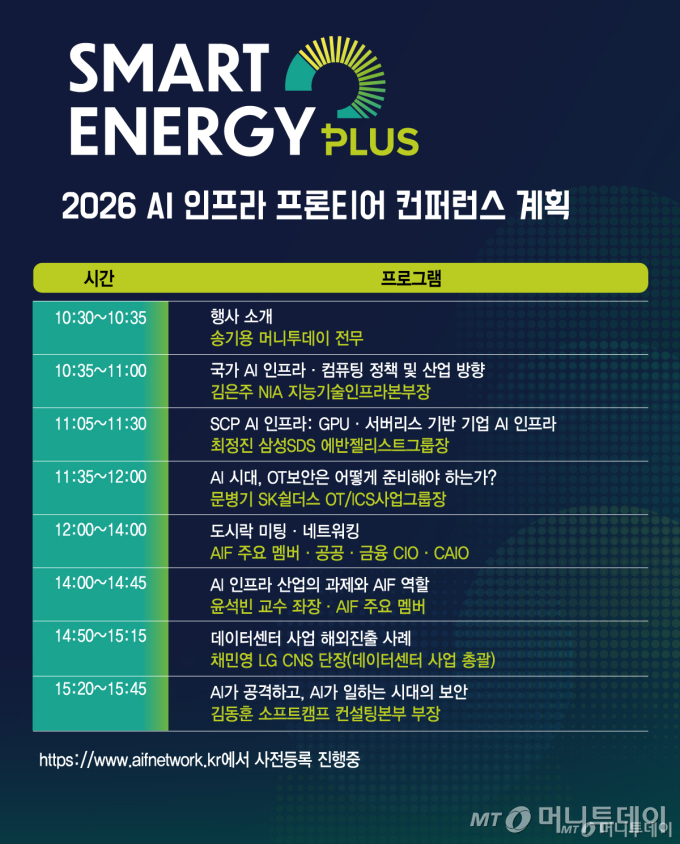
Choi Jung-jin, Head of the Evangelist Group at Samsung SDS, is scheduled to introduce Samsung SDS's AI infrastructure strategy and corporate use cases under the theme 'SCP AI Infrastructure: Enterprise AI Infrastructure Based on GPU·Serverless' at the 'AI Infrastructure Frontier Conference' to be held in Seoul COEX on the 29th.

 in TECH

