

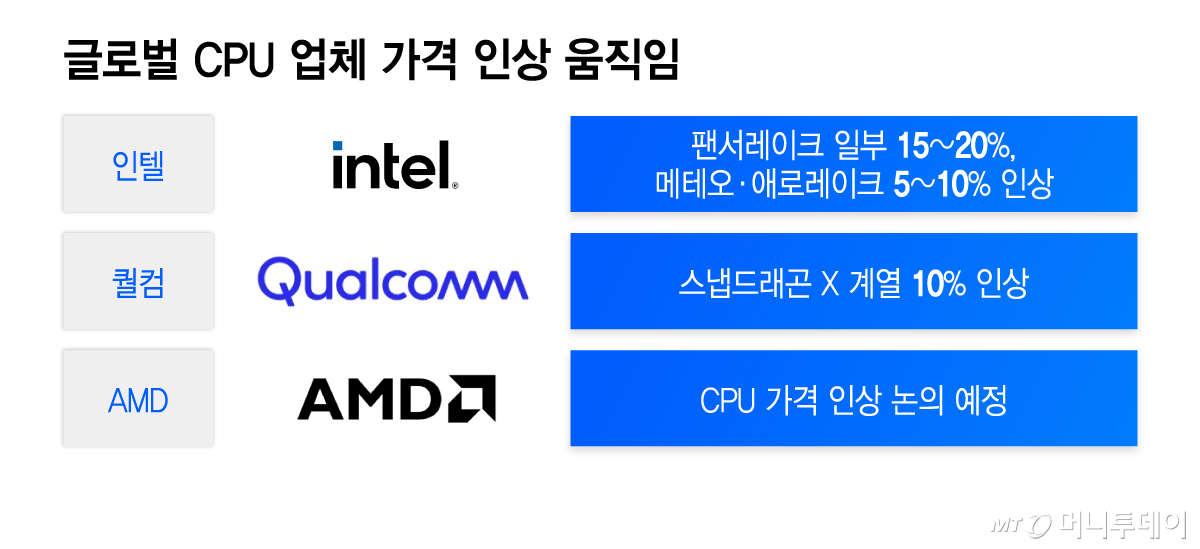
With PC prices already surging due to a sharp increase in demand for AI (artificial intelligence), they are expected to become even more expensive. As AMD is confirmed to be discussing CPU (central processing unit) price hikes, following Intel and Qualcomm, the burden on consumers is likely to grow further.
According to IT (information technology) industry sources on the 23rd, AMD is reportedly considering whether to raise CPU prices. With Intel and Qualcomm having successively increased their prices, signs of price hikes are spreading across major CPU manufacturers as a whole.
According to market research firm TrendForce, Intel raised the prices of some CPU products starting from the 1st of last month. Prices for Panther Lake products equipped with high-performance GPUs (graphics processing units) rose by 15% to 20%, while Meteor Lake and Arrow Lake products increased by 5% to 10%. It is reported that Intel adjusted CPU prices three times since the end of last year.
Qualcomm is also reportedly raising the prices of PC processors, such as the Snapdragon X and X2 Elite, by approximately 10% starting this month. As the AI PC market expands, competition over the performance of CPUs, GPUs, and NPUs (neural processing units) has intensified, and reliance on advanced semiconductor processes has increased.
A major cause of the CPU price hikes is cited as rising costs for semiconductor foundry services. TSMC, the world's largest foundry company, is expected to raise prices for its advanced processes by 5% to 10% and for advanced packaging by 10% to 15% next year. Intel's Panther Lake is a product that combines CPU tiles manufactured using its own 18A process with GPU tiles produced on TSMC's 3-nanometer process. As competition intensifies to secure advanced semiconductor production capacity amid expanded investments in AI data centers, upward pressure is being applied to CPU manufacturing costs.
The problem is that the PC market is already struggling due to rising component prices. According to market research firm Omdia, global PC shipments in the third quarter of this year were 58.1 million units, a decrease of 21.2% compared to the same period last year. This is the largest decline since the first quarter of 2023. The contraction in consumption was driven by PC purchase demand being pulled forward in the first half of the year and rising component prices being reflected in finished product prices.
In particular, PC manufacturing costs have risen by more than 40%, regardless of price range. The share of DRAM and SSDs (solid-state drives) in total manufacturing costs has also increased from approximately 15% to nearly 40%. Analysts note that although PC manufacturers have raised product prices several times recently, they have not fully reflected the increases in component prices.
Ishan Dutt, Research Director at Omdia, analyzed that "rising component prices are being passed on to final consumer prices, affecting purchasing decisions by both consumers and businesses." Omdia forecasts that global PC shipments will decrease by 24% year-on-year in the fourth quarter of this year and decline by 7% annually next year.

 in TECH
