

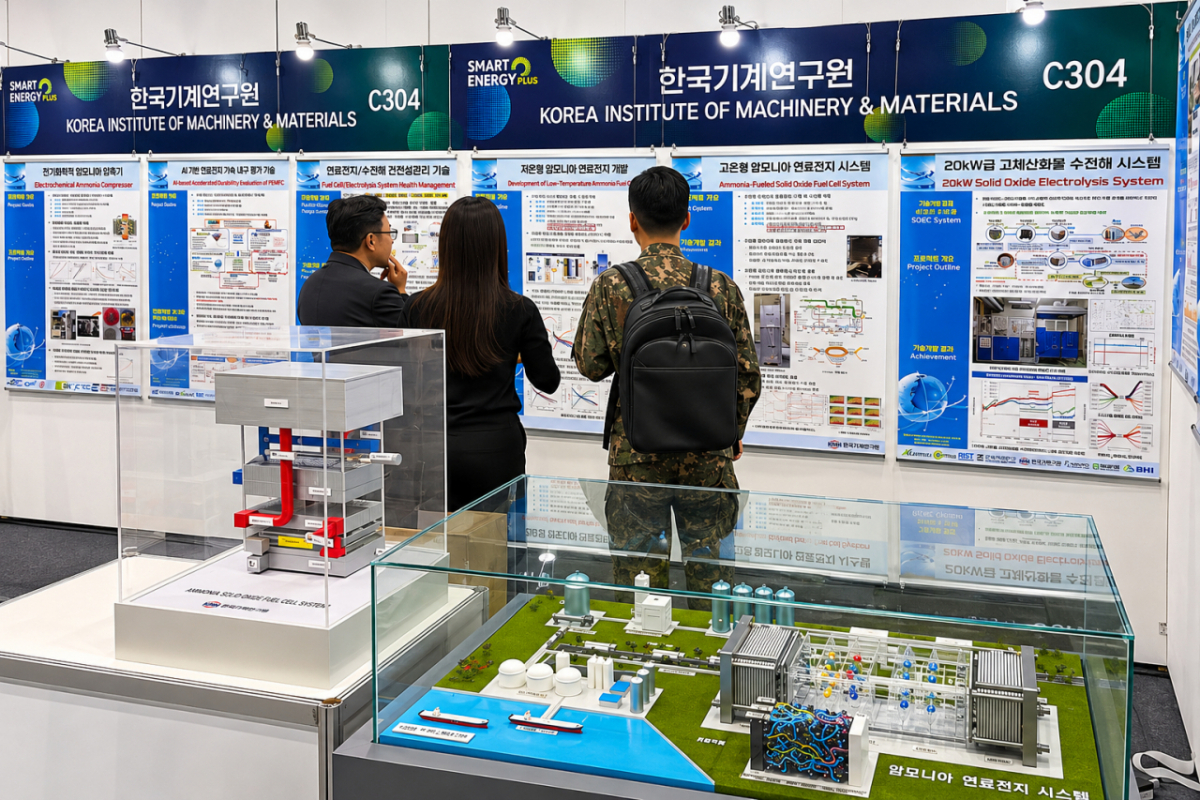
Inside a transparent display case sat a device consisting of a gray metal box connected by red piping. It was a model illustrating the structure of a solid oxide fuel cell (SOFC) system that generates electricity using ammonia as fuel. Right next to it, a scaled-down model depicting the entire process from ammonia production to transportation and power generation was also on display.
At "Smart Energy Plus (SMART ENERGY PLUS·SEP) 2026," held on the 28th in Hall B of COEX in Samsung-dong, Seoul, the Korea Institute of Machinery & Materials (KIMM) showcased next-generation energy technologies utilizing hydrogen and ammonia. The institute introduced, all in one place, technologies for hydrogen production, ammonia power generation, carbon capture, and AI-based equipment management aimed at reducing dependence on fossil fuels.
A model of an ammonia fuel cell system drew attention at the exhibition. It was designed to allow viewers to inspect the internal structure from the fuel supply section to the fuel cell stack that generates electricity. Ammonia is gaining attention as a next-generation energy carrier because it is easier to store and transport than hydrogen.
KIMM is developing a high-temperature fuel cell system utilizing ammonia. The institute has completed long-term evaluations of over 100 hours for a 1-kilowatt (kW) class fuel cell stack, while an integrated 1.5 kW-class system utilizing it recorded an efficiency of 48%. It also completed operational evaluations of more than 150 hours. This method generates electricity by using ammonia directly or through reforming.
Research is also underway on ammonia fuel cells that operate at low temperatures. Unlike existing hydrogen fuel cells, the goal is to reduce system size by utilizing ammonia directly as fuel. The institute also showcased a technology for compressing ammonia through electrochemical reactions. A key feature of this technology is its operation without mechanical drive components, which reduces noise and vibration.
In the field of hydrogen production, a 20 kW-class solid oxide electrolysis (SOEC) system was introduced. This technology produces hydrogen by electrolyzing high-temperature steam. KIMM has completed over 5,000 hours of demonstration operation. The significance lies in securing actual operational data, as maintaining performance during long-term operation is the key to commercialization.
A technology for directly capturing carbon dioxide dissolved in seawater was also exhibited. This method separates and recovers carbon from seawater using electrochemical reactions. Development of fuel production technologies utilizing the captured carbon is also being pursued.
Energy equipment management technologies utilizing AI were also unveiled. This technology analyzes operational data from fuel cell and electrolysis systems to diagnose faults and predict lifespan. KIMM stated that it recorded a fault diagnosis rate of 98.6% by utilizing 5,000 hours of demonstration data from solid oxide electrolysis systems. The goal is to detect equipment failures early to reduce maintenance costs and operational downtime.
A system combining fuel cells with heat pumps, solar thermal energy, and absorption chillers to simultaneously supply electricity, heating, and cooling was also introduced. Through a smart greenhouse demonstration in the Jeonju region, this technology supplies the energy required for agricultural facilities and improves operational efficiency.

 in TECH
