

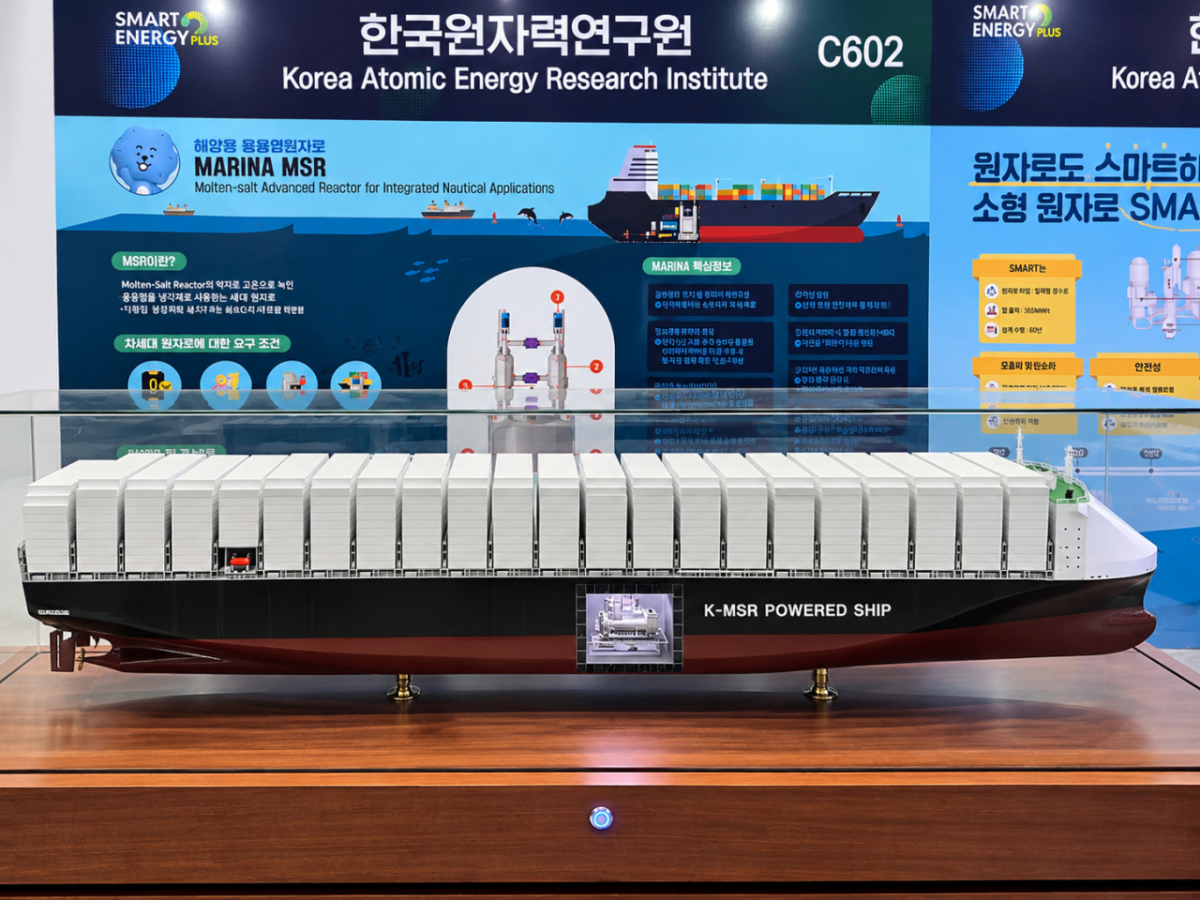
At "Smart Energy Plus (SEP) 2026," held on the 28th in Hall B of COEX in Samsung-dong, Seoul, a large cargo ship model caught the eye upon entering the Korea Atomic Energy Research Institute (KAERI) exhibition booth. The side of the vessel, with its deck densely packed with white containers, bore the inscription "K-MSR POWERED SHIP." It depicted the form of a future cargo ship powered by nuclear energy instead of fossil fuels.
The Korea Atomic Energy Research Institute unveiled the marine molten salt reactor "MARINA MSR" and the Korean-type small modular reactor "SMART" on that day. In particular, the nuclear-powered cargo ship model was an exhibit that President Lee Jae-myung personally viewed at the "Report on Seven Major SEEDs for Future Growth Drivers" held on August 12 at Cheong Wa Dae. A KAERI official described it as a "model brought back from Cheong Wa Dae."
The technology that drew the most attention was the MARINA MSR. Molten salt reactors (MSRs) are next-generation reactors that utilize molten salts melted at high temperatures. MARINA applies a liquid fuel method in which nuclear fuel is dissolved in molten salt. It is designed with a thermal output of 100 MWt (megawatts thermal) per module and an electrical output of approximately 35 MWe (megawatts electric).
The strengths of the MARINA MSR lie in its safety and operational flexibility. Unlike existing reactors, it can operate at atmospheric pressure levels, reducing the burden on equipment required to maintain high pressure. Because the nuclear fuel is in a liquid state, a safety design that allows for discharge into separate storage space in the event of an accident is also possible. A characteristic feature is that fuel can be supplied more flexibly than with solid fuel methods.
In particular, the boiling point of molten salt is approximately 1,460 degrees, which is significantly higher than the reactor operating temperature of 700 degrees. According to KAERI, this means the coolant does not boil easily, securing margin for accident response.
The development of nuclear-powered ships is intertwined with the decarbonization efforts of the international shipping industry. This is because the importance of propulsion technologies that can replace fossil fuels is growing as the International Maritime Organization (IMO) pushes to reduce greenhouse gas emissions from vessels. While nuclear-powered ships can reduce carbon emissions during operation, challenges for commercialization include verifying radiation safety, navigating international regulations, and securing port acceptance.
In one corner of the exhibition hall, a model showing the internal structure of SMART, a small reactor developed independently by Korea, was also installed. Inside a transparent display case, the reactor vessel and internal piping were meticulously reproduced. SMART is designed to place major equipment within a single reactor vessel, simplifying piping and reducing the likelihood of loss-of-coolant accidents.
SMART has a thermal output of 365 MWt and a design life of 60 years. The Korea Atomic Energy Research Institute obtained standard design approval for SMART in 2012 and has since pursued design improvements to enhance safety and economic efficiency. Exhibition materials also presented a development schedule targeting market entry by 2030.
If SMART is a small reactor supplying power and heat on land, the MARINA MSR targets ship propulsion and marine energy supply. This demonstrates the potential for the scope of nuclear technology applications to expand beyond land-based power plants to the sea. However, actual commercialization requires backing in the form of economic verification and the establishment of licensing systems.

 in TECH
