

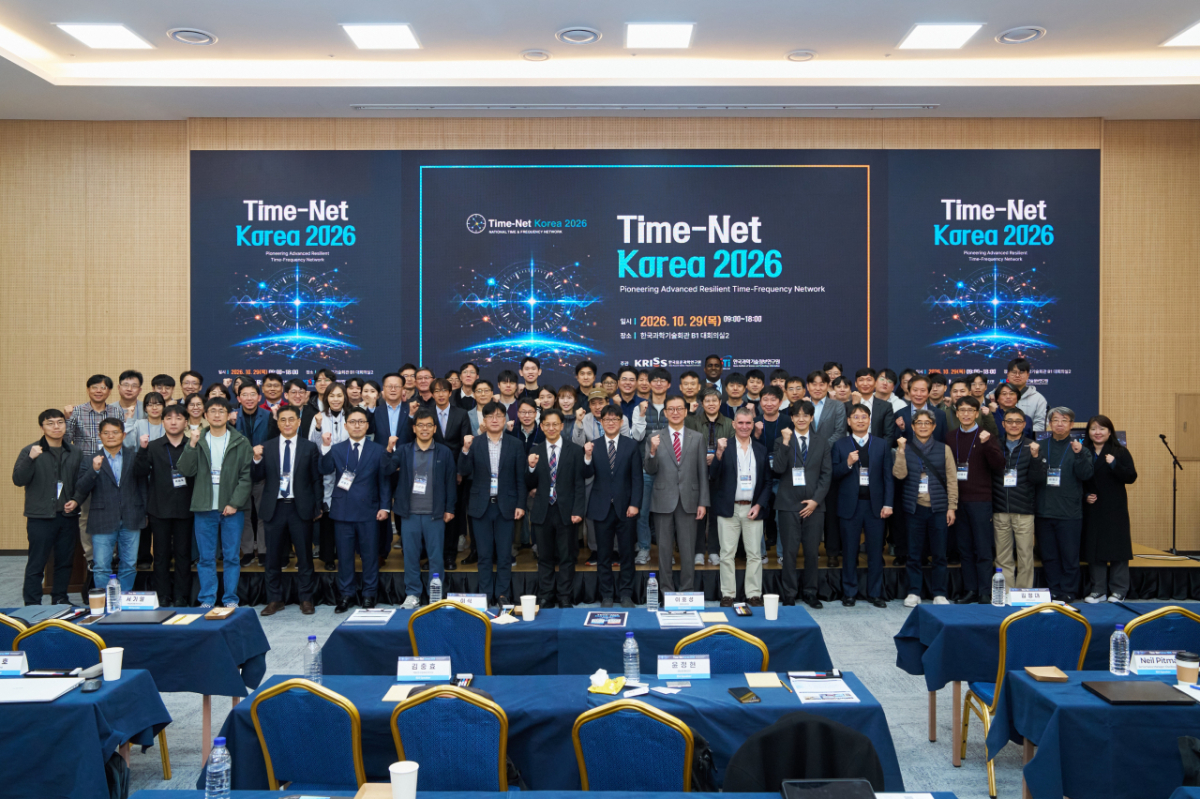
The Korea Research Institute of Standards and Science (KRISS) and Korea Institute of Science and Technology Information(KISTI) will collaborate to build a Korean-style time and frequency transmission network based on the national standard time.
KRISS announced that it held the 'Time-Net Korea 2026' workshop together with KISTI at the Korea Science and Technology Center in Seoul on the 29th.
At this workshop, participants discussed methods for supplying time to complement satellite navigation systems such as optical communication networks, geostationary satellites, and terrestrial broadcasting. The core agenda was the 'Time-Net Korea' plan to directly transmit national standard time through domestic optical communication networks.
The method involves KRISS generating and maintaining the Republic of Korea's standard time, which is then carried on the National Science and Technology Research Network (KREONET) operated by KISTI and supplied to places requiring precise time. Once this transmission network is established, it will secure a high-precision time supply network that is not affected by radio interference, enabling the construction of an independent national time infrastructure.
In a situation where national core infrastructures such as communications, finance, and power that operate according to standard time are becoming increasingly important, academia views that a time supply network is needed to complement GPS (the U.S. satellite navigation system), which is vulnerable to radio interference.
The Republic of Korea's standard time generated by KRISS is evaluated as highly accurate, with the difference from Coordinated Universal Time (UTC) remaining within 5 nanoseconds (5 billionths of a second) over the past year. To maintain this stability, KRISS has developed an optical clock that produces only about 1 second of error over 2 billion years, contributing to the generation of UTC.
KISTI's National Science and Technology Research Network connects more than 200 institutional investors nationwide, allowing it to stably transmit precise time across the country.
Recently, using this network, KRISS achieved a domestic first by successfully transmitting precise time signals with picosecond (one-trillionth of a second) level accuracy over a 230-kilometer section between KRISS and Yonsei Radio Observatory.
Lee Ho-sung, director of KRISS, said, "To reduce dependence on satellite navigation systems such as GPS, an independent and stable time supply system is needed to complement them," adding, "This workshop will be the first step in exploring a new direction for national time infrastructure."
Lee Sik, director of KISTI, said, "We will contribute to ensuring that time flows with the same precision anywhere in the Republic of Korea."

 in TECH
