

Until a few years ago, passing the Certified Public Accountant (CPA) exam was enough to choose among major accounting firms. In 2022, domestic Big 4 accounting firms such as Samil, Samjong, Han Young, and Anjin hired 1,275 new accountants. Three years later, last year's hiring dropped to approximately 800. This year, they plan to increase hiring again to about 880, with Samil at 310, Samjong at 270, Han Young at 170, and Anjin at 130, but this is still one-third of the 2022 level. There are several reasons, including the economic downturn and a decline in resignation rates. The emergence of AI is also an unavoidable factor.
Tasks that new accountants initially handled, such as voucher verification, data collection, transaction classification, and numerical reconciliation, are being rapidly automated. In fact, many accountants have delegated most of their work to AI. The Korea Institute of Certified Public Accountants (KICPA) also believes that the short-term demand for new accountants has decreased as AI takes over simple data collection and repetitive analysis. For example, when Samjong KPMG applied an AI solution to the internal accounting operations of a large corporation, it automated more than 60% of over 500 control tasks. Evaluation work that previously took thousands of hours annually was reduced to several dozen hours, a decrease of approximately 99%.
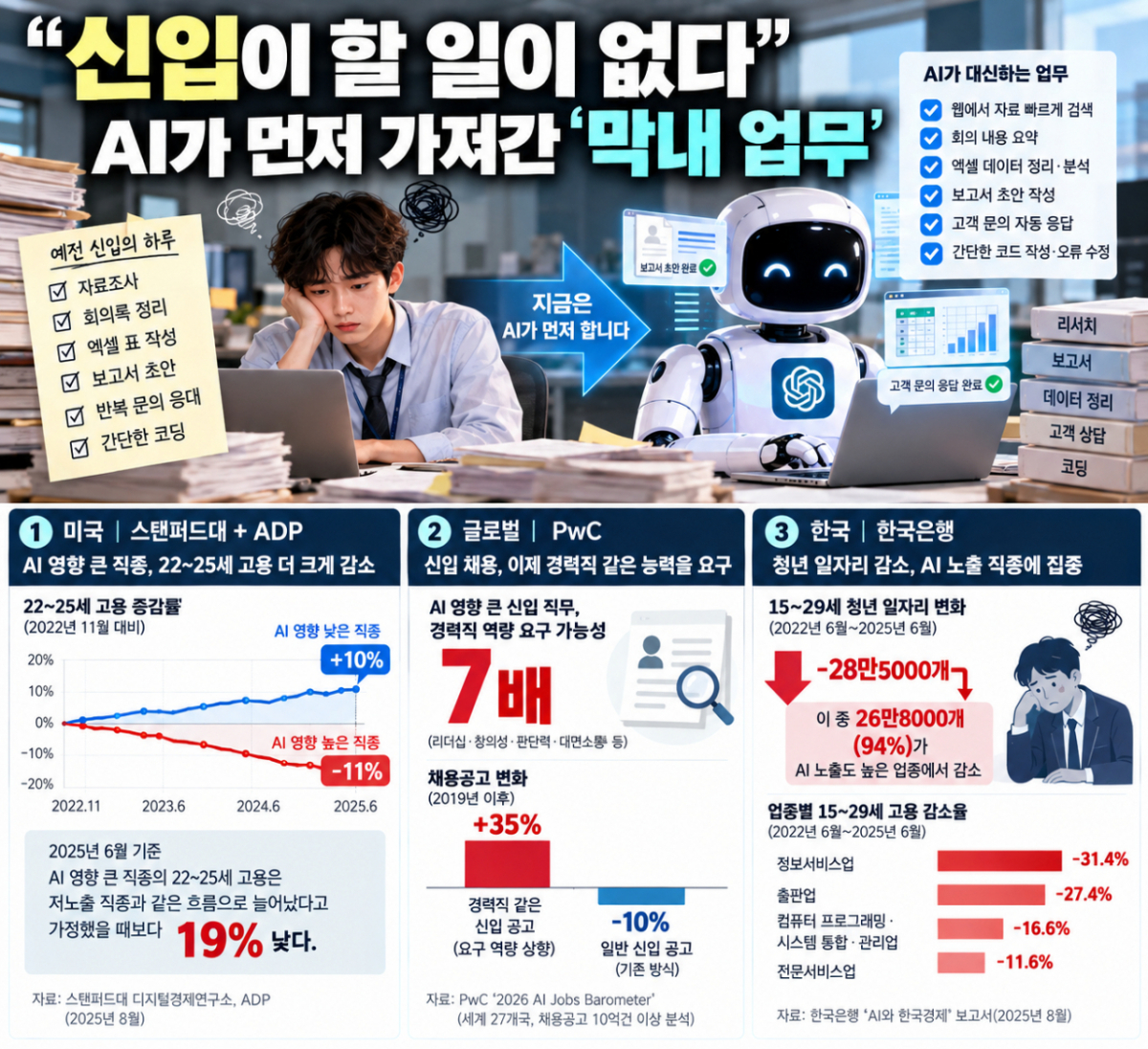
This is not just a story for accountants. New employees must learn their jobs at their first company. The first step in learning is "grunt work." They search for materials, organize meeting notes, tidy up Excel files, and draft reports. Developers write simple code, and customer service staff answer repetitive inquiries. These are the tasks AI does best.
A study by the Stanford Digital Economy Lab analyzing data from millions of employees at payroll management company ADP found that as of June this year, employment among 22- to 25-year-olds in occupations heavily affected by AI was 19% lower than in occupations with less AI impact. When calculated using the same method last year, the gap had widened by another 4 percentage points from 15%. Researchers analyzed that the significant factor was companies hiring fewer new graduates.
It is difficult to hand over the entire workload of an employee with 10 years of experience to AI. This is because they must persuade customers, judge exceptional situations, and take responsibility for results. However, data organization and drafting tasks previously performed by multiple new hires can now be handled by one existing employee and AI. The company's calculations inevitably change.
While entry-level positions are decreasing, recruitment standards have risen. An analysis of 2.4 million U.S. new graduate job postings by PwC found that entry-level roles heavily affected by AI were seven times more likely to require skills such as leadership, creativity, and face-to-face communication—abilities previously mainly required for experienced professionals—than those not heavily affected by AI. Job postings seeking "experienced-like new hires" have increased by 35% since 2019. In contrast, general new graduate job postings have decreased by 10%.
The Bank of Korea also pointed out a similar issue in August last month. Analyzing data from National Pension Service members and others, it found that youth jobs for those aged 15 to 29 decreased by 285,000 over the past four years. Of these, 268,000, or 94%, were lost in industries with high AI exposure.
Youth employment in the information services industry fell by 31.4%, publishing by 27.4%, and computer programming by 16.6%. With the spread of AI, "junior-level" tasks are shrinking first.

 in TECH
