

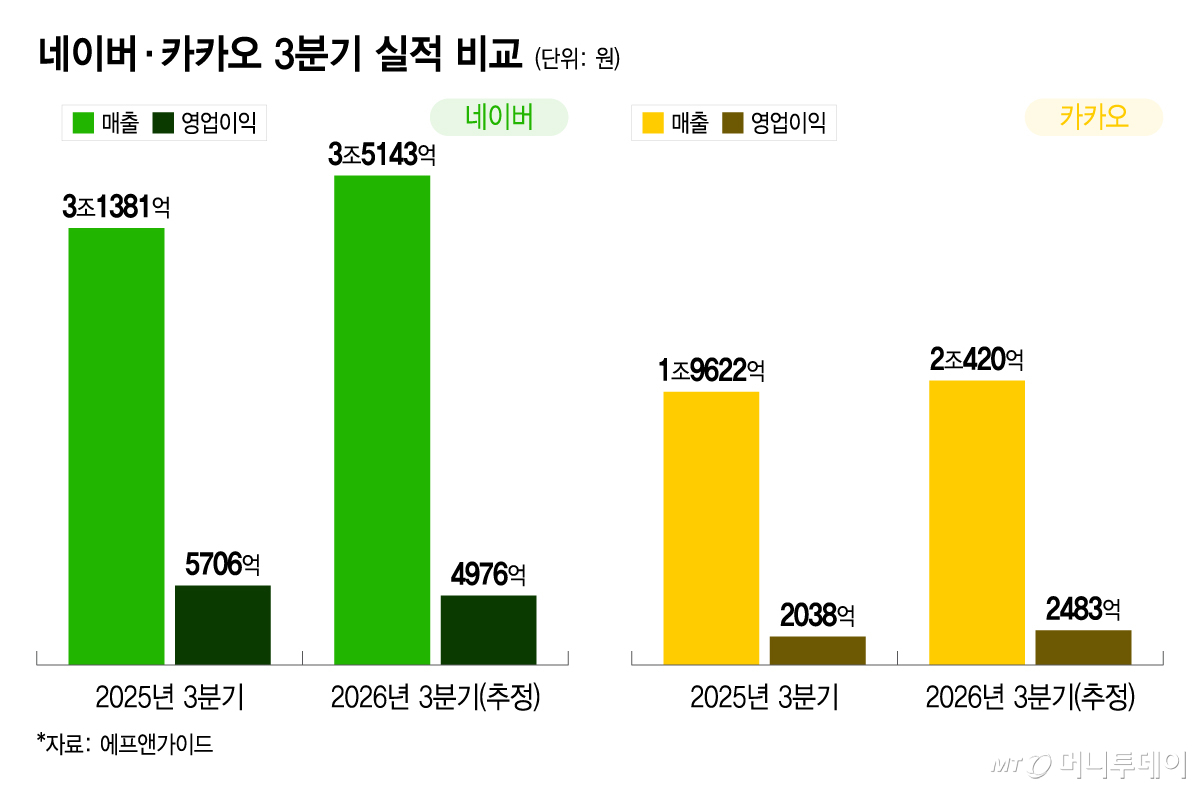
The third-quarter earnings of Naver (NAVER) and Kakao are expected to diverge. While Naver is projected to see revenue growth at the expense of declining profitability, Kakao is expected to post a slight increase in revenue but a double-digit growth rate in operating profit. The key factors for future performance will be the progress and profitability of their AI businesses.
According to financial information provider FnGuide on the 4th, Naver’s consolidated Q3 revenue is projected at 3.5143 trillion won, a 12.0% year-on-year increase. Operating profit is expected to decrease by 12.8% over the same period to 497.6 billion won. Kakao’s revenue and operating profit are forecast at 2.048 trillion won and 248.3 billion won, respectively, representing year-on-year increases of 4.4% and 11.0%. Kakao’s year-on-year growth rates were calculated based on restated results reflecting discontinued operations from the sale of Kakao Games and Kakao Health Care.
Naver’s revenue increase is attributed to the growth of its core advertising and commerce businesses, as well as its global C2C (consumer-to-consumer) platform. Hanwha Investment & Securities projected that Naver would record 409 billion won in revenue from its global C2C segment in Q3, a 63.0% year-on-year increase. The firm also expected platform advertising revenue to rise by 7.0% over the same period to 1.496 trillion won.
However, operating profit margins are expected to decline as costs grow at a faster pace than revenue. This is due to increased investments in AI data centers (AI DCs) and graphics processing units (GPUs), along with rising depreciation expenses, and the expanding rollout of offline payment terminals, “Npay Connect.” Various other costs, including commerce promotion expenses and sports broadcasting rights fees, were also factored in.
Go Jun-hyuk, a research analyst at Shinhan Investment Corp., stated in a report, “The deterioration in profitability is caused by increased commerce promotions and higher installation costs for Npay Connect terminals.” He analyzed that the situation would normalize with the start of 55-megawatt (MW) scale computing supply in the first half of 2027 and a slowdown in the rising trend of infrastructure investment costs.
Kakao’s platform businesses, such as advertising and commerce (TalkBiz), are expected to continue their revenue growth, but at a slowing rate. This is due to the base effect from message advertising related to livelihood recovery consumption coupons executed last year. A reduction in business days caused by the September Chuseok holiday also had an impact. The securities industry expects that the performance growth of subsidiaries such as Kakao Pay and Kakao Mobility will also slow down due to factors like decreased securities trading volume and sluggish travel demand.
Shin Eun-jung, a research analyst at DB Securities, said, “The growth rate of platform revenue, which showed stable growth in the first half, is expected to slow slightly, resulting in profits lower than expectations.” She added, “While advertising volumes are expanding with a focus on feed-type ad products, business message advertising is projected to grow by only 13% year-on-year due to base effects and holiday impacts.”
A notable point in the Q3 earnings release will be the progress and profitability of AI businesses. Naver has signed a contract to secure computing infrastructure worth up to $9 billion (approximately 12 trillion won) with Brookfield, and is advancing a 1-gigawatt (GW)-scale AI factory project with Nvidia. Kakao is focusing on B2C (business-to-consumer) businesses, such as AI agents.
Sun Yu-jin, a research analyst at LS Securities, analyzed regarding Naver, “The conditions for securing customers and contracts for the 55th MW capacity—including demand, contract period, and supply price—will determine how well they align with long-term payment obligations, thereby dictating the profitability and cash flow of the AI factory project.” Shin Eun-jung stated, “For the stock price to trend upward, clear AI results or a specific revenue model are needed.”

 in TECH
