

Kim Beom-soo, the founder of Kakao, has moved one step closer to returning to management. On the 20th, the founder was acquitted on appeal for charges of market manipulation related to the acquisition of SM Entertainment, following his acquittal at first instance. Although a ruling by the Supreme Court remains pending, the likelihood of a final acquittal is high, as the Supreme Court conducts a legal review examining applicable laws rather than factual circumstances. The IT industry assesses that Kakao has been unable to respond adequately to the AI era due to the founder's legal risks over this period.
Kakao led the market by launching the messenger KakaoTalk in the smartphone era, but it failed to accelerate key decisions during the 3rd years and 7 months since the founder became embroiled in legal risks. While global big tech companies strengthened investments in AI and expanded their business areas, Kakao had to pursue its AI business while simultaneously addressing legal risks. The prolonged management uncertainty is assessed to have weighed on business expansion.
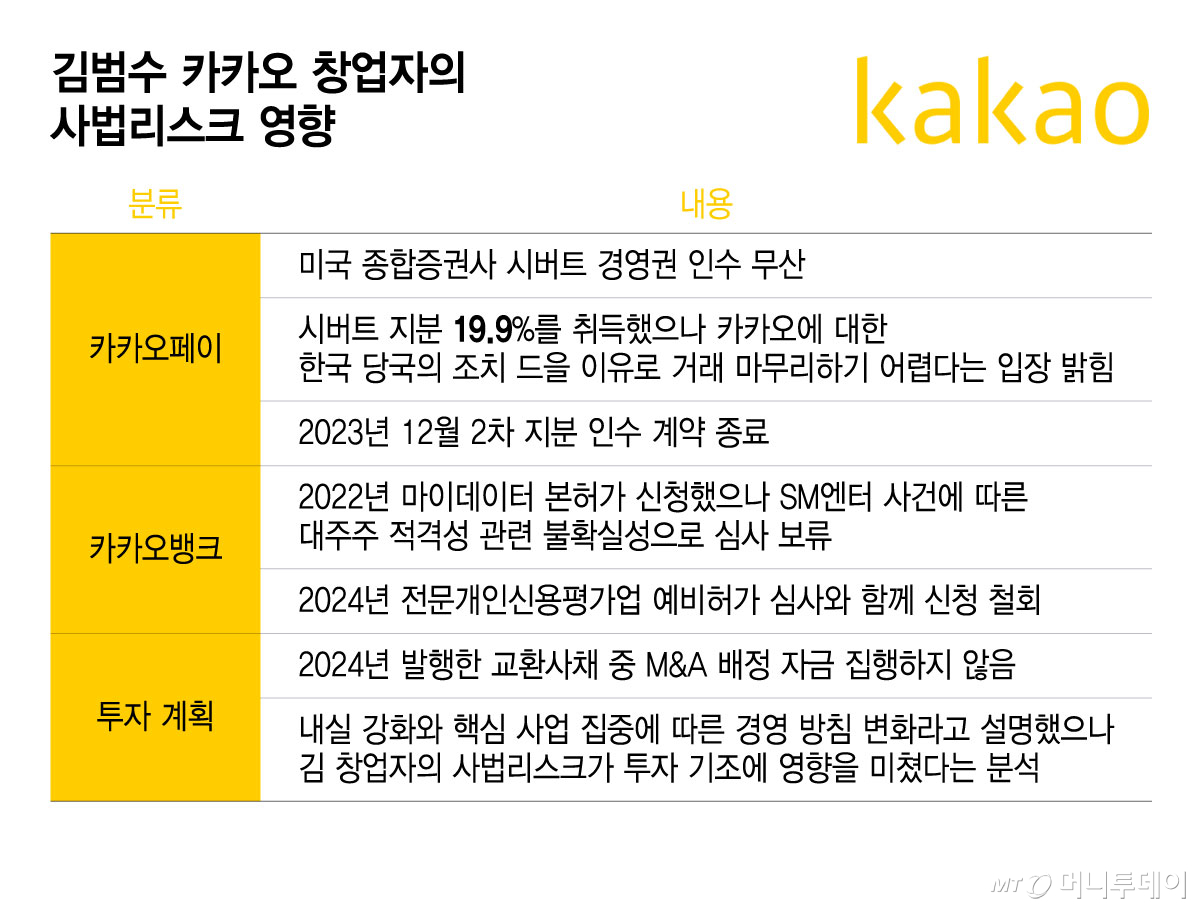
A representative case is the collapse of Kakao Pay's acquisition of control over U.S. brokerage firm Sheba. In 2023, Kakao Pay agreed to secure a 51% stake in Sheba through two transactions and initially acquired a 19.9% stake. However, Sheba stated that it was difficult to complete the transaction due to measures by Korean authorities against Kakao and its affiliates, and the parties agreed in December of the same year to terminate the second share acquisition contract.
The founder's legal risks also affected KakaoBank's entry into new businesses. KakaoBank applied for a full license for My Data services in 2022, but the review was suspended the following year due to uncertainty regarding major shareholder eligibility stemming from the SM Entertainment case. The preliminary license review for specialized personal credit rating services was also suspended, and ultimately, applications for licenses for both businesses were withdrawn in August 2024. Both the business of providing customized asset management using customer information scattered across other financial institutions and the business of providing in-house credit rating capabilities externally saw their entry timing delayed compared to original plans.
Investment plans were also affected. Kakao issued approximately 293 billion won in overseas exchangeable bonds in 2024, but did not execute approximately 190 billion won of the allocated funds for M&A (mergers and acquisitions). The bonds were fully repaid and redeemed about four years before maturity in April of last year. At the time, Kakao explained this as a change in management policy due to strengthening fundamentals and focusing on core businesses, but industry analysis suggested that the founder's legal risks and regulatory burdens influenced the investment stance.
With the founder's return to management becoming even closer, Kakao plans to recover its past execution speed through a corporate split. The goal is to carry out the distinct tasks of growth and investment within independent management systems, enabling timely decision-making and execution for each business. To this end, Kakao has been focusing its resources on core businesses by streamlining non-core operations, reducing affiliates, and refreshing governance.
An IT industry official said, "CEO Chung Shin-a has led Kakao while filling the void left by the founder, but as seen in the cases of Lee Jae-yong, Chairman of Samsung Electronics, and Lee Suk-jae, Chairman of KT, a controlling shareholder's legal risks have a significant impact on corporate management," adding, "As the possibility of a final acquittal has increased, Kakao will now gain momentum in its business."

 in TECH
