

Domestic AI-related budget for next year will nearly double compared to this year. The plan is to secure 140 GPU (Graphics Processing Unit) servers, each costing 27.5 billion won, and invest 800 billion won in training data, making a decisive bet on 'AI independence and self-strengthening.' However, it remains small compared to advanced countries. Japan plans to provide 85 trillion won in public support by 2030 and induce 425 trillion won in public-private investment over 10 years. The United States is pushing a private investment project worth 672 trillion won over four years. It is time to swiftly detail and rapidly advance the AI infrastructure development, where neither speed nor tension can be relaxed.
① 'Year One of the Three Mega-Projects': How the 9.4 Trillion Won AI Budget Will Be Spent
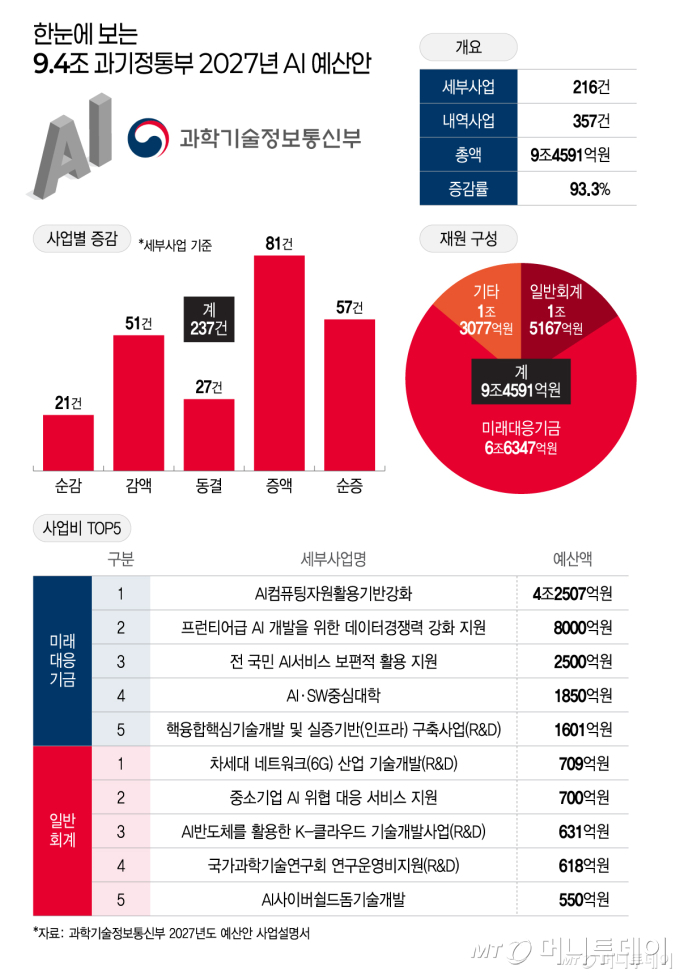
The Ministry of Science and ICT's AI (Artificial Intelligence) related budget for fiscal year 2027 approaches a total of 9.5 trillion won. The plan is to concentrate investment in a budget nearly double that of this year to provide the initial impetus for the AI transformation. In particular, the ministry aims to secure South Korea's AI competitiveness by supporting Frontier (top-tier) AI and the development of an independent AI foundation model, while focusing on leading into the era of universal AI.
According to the '2027 AI-Related Project Budget Status Document' submitted by the Ministry of Science and ICT to the National Assembly, next year's total AI-related project budget is 9.4591 trillion won, a 93.3% increase from this year's budget. With 57 new projects added (net increase) and 21 removed (net decrease), the total number of projects has increased to 216. Among these, budgets for 81 projects have increased compared to the previous year, while 51 have decreased. The detailed sub-projects within these categories number 357.
Looking at funding sources: △ 1.5167 trillion won for 130 general budget projects; △ 6.6347 trillion won for 22 projects under the Future Response Fund, newly established this year due to surplus tax revenue from the semiconductor boom; and △ 1.3077 trillion won for 64 other items, including the Regional Balanced Development Special Account, Semiconductor Industry Competitiveness Enhancement Special Account, Information and Communications Promotion Fund, and Broadcasting and Communications Development Fund.
The reason the Future Response Fund accounts for 70% of the Ministry of Science and ICT's AI project budget is that it includes the 4.2507 trillion won budget for the 'Strengthening the Foundation for Utilizing AI Computing Resources' project. Of this, 3.85 trillion won, representing 90%, is earmarked to secure 140 units of next-generation GPU (Graphics Processing Unit) servers called 'Vera Rubin' at 27.5 billion won per unit. The budget also includes leasing costs for GPUs (H100, B200, etc.) intended for lending to industries, academia, and research institutes.
A data purchase cost of 750 billion won to train Frontier AI has also been reflected. Data acquisition costs, which were 30 billion won this year, have increased 25-fold. The concept is to support the securing and utilization of high-quality training data so that intelligence and performance levels comparable to Frontier-grade AI models can be reached in a short period. This reflects the fact that data acquisition has become crucial as major countries and big tech companies compete over Frontier AI development, leading to a sharp rise in associated costs. A budget of 50 billion won has also been allocated for training data for cybersecurity AI. Additionally, 250 billion won is included for supporting the universal utilization of AI services for all citizens, and 185 billion won for the designation of AI/SW-centric universities.
In the R&D (Research and Development) sector, a budget of 145.7 billion won for the 'Creating an SW Platform R&D Ecosystem Based on Collaborative Intelligence Physical AI' project has been included in the Regional Balanced Development Special Account. The Ministry of Science and ICT explained that this project aims to develop physical AI-based software specialized in industrial fields where Korean companies have strengths, to preemptively secure global technology standards, and to acquire the AI Metafactory technology implemented at Hyundai Motor's unmanned factory in Singapore. The project includes core technology development, creation of research infrastructure such as testbeds, and activities to build a global ecosystem.
Furthermore, the Ministry of Trade, Industry and Energy, one of the ministries overseeing the three mega-projects (semiconductors, physical AI, and AI data centers), has allocated 3.7261 trillion won in its fiscal year 2027 budget bill for Manufacturing AI Transformation (M.AX) and full-scale support for the mega-projects. Key items include: △ 120 billion won for Full-Stack AI Factory and Manufacturing AI Foundation Model Development (R&D); △ 290 billion won for Developing AI Solutions Utilizing Manufacturing Tacit Knowledge (R&D); △ 115.8 billion won for Building and Operating the National Manufacturing Data Library; and △ 119.3 billion won for Building the M.AX Autonomous Manufacturing Ecosystem.
President Lee Jae-myung stated in his budget address to the National Assembly on the 2nd, "We will boldly invest in artificial intelligence and future growth drivers to enhance our economic growth potential." He added, "We are investing 21.3 trillion won, nearly double this year's amount, in 'Three Mega-Projects' and artificial intelligence. We are concentrating 4.7 trillion won on Frontier AI development with the goal of securing top-tier global performance for an independent AI model, which is a national strategic asset."
② Countdown to Budget Review on December 2: Crossing the Hurdle of the National Assembly
As the National Assembly's Special Committee on Budget and Accounts has fully begun reviewing the fiscal year 2027 budget bill, attention is growing on whether key AI project budgets will pass through the National Assembly. While both ruling and opposition parties agree on the necessity of nurturing the AI industry and national-level investment, they show differences in opinion regarding specific projects.
Regarding next year's budget bill, the National Assembly will conduct departmental reviews for economic and non-economic ministries from the 9th to the 12th, followed by convening the Budget Adjustment Subcommittee starting on the 16th to review detailed budgets. The statutory deadline for processing next year's budget bill is December 2.
Attention is drawn to the fact that the People Power Party has set a policy to cut at least 30 trillion won from the total government budget and has foreshadowed an all-out offensive against the Future Response Fund, which includes AI budgets. In particular, opinions are divided over the 800 billion won scale of AI data support budget within the 4.7 trillion won 'Frontier AI Development Project' budget.
The Frontier AI Development Project budget includes a 3.85 trillion won purchase budget for 10,000 units of Vera Rubin, the latest GPU that the government plans to procure from NVIDIA next year, an 800 billion won AI data support budget (including 50 billion won for security-specialized data), and 25 billion won for talent development costs.
The data budget is designed as a structure where the government contributes 750 billion won to the Korea Development Bank, which then invests in domestic AI companies. In this regard, the opposition party points out that the use of funds is unclear because the data budget combines both the 'Independent AI Foundation Model' and Frontier AI development projects, which are being pursued separately.
Additionally, issues include whether to establish a Special Purpose Vehicle (SPV) regarding the project method, and the relationship between independent AI model development and the Frontier AI project. It is noted that funds transferred from existing projects and newly increased amounts are not distinguished, and criteria for selecting investment target companies, the equity stake the government will secure, and conditions for recovering investment funds are not included. They also demanded clear explanations regarding the change in performance measurement methods resulting from the support form changing from initial contributions to capital injections.
Since the core of AI budget review lies in gaining consensus on the necessity of investment, experts advise that specific budget plans must be disclosed and the necessity conveyed persuasively. Professor Yoo Byung-jun of the Department of Business Administration at Seoul National University said, "Data is also infrastructure for the AI era, so it has the characteristic of needing to be secured in advance, like building a dam." He added, "We must persuade well about the need and reach an agreement on future infrastructure-type budgets, and should also consider budgets prepared for market failures rather than popularity-seeking budgets."
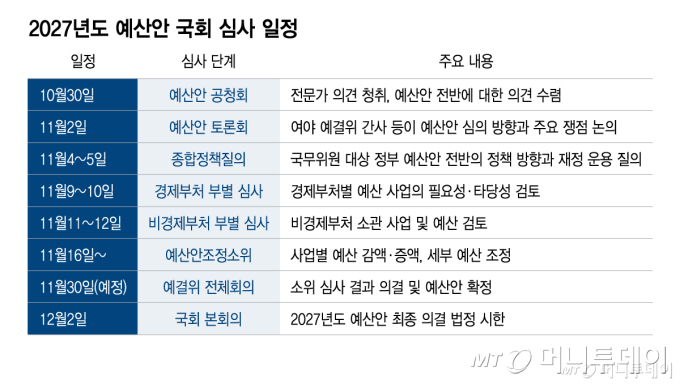
③ Japan's AI Budget Increased by 60%, EU Pushes 45 Trillion Won Investment… Advanced Nations' AI Investment Competition
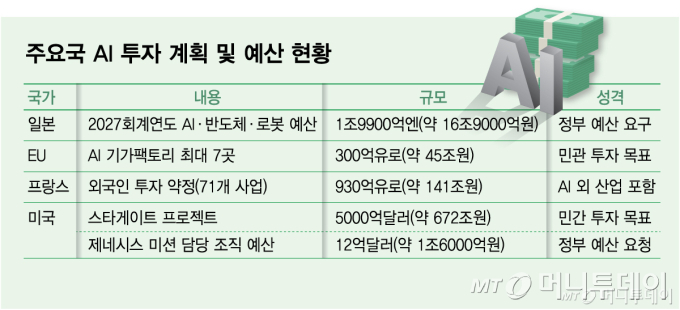
Major countries, including the United States, the EU (European Union), and Japan, have launched large-scale investments to secure AI (Artificial Intelligence) competitiveness.
Japan's Ministry of Economy, Trade and Industry requested 1.99 trillion yen (approximately 16.9 trillion won) for AI, semiconductors, and robotics in its fiscal year 2027 budget request. This is an increase of approximately 60% from this year's regular budget, placing emphasis on the development of 'Physical AI.' Japan aims to provide over 10 trillion yen (approximately 85 trillion won) in public support for AI and semiconductors by fiscal year 2030 and induce over 50 trillion yen (approximately 425 trillion won) in public-private investment over 10 years.
The EU launched a call for proposals in July to build up to seven 'AI Gigafactories.' The plan is for the EU and member states to support with up to 10 billion euros, attract at least 20 billion euros from the private sector, and invest a total of over 30 billion euros (approximately 45 trillion won).
France is focusing on attracting overseas capital. Following its announcement of an AI investment plan worth 109 billion euros last year, it secured foreign investment commitments totaling 93 billion euros (approximately 141 trillion won) across 71 projects in June this year. This amount includes fields other than AI. Of this, 45 billion euros (approximately 68 trillion won) is for a project by Japan's SoftBank to build three AI data centers with a total capacity of 3.1 GW by 2031.
The United States has a structure where the private sector leads large-scale AI infrastructure investment and the government supports research and development. The 'Stargate' project, involving OpenAI, SoftBank, Oracle, and others, will invest up to 500 billion dollars (approximately 672 trillion won) in AI infrastructure over four years. The Trump administration requested 1.2 billion dollars (approximately 1.6 trillion won) for the Department of Energy's AI scientific research project 'Genesis Mission' in its fiscal year 2027 budget.
An industry official said, "It is realistically difficult for Korea to pursue AI investment on a scale similar to that of the United States." He added, "We must maximize investment efficiency to achieve maximum results with limited resources and concentrate resources on fields where competitiveness can be secured."
[Production Support: Ministry of Culture, Sports and Tourism Citizen-Centered Communication Activation Project]

 in TECH


