

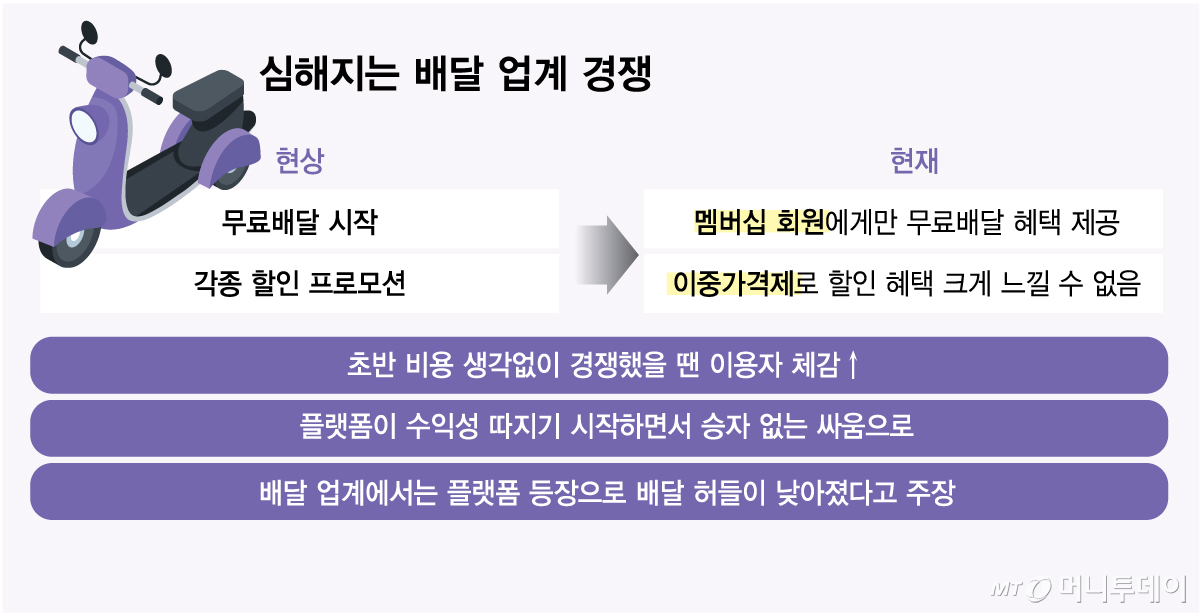
As the delivery industry, including Baemin and Coupang Eats, intensifies its competition, changes have emerged in the consumer landscape. Given that companies must secure users within a limited domestic market, analysts suggest that consumers benefit as each company absorbs losses to offer discount incentives. On the other hand, some observers argue that, due to membership systems and dual pricing structures, there is ultimately no real change.
According to IT industry sources on the 22nd, Baemin is currently running various promotions. In a “One Bowl” promotion with Coca-Cola, the first 700 customers who order a one-bowl set menu including Coca-Cola will receive a 1,000-won discount coupon. Additionally, to mark the launch of new products from Dunkin’, the company is selling the “Dunkin’ Dubai Donut Pack” at a discount of up to 5,000 won. On last year’s Pepero Day, Baemin exclusively launched and sold discounted limited-edition collaboration items with Lotte Pepero.
Coupang Eats has also introduced a stamp event. Users accumulate stamps for each delivery order and receive a discount coupon or menu reward once they collect five. The “Maximum Discount” tab within the app offers various benefits, including Weeekly Super Deals, first-come-first-served special prices, and first-order specials. In June, aligned with the Asian Games, the platform issued cheering gratitude discount coupons based on the scoring results of the national soccer team: 4,000 won for no goals or one goal, 5,000 won for two goals, and up to 6,000 won for three goals.
Free delivery is now considered a standard benefit. When Coupang Eats introduced its free delivery card, Baemin, Yogiyo, and others followed suit, ushering in the era of free delivery. Delivery platforms link free delivery with their own delivery systems to ensure efficient service delivery. Recently, the minimum order amount that users had to meet to place an order is also disappearing. As Coupang Eats followed Baemin’s service targeting the growing number of single-person households, user convenience has further increased.
Meanwhile, some analysts argue that as competition continues, a situation with no clear winner has emerged. Free delivery, which changed the industry landscape, has now become a membership benefit. Platforms are strengthening membership perks to lock in users. Since members pay a fee, it is not strictly free delivery. Some also contend that discount offers hold little meaning in the face of dual pricing structures. Dual pricing refers to the difference between in-store prices and delivery prices, a phenomenon that has emerged as businesses seek to maintain margins amid rising intermediary commission rates and delivery costs. From the user’s perspective, no matter how much they save through discounts, it is merely a case of “a fox for a hare” (getting nothing of real value).
A delivery industry official said, “While there are changes due to intensifying competition recently, it is true that users can utilize delivery services more conveniently than before since the emergence of delivery platforms.” The official added, “The barrier itself has been lowered by free delivery, and for store owners, it has become much easier to generate additional revenue compared to before, even if the overall market pie is not large.”

 in TECH
