


"No one who has not experienced chronic obstructive pulmonary disease (COPD) can ever know how desperately important breathing is. I truly hope that a day will come when the 'dupilumab' treatment is covered by insurance, allowing me to breathe without worrying about money. Please, let me be able to breathe comfortably."
COPD is a chronic respiratory disease in which airways and alveoli are damaged by inflammatory responses, restricting airflow. It is characterized by chronic cough, worsening dyspnea, sputum, wheezing (wheezing sounds), chest tightness, and fatigue. According to the World Health Organization (WHO), it ranks as the third leading cause of death after ischemic heart disease and stroke.
According to the KDCA, the prevalence of COPD among South Koreans aged 65 and older is 25.6%, and among adults aged 40 and older, it is 12.7%. However, disease awareness remains at just 2.3%. This is analyzed as being because symptoms do not appear until lung function has been lost.
Patients suffering from this disease often fail to recognize the condition even when their lung function is damaged by more than 50%, only seeking medical attention late after their illness has significantly worsened. Kim Young-ho (pseudonym), a 73-year-old resident of Anyang City, Gyeonggi Province, was one such case.
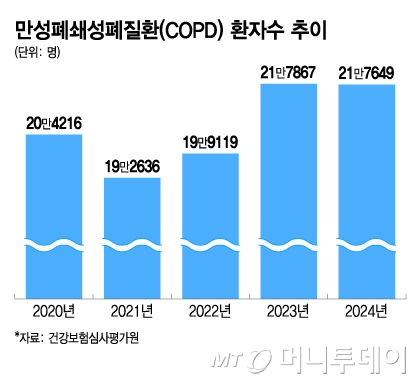
Mr. Kim sent a letter to Money Today detailing what symptoms he experienced before his COPD diagnosis and the suffering he is currently enduring.
Mr. Kim began by saying, "I only learned the disease name COPD after being diagnosed four years ago." He added, "Before the diagnosis, I climbed mountains two or three times a month, and it has been more than 30 years since I quit smoking. People around me would say, 'What kind of illness could such a healthy person possibly get?'"
He continued, "One day, I started feeling short of breath even with slight movement, and at one point, I felt as if my anus was falling out, but since it would improve if I stayed still, I dismissed it as nothing serious." He stated, "The following year, I became short of breath and gasped for air even when walking a distance of 10 meters. At night, my cough worsened so much that I could not sleep, my appetite disappeared, and my body grew increasingly exhausted."
Although he visited the hospital periodically for checkups, there were no abnormalities found in cardiac examinations. He only received a COPD diagnosis after eventually switching to a respiratory internal medicine department.
Mr. Kim said, "After that, I started inhaler treatment, but I continued to feel short of breath and my cough did not stop, so the company recommended I take leave, and I ultimately had no choice but to resign." He added, "I left home for a sanatorium, but in the early morning hours, my breathing would completely block up, and I once called 119 and was rushed to the emergency room." He recounted his suffering, stating, "In autumn, abdominal pain and vomiting overlapped, and I could not even swallow water. My weight dropped from 73 kg to 59 kg." He continued, "Eventually, I had to carry a portable oxygen respirator with me, and after suddenly losing my breath, I was taken by ambulance and hospitalized for ten days."
The turning point that changed his life was the dupilumab treatment. Although it was not covered by insurance and he had to bear the cost as an out-of-pocket expense, breathing became easier after the second dose of the drug, and his lost sense of smell gradually returned. Now, he can climb several floors without difficulty. Since starting the treatment, he has not visited the emergency room. Last year, he also returned to work. He even drives long distances and sings along to songs playing on the radio.
However, high treatment costs have been squeezing Mr. Kim in a different way. Mr. Kim revealed, "Over four years of going back and forth to the hospital, I spent tens of millions of won on treatment costs, and my saved severance pay disappeared." He added, "The national pension I receive every month goes entirely toward treatment costs, and since I have to continue administering the drug, thinking about the future makes hope disappear and leaves me feeling desperate."
Mr. Kim said, "I tried reducing the frequency of taking the drug, but now even doing so, my heart grows heavier with each monthly invoice for injections." He expressed his wish, saying, "Honestly, I am very afraid of returning to that time when I could not breathe because I couldn't afford the drug. It would be good if the treatment were covered by insurance so I could breathe comfortably."
Meanwhile, the monthly cost of dupilumab treatment is known to be around 1.5 million won on an out-of-pocket basis. The pharmaceutical company Sanofi has applied for health insurance coverage for dupilumab when treating COPD patients.

 in THEBIO

