

Lunit, a domestic medical AI company, has positioned itself at the center of the international stage by expanding its research scope beyond breast cancer screening to include risk prediction, target selection, and imaging quality management.
Expectations are also growing that the expansion of diagnostic and management demand in the United States could positively impact Lunit's performance in the long term.
Lunit said Tuesday that it will present a total of 17 research abstracts, including 15 on breast cancer, at the 'North American Radiological Society (hereinafter RSNA)' conference to be held in Chicago, U.S., starting on the 29th. RSNA is the world's largest radiology conference, and according to Lunit, the company will present the most research abstracts among global medical AI companies this year.
At this conference, Lunit is drawing attention for its extensive research activities related to 'breast cancer.' Fifteen of the total abstracts, accounting for 88%, are breast cancer-related studies, and 11 of these have been selected for oral presentations, which are awarded to major research achievements.
A Lunit official said, "Lunit's prominence in the global medical AI market has grown as breast cancer-related topics, such as prevention and screening target selection, appeared in this year's RSNA official recommended program," adding, "Long-term research results reflecting the needs of the medical field are coming to light in line with changes in U.S. breast cancer screening policies."
Expansion of Screening Targets… 'Quality Assessment' Becomes Important
The reason AI is drawing attention in the breast cancer field is that 'quality assessment' becomes increasingly important alongside the 'quantitative expansion' of examinations.
In particular, to manage rising breast cancer incidence and mortality rates, the U.S. Preventive Services Task Force (USPSTF) took a "bold step" in 2024 by expanding the recommended screening age from the previous 50 years old to 40–74 years old at two-year intervals.
Along with this, the U.S. Food and Drug Administration (FDA) mandated in the same year that 'density information' be disclosed to patients during mammography, initiating management for dense breasts, where tissue density makes it easy to miss cancer.
Accordingly, the role of medical AI is also changing. While the core focus in the past was how accurately cancer could be detected from images, recent research actively focuses on predicting future risk of onset even when cancer is not detected. U.S. medical AI company Everiwell received FDA approval in July for its AI solution 'Clarity Breast,' which predicts the probability of breast cancer onset within five years using mammography images, and has been conducting actual examinations since last month.
A Lunit official noted, "This year's RSNA is also focusing on how to utilize AI prediction results in decisions regarding additional screening," adding, "AI is evolving into a technology that supports prevention and personalized screening strategies beyond diagnostic assistance."
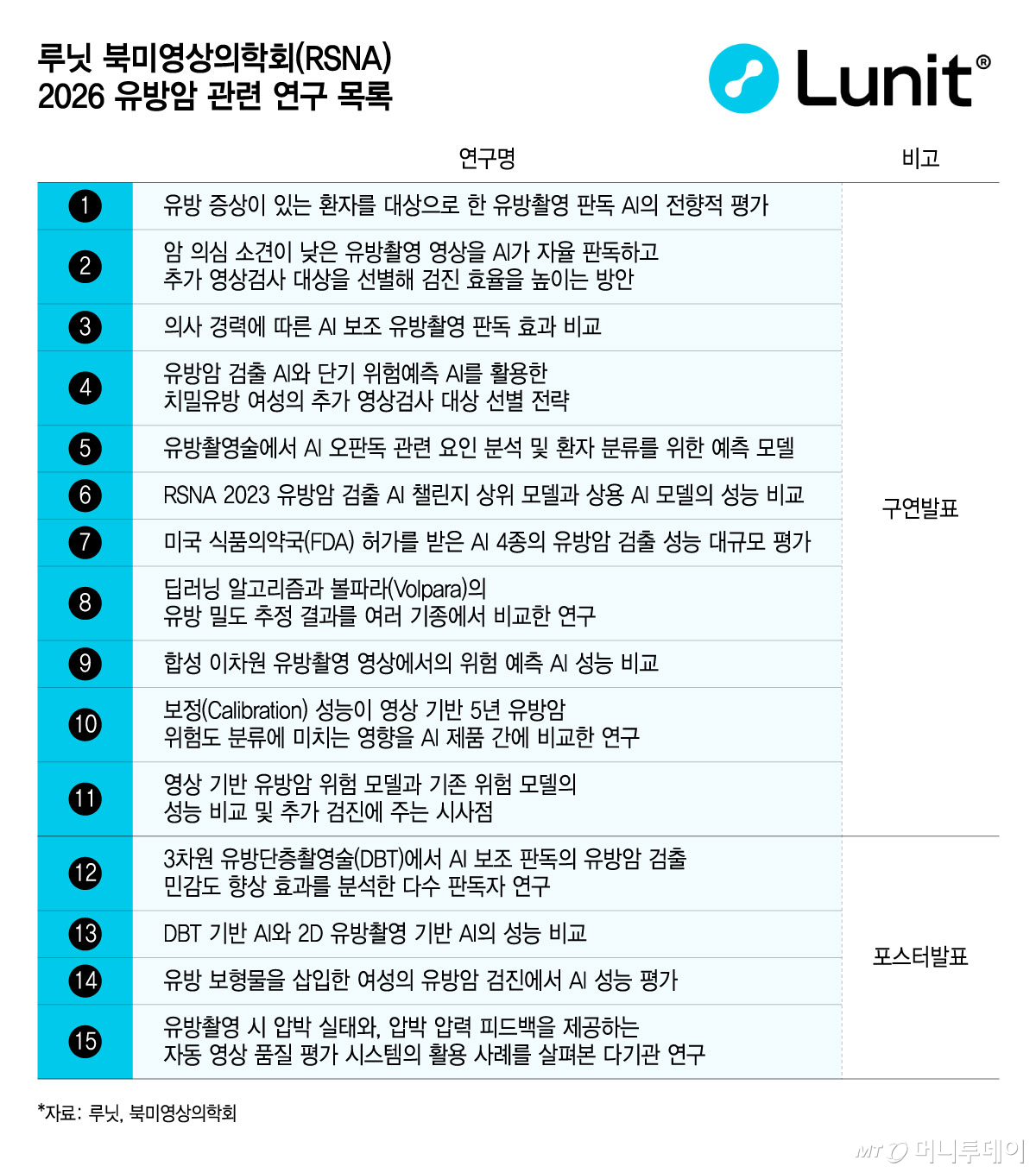
Through oral presentations, Lunit plans to present a method for selecting additional examination targets among women with dense breasts by combining breast cancer detection AI and short-term risk prediction AI.
It will also address methods where AI autonomously reads images with low suspicion of cancer and filters patients requiring additional examinations. These studies are scheduled to be presented in the recommended sessions for the breast imaging field selected by the RSNA program planning committee.
In addition, Lunit plans to showcase AI research results covering the entire process of breast cancer screening, including △a large-scale performance comparison of four types of breast cancer detection AI △accuracy assessment of breast density estimation technology △the effect of AI-assisted reading in three-dimensional digital breast tomosynthesis (DBT).
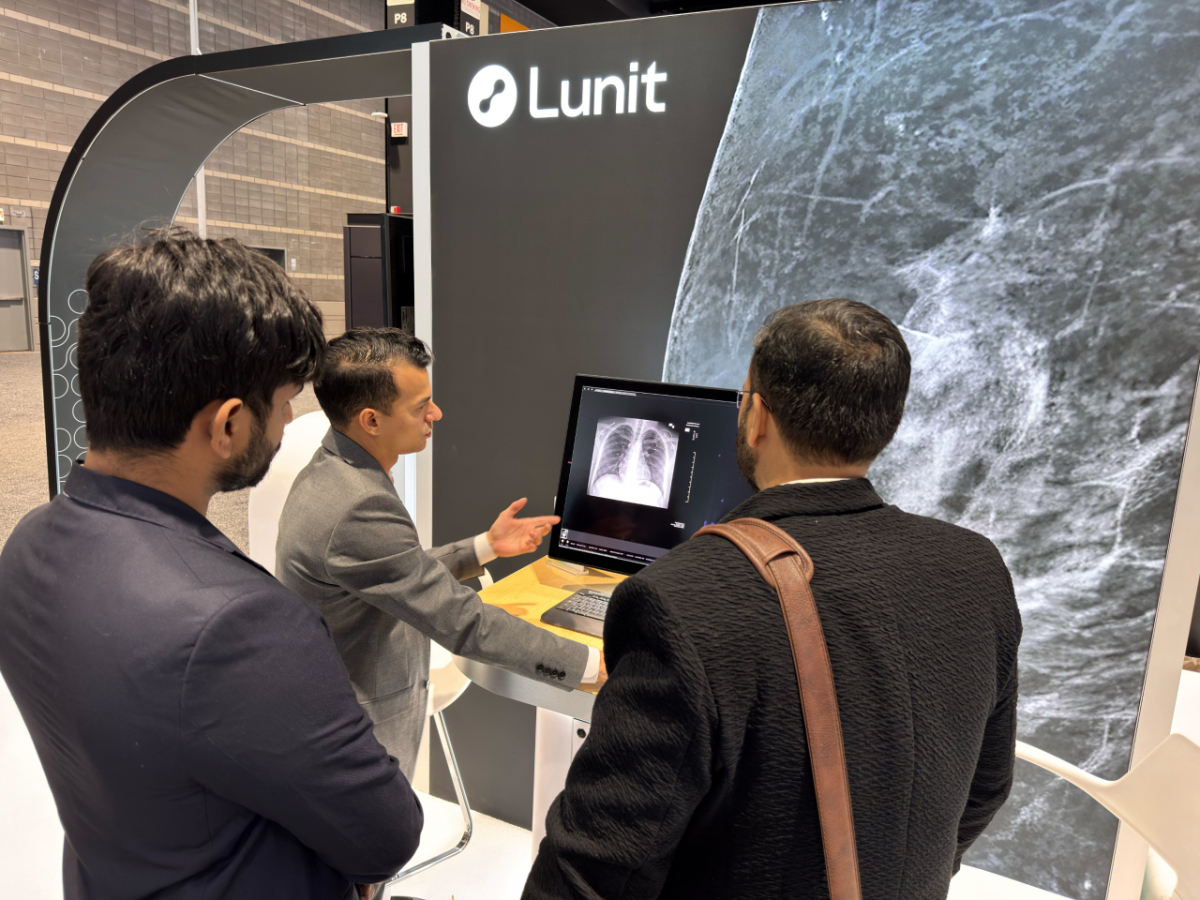
The company also plans to expand its contact with medical professionals by exhibiting its 'Lunit INSIGHT' LINEUP, an AI solution covering the breast and chest areas, at its on-site booth.
Speeding Up U.S. Entry of 'Lunit INSIGHT' LINEUP
In Europe, cases have already emerged where Lunit's breast cancer solutions are being introduced not only in hospitals but also in regional clinical settings.
Through a prospective clinical study analyzing 55,810 real mammography data points conducted with the Karolinska Institute and Capio St. Goran Hospital in Sweden in 2022, Lunit demonstrated that a combination of AI and one radiologist could achieve a higher cancer detection rate and lower recall rate than two radiologists (median average experience of 17 years).
Furthermore, hospital researchers announced at the 2024 RSNA that real-world data showed AI can improve cancer detection rates and shorten reading time.
Based on these research results, St. Goran Hospital signed a contract with Lunit in 2023 to apply 'Lunit INSIGHT MMG' instead of one radiologist, conducting approximately 200,000 readings over three years. Following this, the Stockholm County Council in Sweden introduced Lunit INSIGHT MMG into breast cancer screening across the entire county in September last year, based on the hospital's research and clinical data.
Lunit is accelerating its market strategy by applying to the FDA for pre-market approval (510(k)) for 'Lunit INSIGHT Risk,' an AI solution that predicts the risk of breast cancer occurrence within the next five years using only mammography images and patient age information.
Lunit INSIGHT MMG and DBT, which assist in breast cancer diagnosis, have already obtained U.S. approval. Seo Beom-seok, CEO of Lunit, stated, "We will conduct active marketing activities on-site to ensure that the research results presented at this year's RSNA lead to business achievements."

 in THEBIO


