

There are numerous cases where prices rise when the government provides support through tax revenue. As support for infertility treatment was expanded, hospitals raised their fees for non-covered infertility treatments. Voices are emerging that mechanisms are needed to prevent public financial support from being exploited to line the pockets of business operators.
Non-covered medical service prices surged as eligibility for infertility support expanded in 2024
According to data provided by the Health Insurance Review and Assessment Service to Nam In-soon, a member of the Democratic Party of Korea on the National Assembly’s Health and Welfare Committee (Seoul Songpa-byeong), the number of patients undergoing infertility procedures last year was 192,395, a 34.4% increase from 143,162 four years earlier in 2021. Total medical expenses surged by 89.8% to 458.7 billion won. Per-person medical expenses rose by 41.2% to 2.383939 million won. This is due to the government’s expansion of support eligibility in 2024, allowing infertility couples to receive procedure cost support regardless of income level.
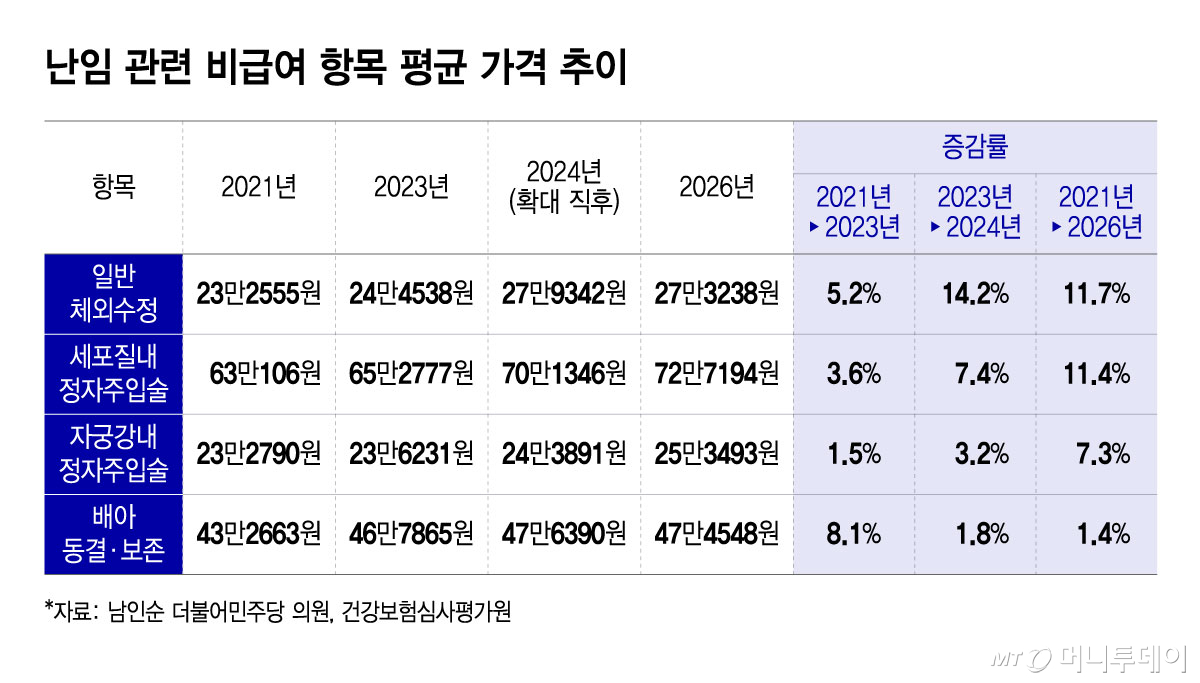
Consequently, prices for non-covered infertility procedures, where medical institutional investors set prices independently, increased. For “conventional in vitro fertilization,” the average treatment price by medical institutional investors in 2024 was 279,342 won, a 14.2% increase from the previous year. This contrasts with the 5.2% rise to an average of 244,538 won in 2023 compared to the prior year. The average price for “intracytoplasmic sperm injection” also rose by 7.4% to 701,346 won in 2024 from the previous year. Considering that the average cost in the prior year, 2023, had increased by only 3.6%, this is a notable surge.
Ham Myeong-il, Gyeong Yeong-hak-gwa (Prof.) in Health Administration at Suncheon Hyang University, noted, “When patients receive financial support, they become less sensitive to costs and seek more services, making price elasticity inelastic. Profit-seeking medical providers naturally exploit this by raising prices, which diminishes policy effectiveness.” He added, “Since infertility treatment involves both covered and non-covered procedures, it is necessary to either convert these non-covered services to covered status or manage them as managed benefits to control prices.”
Postpartum care centers, Korean beef, and others also see price spikes due to subsidies
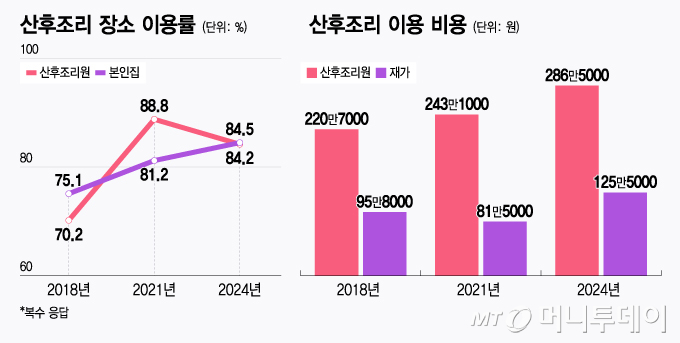
Postpartum care centers are a similar case where prices skyrocketed after the government and local governments provided cost support. Starting in 2022, the government has issued “First Encounter Vouchers” worth over 2 million won, usable at postpartum care centers and other facilities upon childbirth. According to Hana Bank’s Hana Financial Research Institute report titled “Review of Small Business Sectors Amid Changing Consumer Environment,” while the total number of approved transactions at postpartum care centers decreased by an annual average of 16.8% from 2022 to 2024, the approved amount per transaction increased by 23.6%.
There are also cases where some marts and eyeglass stores raised prices after the government distributed disaster relief funds or livelihood recovery consumption coupons. The sharp spike in Korean beef prices during the 2020 emergency disaster relief fund distribution is a representative example. Korean beef prices, which were in the 3rd% range before the subsidy payment, surged to the 10th% range after the funds were distributed in May 2020.
In economics, this phenomenon is called “subsidy incidence.” It refers to the situation where the actual benefits of government subsidies go to economic actors other than the intended recipients. Kim Jung-sik, a professor emeritus in the Department of Economics at Yonsei University, stated, “When the government provides subsidies, it must clearly set conditions, such as prohibiting price increases, to prevent tax revenue from being wasted.”

 in THEBIO

