

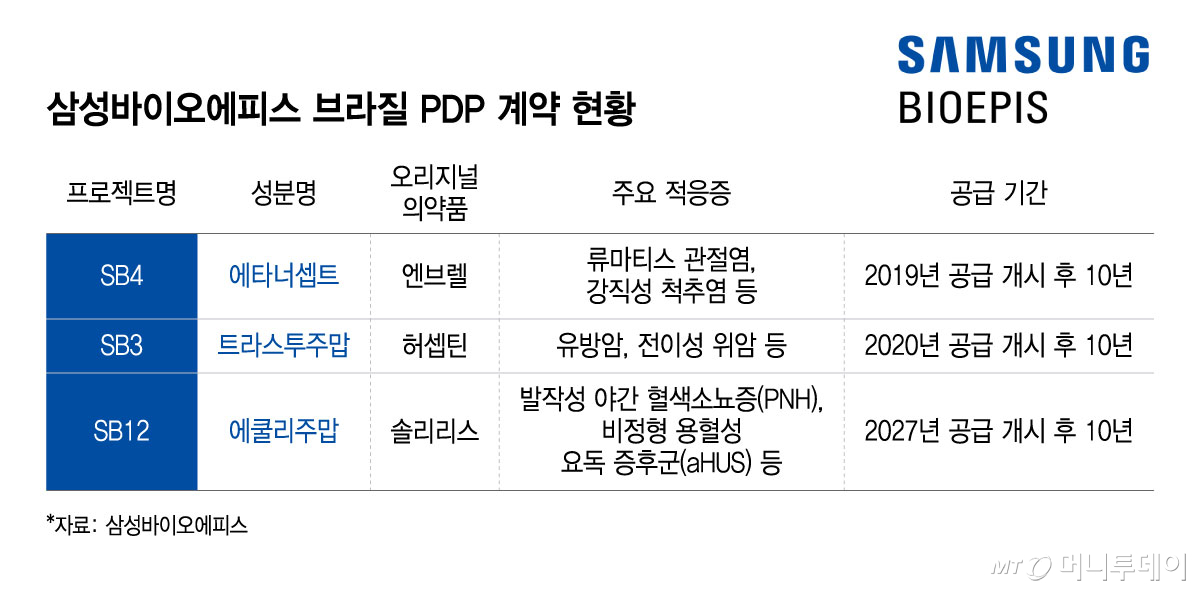
Samsung Bioepis, a subsidiary of Samsung Episy Holdings (hereinafter referred to as Samsung Episy), has secured the third "exclusive supply rights" for a biosimilar (biosimilar drug) in Brazil, the largest pharmaceutical market in Latin America and the Caribbean. Analysts assess that this move lays the foundation for an emerging market strategy by accumulating "evidence" regarding manufacturing and supply safety, in addition to securing stable revenue.
Samsung Episy announced on the 20th that it signed a local partnership contract with Brazil's Ministry of Health to supply 'SB12' (active ingredient: eculizumab), a biosimilar of the rare disease therapy 'Soliris'.
This contract was concluded through the Brazilian government's PDP (Productive Development Partnership) system. The PDP is a policy in which the Brazilian government facilitates a tripartite partnership between global pharmaceutical companies, local pharmaceutical companies, and state-owned research institutional investors. Under this framework, product manufacturing technology is transferred over a set period, and exclusive (priority) purchasing of the relevant item for 10 years is legally guaranteed within the Unified Health System (SUS), which covers 70% of the total population.
Samsung Episy will form partnerships with local pharmaceutical company 'BioNovis' and state-owned research institutional investor 'Biafarma' to advance supply procedures for 'SB12'. Previously, Samsung Episy signed PDP contracts in 2019 for 'SB4 (Enbrel biosimilar, active ingredient: etanercept)', a therapy for autoimmune diseases, and in 2020 for 'SB3 (Herceptin biosimilar, active ingredient: trastuzumab)', an anticancer drug for breast cancer and other conditions. To date, the company has supplied more than 6 million units of these products.
Brazil is a market attracting attention from global pharmaceutical companies. According to Statista, a global market research institutional investor, Brazil's pharmaceutical market growth rate in 2024 was 12%, recording the steepest growth among the top 10 global pharmaceutical markets, including Spain (10%), the United States (9.7%), and Italy (9%).
Another market research institutional investor, Fitch Solutions, forecasts that the size of Brazil's pharmaceutical market will expand from $25.1 billion (approximately 37 trillion won) in 2024 to $33.2 billion (approximately 46 trillion won) by 2028.
The size of Brazil's eculizumab market was approximately 250 billion won ($170 million) last year, and this contract is expected to serve as an opportunity for Samsung Episy to broaden its business base in the local public healthcare market.
Samsung Episy emphasized, "Unlike general competitive markets where fierce price-reduction bidding must be conducted every one to two years, PDP contracts guarantee exclusive or priority supply status in Brazil's government public insurance (SUS) market for the next 10 years," adding that "the government-led PDP system is a key element in tackling the growing Brazilian market."
Industry observers also assess that the consecutive PDP contracts signed in Brazil will serve as a significant advantage in future bids in other countries.
A source in the bio industry stated, "Samsung Episy's 'technology transfer + revenue guarantee' win-win cooperation business model is highly attractive to countries pursuing both stable pharmaceutical procurement and securing domestic production capabilities," adding that "it can be evaluated as a successful business model not only for expanding influence in the Brazilian market but also in global emerging markets such as Southeast Asia and the Middle East, where public healthcare accounts for a large share and policies promoting the localization of biopharmaceuticals are being pursued."

 in THEBIO

