

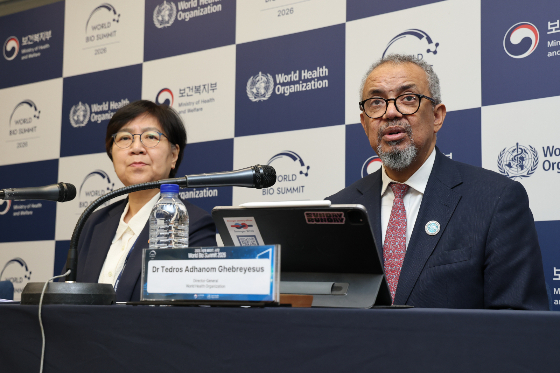
The government will discuss with the World Health Organization (WHO) plans to leverage medical artificial intelligence (AI) to address regional disparities and shortages in essential healthcare, and to share its experience with the international community. Based on the ‘AI Healthcare Seoul Declaration,’ the two sides aim to concretize cooperation tasks such as education, development of standard guidelines, and technology development and verification, with the goal of expanding the benefits of AI under the premise of medical professional supervision and safety.
Jung Eun-kyung, Minister of Health and Welfare, stated during an on-site briefing at the ‘2026 Global Bio Summit’ held on the 21st at COEX Magok Convention Center in Seoul, “AI will play a major role in resolving unmet medical needs such as regional disparities and shortages in essential healthcare,” adding, “It means we should effectively utilize AI to solve not only domestic but also global issues through research and development, international cooperation, sharing, and expansion.”
The health ministry and the WHO are holding the Global Bio Summit on Oct. 21-22 under the theme ‘Expanding Biomedical Innovation Brought by AI.’ At the opening ceremony that day, Jung (Minister) and Tedros Adhanom Ghebreyesus, WHO Director-General, jointly issued the ‘AI Healthcare Seoul Declaration for Responsible Innovation and Global Solidarity.’
The Seoul Declaration was prepared to present basic principles and practical directions so that the benefits of AI innovation do not concentrate in specific countries or social classes but lead to improved healthcare accessibility.
It includes expanding research and development and infrastructure investment to resolve unmet medical needs, prioritizing human safety and dignity, and affirming that final judgment and responsibility regarding medical AI lie with humans. It also includes participation of middle- and low-income countries in international standardization, early detection of public health crises using AI, and the establishment of safeguards against cyber and biosecurity risks.
Jung explained that the value of the ‘AI Basic Healthcare’ plan previously announced by the government was reflected in the declaration. Regarding implementation plans, he revealed that detailed tasks for cooperation with the WHO are being discussed through the Global AI Hub project.
She said, “Our country and the WHO are conducting close practical consultations in the health sector,” presenting education and consulting for capacity building and the development of standard guidelines as priority areas to be promoted first.
She also outlined plans to develop and verify AI technologies and models that solve medical problems, and to expand them to middle- and low-income countries once safety is confirmed. Specific tasks are scheduled to be established as the AI Hub project becomes more concrete.
Director-General Tedros explained the need for international solidarity by referring to healthcare accessibility disparities revealed during the COVID-19 pandemic. He noted that wealth gaps existed in vaccines, diagnostics, and treatment, and that risks were confirmed when production facilities were concentrated in some countries. In particular, he cited Korea’s Global Bio Talent Development Hub as an example.
Tedros stated, “Through Korea’s Global Bio Talent Development Hub, more than 4,500 personnel from over 100 middle- and low-income countries received practical training for local production,” adding, “Through such education, local production capacity will be strengthened, and the equity issue of pharmaceutical accessibility will also be resolved.”
Regarding the speed of AI adoption, he emphasized that evidence to verify effects and risks must come first. He stressed, “Speed is not the same as progress,” stating, “We must understand what AI can do, who it can help, and who it cannot protect.” To this end, he explained that securing transparency and accountability, investing in infrastructure and data protection, and resolving regulatory and cybersecurity issues are necessary.
In response to a question about the possibility of risks and responsibilities from AI utilization remaining with medical professionals and patients, he emphasized the balance between utilizing the potential of technology and regulation. Citing the analogy that a knife can be used for good purposes or to harm people, but its use has not been stopped, he stated that the potential of AI should not be underutilized due to risks.
However, regarding concerns from medical staff and patients, he answered, “There are no one-size-fits-all recommendations yet, and it is an issue requiring future consensus.”
Plans to apply the principles of the declaration in hospital settings were also presented. Lee Wang-jun, incoming President of the International Hospital Federation (IHF), explained that as AI expands from diagnostic assistance to the treatment field, the importance of ethical verification and management is growing. He stated that applying national-level guidelines to the field requires specific cases and operational plans that each hospital and medical staff can utilize.
Lee stated, “We have decided to promote a Global AI Healthcare Leadership Center under the International Hospital Federation to share knowledge and cases between hospitals and enhance the capacity of personnel leading AI utilization,” adding, “We plan to formulate a specific execution plan by next February and proceed with it.”

 in THEBIO
