

The Ministry of Health and Welfare has decided to include management measures to reduce diagnostic delays for rare diseases among the elderly in the 'Third Comprehensive Plan for Rare Disease Management.'
According to a response received on Monday from the Ministry of Health and Welfare and the KDCA by Heo Jong-sik, a Democratic Party of Korea lawmaker, the ministry said, "We agree with establishing a discovery, diagnosis, and treatment management system to resolve diagnostic delays for rare diseases among the elderly."
It added, "In cooperation with relevant institutional investors such as the KDCA, the Ministry of Food and Drug Safety, and the Korea Rare and Essential Medicines Center, we will actively promote including management measures for rare diseases among the elderly in the Third Comprehensive Plan for Rare Disease Management."
The Ministry explained that "rare diseases among the elderly are easily attributed to aging or pre-existing conditions, making it important to receive timely diagnosis, treatment, and management."
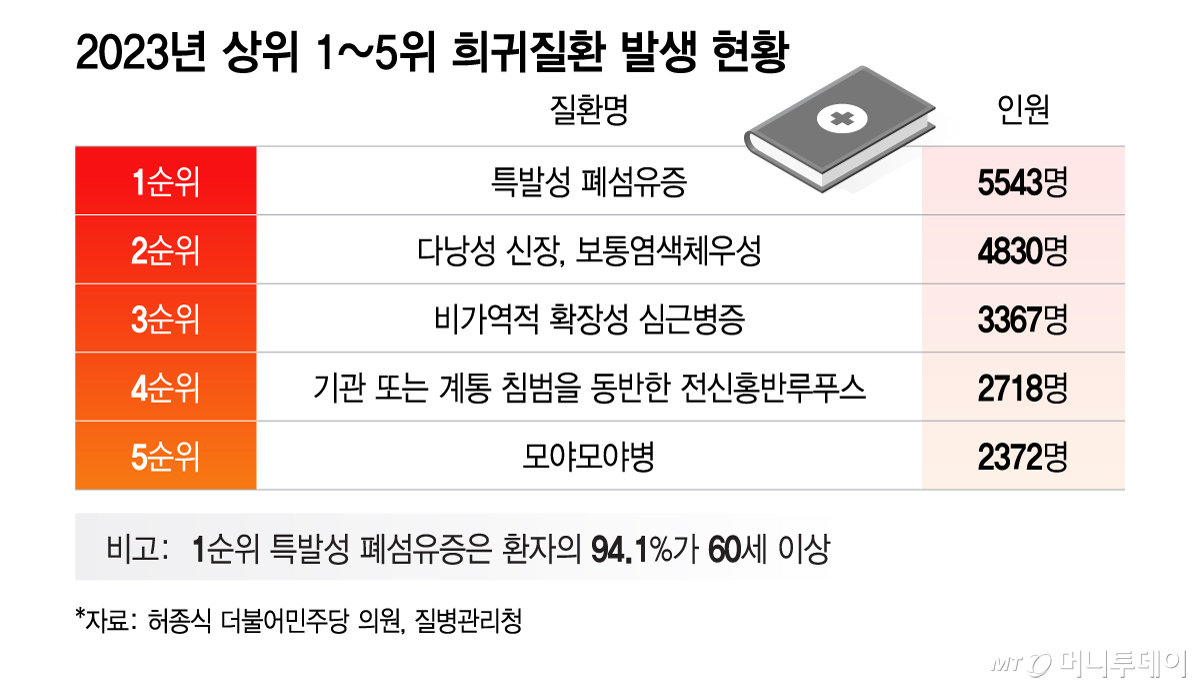
A representative rare disease among the elderly is idiopathic pulmonary fibrosis (IPF). According to the Disease Control Agency's Statistical Yearbook on Rare Disease Patients, 5,543 patients newly registered for the special benefit for rare diseases due to idiopathic pulmonary fibrosis in 2023. It ranks first in rare disease incidence. Among them, 5,214 (94.1%) were elderly individuals aged 60 or older. Those in their 70s numbered 2,251 (40.6%), the largest group, while those aged 80 and above also reached 1,464 (26.4%).
Idiopathic pulmonary fibrosis is a progressive disease in which lung tissue stiffens without a clear cause, leading to decreased lung function. As lung structure is destroyed, chronic coughing and shortness of breath appear, eventually leading to respiratory failure.
Once lungs have stiffened, they are difficult to reverse, making early diagnosis and timely treatment crucial. However, among the 5,543 newly registered patients in 2023, 506 (9.1%) died in the year of registration, of whom 235 were aged 80 or older.
The reason for delayed diagnosis is that symptoms such as coughing and shortness of breath are common, making it easy to dismiss them as other respiratory diseases or aging and leave them untreated.
A Danish study found that the median time from symptom onset to confirmed diagnosis was 2.1 years, analyzing advanced age as a factor delaying diagnosis within the medical system. A US study also found that the average time from an initial respiratory disease diagnosis to a confirmed diagnosis of idiopathic pulmonary fibrosis was 2.7 years.
The current Second Comprehensive Plan for Rare Disease Management (2022-2026) also includes an 'early diagnosis rate' indicator. However, this indicator is defined as the 'proportion diagnosed within one year after the first visit to a specialized institutional investor,' and does not measure the time it takes for patients to reach a specialized institutional investor or the time from confirmed diagnosis to starting treatment.
However, means to measure this are already in place. The National Rare Disease Registration Project, which the Disease Control Agency transitioned to a full-scale project last April, collects 'diagnostic process information' such as the timing of symptom onset, consultation dates, and diagnosis dates. Nevertheless, the elderly are marginalized from national support. Among the 810th recipients of the rare disease diagnostic support project last year, only 24 (3.0%) were aged 61 or older.
Heo (Rep.) stated, "Since rare diseases can be hidden behind common respiratory symptoms, we must not leave the process from suspicion to receiving specialized care solely to individual patient judgment," adding, "The Third Comprehensive Plan should include specific management measures ranging from early recognition of suspicious symptoms to rapid referrals between primary care and specialized institutional investors, and treatment linkage after confirmed diagnosis."
He continued, "Since information from symptom onset to diagnosis is already accumulating through the registration project, diseases where early diagnosis is crucial, such as idiopathic pulmonary fibrosis, should be managed with performance indicators for the time required at each stage from discovery to confirmed diagnosis and treatment initiation," emphasizing, "We must be able to verify how quickly patients actually received diagnosis and started treatment as a policy outcome."

 in THEBIO
