

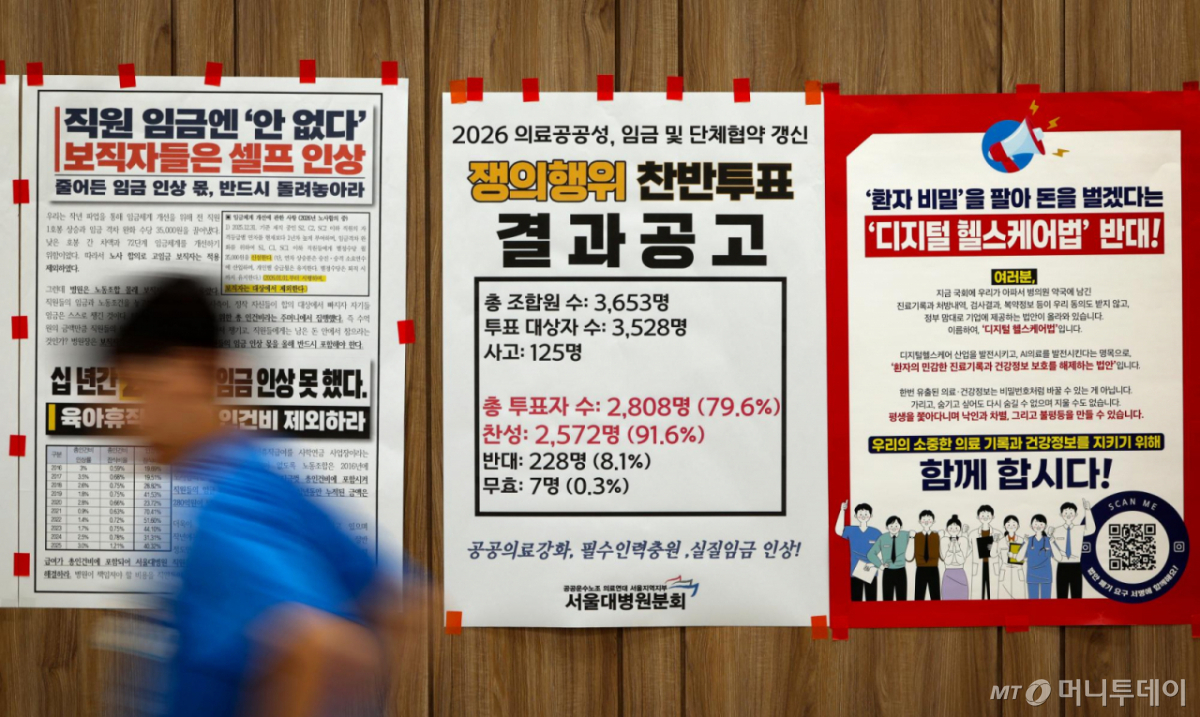
The labor union of Seoul National University Hospital declared that it will launch a full-scale strike on the 28th, demanding the reinforcement of essential personnel and other measures. They appealed that they are suffering from an extreme manpower shortage due to a domino effect caused by the reassignment of 200 nurses to fill the vacancies left by resident physicians.
The Seoul National University Hospital Branch of the Seoul District, Medical Solidarity Federation, Public Transport Workers’ Union, Democratic Confederation of Trade Unions, stated, “Due to the hospital side’s stance that it cannot present an acceptable proposal, we will launch an indefinite full-scale strike from October 28 until the hospital presents an acceptable proposal.”
Citing the reasons for the strike, they claimed, “The current hospital scene is in a situation that is dangerous for both patients and workers, going beyond merely being busy. In a situation of insufficient personnel, the workload has increased not only in the nursing department but also in all departments, including examination rooms, and the resignation rate among skilled workers is rising amid excessive labor and tension.”
They added, “Ultimately, the manpower shortage is an issue that directly threatens patient safety, going beyond the problem of labor intensity. Securing sufficient personnel is necessary to protect patient safety. However, the hospital operates its personnel based solely on mechanical criteria such as the number of beds and patients.” The union claimed that even in a situation where the union has resolved to strike, the hospital side merely repeats its stance that there is “no acceptable proposal.”
Previously, the union had been conducting collective bargaining for the renewal of wage and collective agreements since August 4, with main demands including strengthening public healthcare, reinforcing essential personnel linked to severity levels, and raising real wages. Despite conducting 16 rounds of collective bargaining and more than 20 rounds of practical negotiations, they have yet to find a point of agreement.
The scene at Seoul National University Hospital changed rapidly after the collective action by resident physicians and the structural transformation project for tertiary general hospitals. The union mentioned, “Due to the structural transformation project for tertiary general hospitals, patient severity has increased, resulting in a surge in total workload from examination rooms to wards.”
They further claimed, “In this process, more than 200 skilled nurses who had been on-site in wards and intensive care units were reassigned as Physician Assistant (PA) nurses to fill the resident physician vacancies, and that vacancy was filled by newly hired nurses who had not yet fully adapted.”
In a press conference statement on the day, the union stated, “The chaos in the unprepared scene was devastating. The labor intensity of skilled nurses reached its peak as they trained and supported newly hired nurses who increased rapidly over a short period, while new nurses were left to handle unbearable severe duties without sufficient education or training.”
They continued, “The result led to consecutive leaves and resignations by nurses and a sharp increase in patient safety incidents. Recently, 224 fall accidents occurred in just six months, a figure that is 10 times higher than in previous years,” they emphasized.
The union also lamented, “Workers must give up wage increases to receive parental leave pay.”
They stated, “Workers at Seoul National University Hospital cannot receive parental leave pay due to the application of the Private Pension Act, so the hospital has been covering the salary costs. The problem is that this cost is included in the government’s total personnel expenses, reducing the resources for wage increases for current employees and causing real wages to decline.”
They added, “The government should exclude parental leave pay from total personnel expenses and guarantee separate funding, and the hospital must also prepare measures to compensate for wages. Furthermore, while nine national university hospitals were transferred to the Ministry of Health and Welfare on August 20, Seoul National University Hospital remains under the jurisdiction of the Ministry of Education. The hospital director should clarify their stance on the transfer and plans to strengthen public healthcare.”

 in THEBIO
