

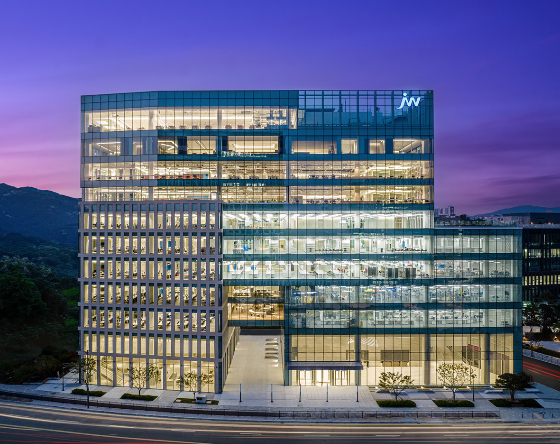
JW Pharma's third-quarter revenue increased by more than 6% compared to the same period last year. Operating profit decreased due to the impact of rising research and development expenses.
JW Pharma announced that its third-quarter revenue reached 211.1 billion won, a 6.3% increase from the same period last year. Operating profit fell by 10.7% to 29.1 billion won. The company explained that factors such as increased R&D expenses affected performance. The operating profit margin also declined by 2.6 percentage points from the same period last year to 13.8%.
The growth in third-quarter revenue was led by the prescription drug (ETC) segment. Prescription drug sales rose 5.8% year-on-year to 176.1 billion won, accounting for approximately 83.4% of total revenue.
Livalo Jet generated 30.9 billion won in revenue, growing 16.6% from the same period last year. As a combination drug containing pitavastatin and ezetimibe, it is one of the company's key revenue sources alongside the single-agent product 'Livalo'. The combined sales of the Livalo family, including Livalo, Livalo Jet, Livalo V, Livalo High, and Livalo Feno, reached 53.1 billion won, a 9.6% increase from the same period last year.
The IV fluid segment also continued its growth trend. Third-quarter revenue increased by 4.1% year-on-year to 73.5 billion won. The 'WINNER P' total nutrition IV fluid product line recorded 23.1 billion won in sales, while basic IV fluids generated 21.7 billion won. Sales of the enteral nutrition IV fluid 'Encover' were reported at 12.3 billion won.
In the over-the-counter (OTC) drug segment, artificial tear brands drove growth. Third-quarter revenue rose 18.0% to 15.7 billion won from 13.3 billion won in the same period last year. Among these, 'Friends' sales increased by 60.0% year-on-year to 7.2 billion won.
A JW Pharma official stated, "The growth of original prescription drugs continues, maintaining a stable revenue flow," adding, "We will continue R&D investment to secure future growth drivers while strengthening the competitiveness of core products to solidify the foundation for medium- and long-term growth."
Meanwhile, in the new drug development field, which is expected to be its next growth driver, JW Pharma is advancing the commercialization of 'epaminurad' (URC102), a gout treatment candidate. In the multinational Phase 3 clinical trial results disclosed last August, the main development dose of 6 mg demonstrated statistically superior blood uric acid reduction effects compared to 40 mg of the existing treatment febuxostat.
However, the high dose of 9 mg did not meet the non-inferiority criteria compared to 80 mg of febuxostat. The company is preparing for the approval process with the goal of obtaining domestic product approval next year, while also advancing technology transfer deals for entry into overseas markets.
As follow-up pipeline candidates, the company is developing 'JW0061', an alopecia treatment, and 'JW2286', a STAT3-targeting anticancer agent. Both candidate drugs are currently in Phase 1 clinical trials. 'JW1601', which shifted its development direction from atopic dermatitis to ophthalmic diseases, is preparing for Phase 2 clinical trials.

 in THEBIO
