

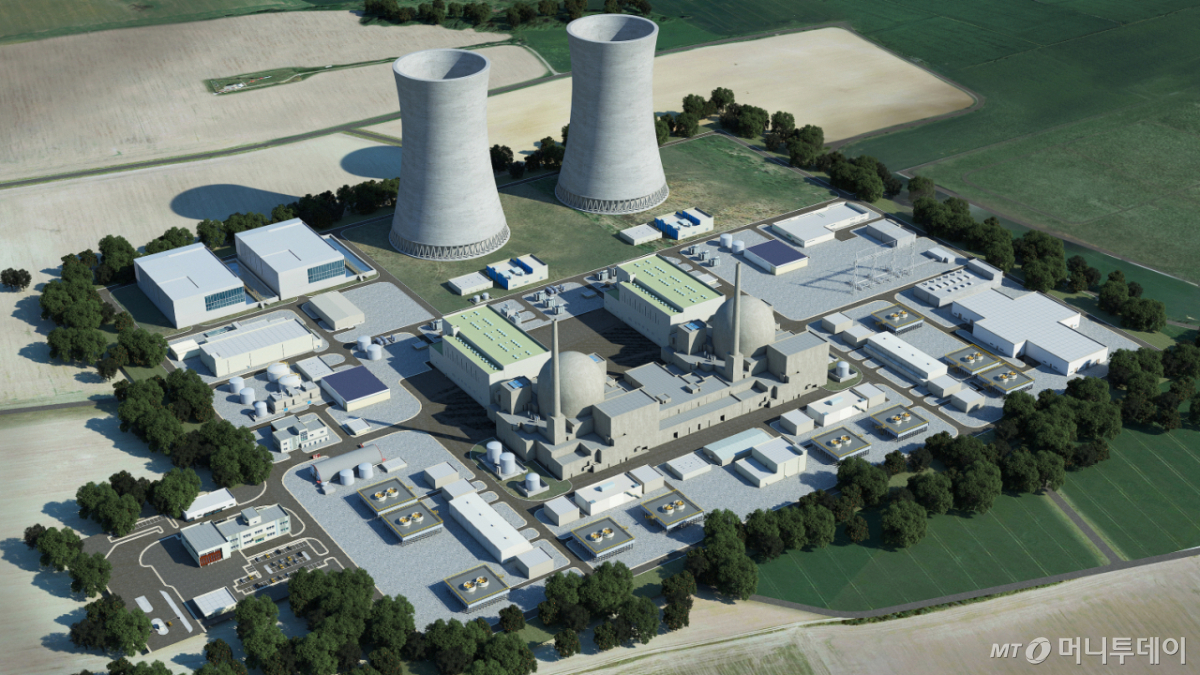
The government has finalized a basic plan for a nuclear export dispute mediation committee, prepared in response to the Barakah nuclear power plant dispute with the United Arab Emirates. However, it remains unclear whether the body will be able to address disputes between public and private enterprises, such as those arising from the Czech nuclear project. Key challenges include whether to include private companies within the scope of mediation and whether to grant binding force to mediation outcomes.
According to the Ministry of Trade, Industry and Energy on Wednesday, the government is advancing legislation to incorporate the basic plan for the dispute mediation committee into the Nuclear Export Promotion Act. Minister Kim Jung-kwan of the Ministry of Trade, Industry and Energy also stated on the 1st, "We will establish institutional mechanisms, including a dispute mediation committee with the participation of neutral experts, in the Nuclear Export Promotion Act currently under legislative consideration."
Discussions regarding the dispute mediation committee stemmed from construction cost disputes over the Barakah nuclear power plant project. Korea Hydro & Nuclear Power (KHNP) filed for arbitration at the London Court of International Arbitration (LCIA) against KEPCO in May last year, demanding settlement of construction costs amounting to several trillion won due to project delays and additional work. Following a recommendation from the Ministry of Trade, Industry and Energy, both parties agreed in March this year to change the arbitration venue to the Korean Commercial Arbitration Board, and KHNP filed for arbitration on May 21.
Recently, conflicts between public and private enterprises have also emerged over the Czech nuclear project. On the 29th of last month, KHNP announced that it had terminated construction contract negotiations with a consortium comprising Daewoo E&C and Doosan Enerbility and would proceed to select a new contractor. As the breakdown in negotiations was formalized, Minister Kim emphasized, "We will never lightly overlook actions that leave conflicts unaddressed and jeopardize shared commitments."
However, when Daewoo E&C issued a statement on the 2nd requesting renegotiation through mediation by the Ministry of Trade, Industry and Energy, the ministry stated that it had not received any formal request and lacked legal authority to mediate commercial negotiations between companies.
As the nature of disputes has evolved, the role and authority of the new mediation body have become points of contention. The concept for the Nuclear Export Promotion Act released by the Ministry of Trade, Industry and Energy in May last year focused on establishing government oversight over major decision-making processes at public institutions.
It has not yet been specified whether contract disputes involving private companies within consortiums, such as those in the Czech project, will be included in the scope of mediation, or whether mediation outcomes will be granted binding force. The Dispute Resolution Board (DRB) discussed by Korea Electric Power Corporation and KHNP to resolve the Barakah dispute could also lead to separate procedures, such as arbitration or litigation, if the parties do not accept the mediation outcome.
Existing mediation bodies have also shown limitations in narrowing price disagreements. In the Czech negotiations, a disagreement resolution committee involving KHNP, the contractor, and the designer was held 11 times between June 30 and July 31, but according to KHNP, it did not lead to substantive price negotiations.
Professor Chung Jae-hak of the Department of Nuclear Engineering at Kyung Hee University stated, "Team Korea includes both public sector institutional investors and private entities prioritizing profit generation," adding, "I believe that even if the Ministry of Trade, Industry and Energy mediates, it cannot legally compel private parties to comply with decisions."
There are also arguments that reducing disputes requires not only establishing a mediation body but also considering risk sharing and project viability from the bidding stage. KHNP explained that while it proposed construction cost increases and civil engineering performance settlements based on a lump-sum contract method as the baseline, the price gap between the two sides exceeded 1 trillion won. Daewoo E&C countered that a contractor not responsible for design should not bear the risk of increased work volumes. Given that the APR1000 reactor has no commercial construction track record, determining who bears the additional costs resulting from design changes and increased work volumes was a core issue.
Professor Chung emphasized, "Private companies with shareholders cannot enter projects that incur losses without generating profits," stressing the need to also review bidding prices and profitability.
KHNP is considering plans to select a new contractor by July next year. Hyundai E&C has expressed its intention to participate in the bid but stated that profitability would be its priority, while it remains unconfirmed whether Samsung C&T or other companies will participate. The task remains to re-examine bidding conditions and risk-sharing structures and to establish a mediation system that can effectively function even for contract disputes involving private companies.

 in ECONOMY
