

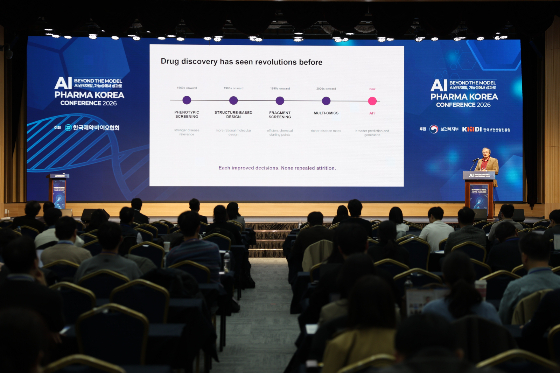
The key to turning artificial intelligence (AI) into tangible results in drug development lies in ensuring data accuracy and connecting information across every stage, from candidate molecule design to clinical trials, experts said. They also stressed the importance of applying AI to address unmet medical needs and validating the reliability of its predictions.
Experts from academia, industry and regulatory agencies outlined strategies and challenges for the practical application of AI in drug development at the AI Pharma Korea Conference 2026, hosted by the Korea Pharmaceutical and Bio-Pharma Manufacturers Association at the ST Center in Gangnam-gu, Seoul, on Nov. 10.
The conference was organized to translate AI's technological potential into practical research applications and drug development outcomes. The Ministry of Health and Welfare also outlined plans to explore support measures for securing high-quality data, expanding infrastructure and linking research findings to technology development and commercialization.
Edith Chan, a professor at University College London (UCL) in the United Kingdom, delivered a keynote speech titled "AI-Driven Prioritization of Drug Targets for CNS Diseases." She emphasized that data accuracy is critical when using AI to identify drug candidates and targets.
"Good AI models start with high-quality data, but a database does not become good simply because it contains a large amount of data," Chan said. "We need to correct errors in compound structures and fill in missing stereochemical information to obtain predictions that can be used in drug development."
David Ascher, a professor at the University of Queensland in Australia, said AI applications should expand beyond predicting drug-target binding to include safety, manufacturability and patient-specific responses. He also stressed the need to connect information across development stages.
"Binding well to a target is just the tip of the iceberg when it comes to what makes an effective medicine," Ascher said. "The best AI model is one that improves the next decision. The goal should not simply be to produce more molecules, but to develop better ones."
Even a drug candidate with strong binding affinity can fail if it does not meet other requirements, such as solubility, safety and manufacturability. Ascher also said AI should be used to understand differences in individual patients' responses to drugs and the potential development of resistance.
Park Yong-min, a leader at LG AI Research, presented an integrated AI strategy for drug development that goes beyond individual tools, emphasizing the need to start with unmet medical needs.
"We initially tried to collect data and apply it to as many cases as possible, but there was actually very little data that could be used in drug development," Park said. "That led us to reconsider whether we should instead start with unmet medical needs."
Park said researchers need to collect and analyze patient samples taken before and after treatment alongside clinical outcomes. Even precise molecular analysis data can be difficult to interpret in relation to drug responses if the timing of sample collection or a patient's treatment history is unclear. He said his team was revising its analysis by refining how sample collection times are defined.
He also stressed the need for collaboration among hospitals, research institutions and pharmaceutical companies to jointly generate and analyze data and validate findings in clinical settings, rather than simply providing individual AI models in response to rapid technological advances.
"It is unrealistic to expect a single technology to deliver all the benefits," Park said. "We need to combine multiple technologies and work with partners to make them useful in actual drug development."
Kim So-hee, a division director at the Ministry of Food and Drug Safety, said the agency plans to issue guidelines next month on considerations for drug development using AI.
The guidelines will cover data suitability, model reliability assessments, management of third-party and pretrained models, personal information protection, post-deployment performance monitoring and consultations with regulators.
The key is to determine the level of validation based on the intended use of AI and its influence on decision-making. Citing the U.S. Food and Drug Administration's evaluation framework, Kim explained that developers should define the questions the AI system is intended to address and the context in which it will be used, then establish, implement and document plans for assessing model risks and reliability.
The greater the reliance on AI outputs and the potential impact of its decisions, the higher the required level of validation.
The MFDS also plans to introduce AI into its own drug approval and review processes. Through a 20 billion won project over three years to establish an AI-based drug review and industry support system, the agency will offer applicants a self-check service to identify missing documents and verify submission formats and requirements in advance.
For reviewers, AI tools will support the drafting of review reports, verification of data sources, summarization and translation of documents, and comparison and searches of previously approved drug information.
"Rather than allowing AI to operate fully autonomously and make decisions on its own, it is important to use it as a tool to assist human evaluators," Kim said. "The intended context of use and the representativeness and potential bias of the data are key considerations."

 in THEBIO
