

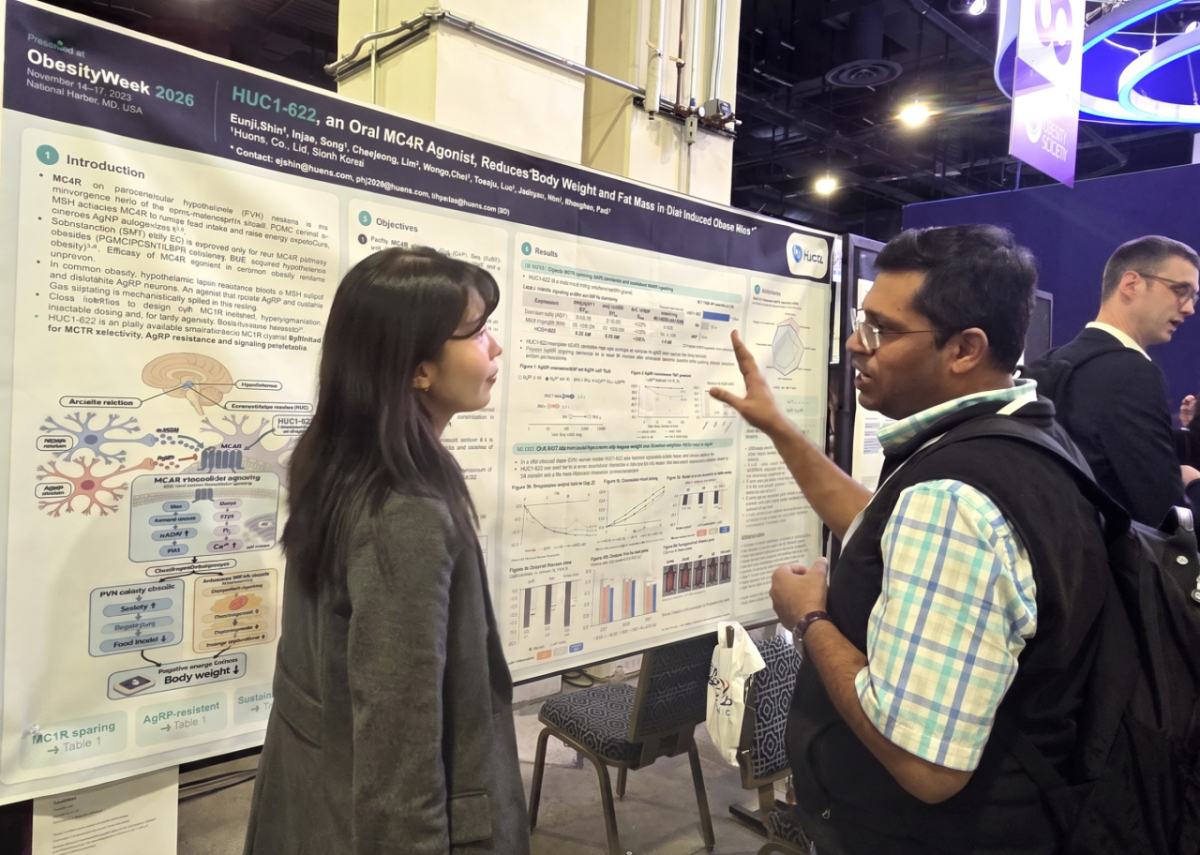
Huons disclosed the preclinical research results for 'HUC1-622,' an oral small-molecule drug candidate being developed to replace rare obesity peptide injections. The compound was confirmed to reduce weight and body fat in obese animal models.
On the 17th, Huons announced that it presented the preclinical research results of the oral MC4R (melanocortin-4 receptor) agonist 'HUC1-622' as a poster at the recent Obesity Week 2026, the annual academic conference of the American Society for Obesity. The company's study was selected as a Late-Breaking Abstract (LBA).
MC4R is a receptor in the hypothalamus (a part of the brain responsible for maintaining the body's homeostasis) that regulates appetite and energy balance. Currently approved existing MC4R agonist mechanism peptide therapies are used via daily injections to treat rare obesity in patients whose appetite suppression pathways have been damaged due to genetic abnormalities or brain surgery, among other reasons. It is known that when an MC4R agonist activates MC4R, satiety increases and energy metabolism expands.
HUC1-622 possesses resistance to 'AgRP' (Agouti-related peptide), an appetite-stimulating substance. AgRP is a substance secreted in the body to maintain homeostasis when MC1R is activated. HUC1-622 maintained its efficacy even in an environment where AgRP was present, and receptor signaling persisted after administration ended. As a result, it is reported that the drug's sustained effect can be increased compared to existing therapies.
The research team confirmed that repeated oral administration of HUC1-622 to obese animal models resulted in a significant reduction in weight and a decrease in body fat.
A strength of the compound is its high selectivity for MC4R, the therapeutic target, compared to existing approved peptide therapies. Peptide therapies are difficult to assign selectivity to specific melanocortin receptors (MCR), which means they can act not only on the therapeutic target MC4R but also on MC1R, which is involved in skin pigmentation. This can result in side effects such as skin hyperpigmentation and spots. HUC1-622 was found to have high selectivity for MC4R and low selectivity for MC1R due to its small-molecule approach.
Huons plans to develop HUC1-622 as an oral formulation rare obesity treatment to replace existing injections. The company also plans to continue development as a next-generation oral therapy by expanding the indication to general obesity. Future evaluations will include dose-dependent effects and combination/maintenance therapy with GLP-1 (glucagon-like peptide-1).
Park Kyung-mi, Vice President of R&D at Huons, stated, "HUC1-622 is a candidate that considered the core challenges of MC4R agonists—AgRP resistance, signal persistence, and receptor selectivity—from the design stage," adding, "We will systematically verify its efficacy and safety through subsequent research."

 in THEBIO
