

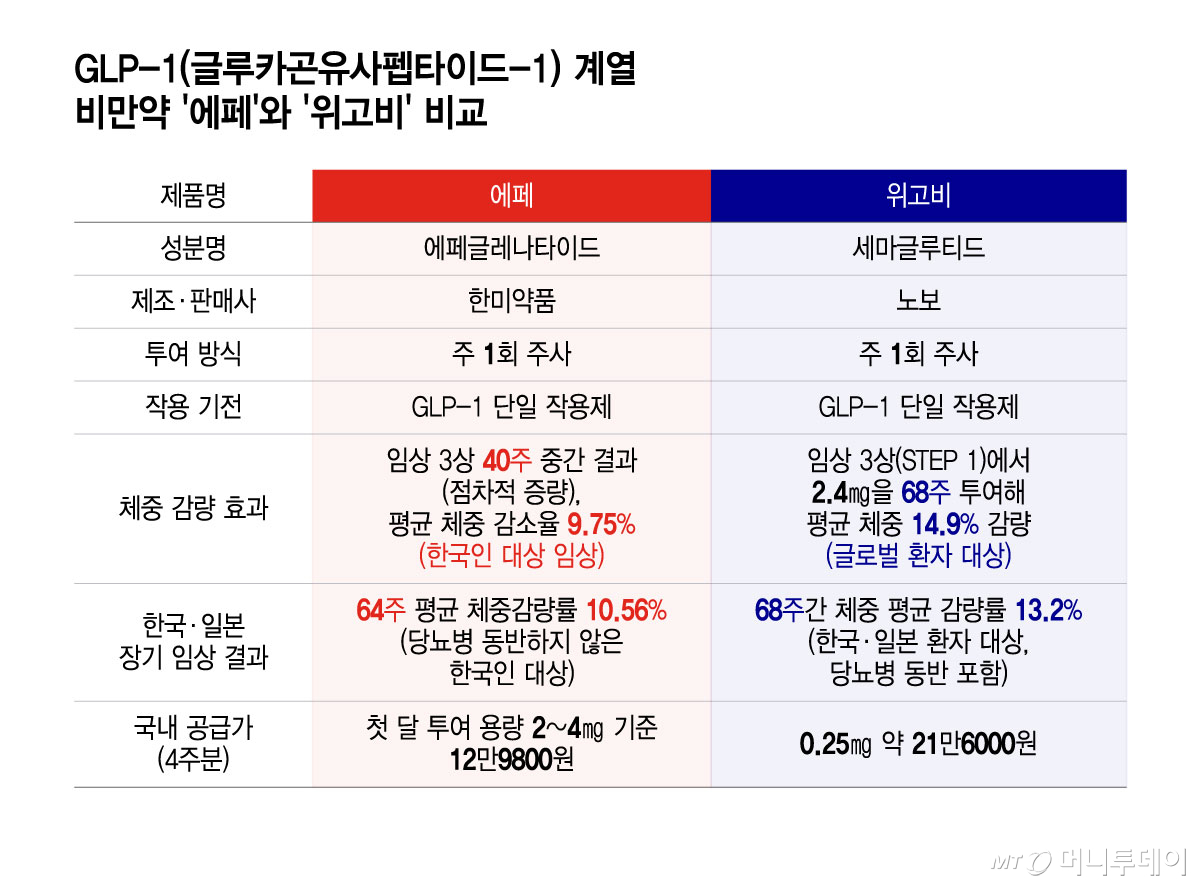
Hanmi Pharmaceutical has released long-term clinical trial results in Korean patients for Eppe (ingredient: epeglentide), its first domestically developed obesity drug in the GLP-1 (glucagon-like peptide-1) class. Patients who received the drug for 64 weeks recorded an average weight loss of 10.56 percent, up 0.81 percentage points from the 9.75 percent reported in interim results at 40 weeks.
According to the pharmaceutical industry on Nov. 18, Hanmi Pharmaceutical presented the 64-week results of its domestic Phase 3 trial of Eppe at the Obesity Society's annual meeting in the United States on Nov. 16 (local time).
The study involved 448 Korean adults with obesity or overweight. It was designed primarily around a body mass index (BMI) range of 27 to 35 kilograms per square meter to reflect obesity criteria and the actual patient distribution in Korea.
About 30 percent of participants had a BMI below 30, while approximately 52 percent had a BMI of 30 to below 35. Overall, around 82 percent had a BMI below 35.
Clinical results showed that the average weight loss rate was 9.75% with gradual dose escalation of Eppe over 40 weeks, and 10.56% with administration over 64 weeks.
This is slightly lower than the record at week 68 for Novo's GLP-1 class obesity drug Wegovy (active ingredient: semaglutide). Wegovy recorded an average weight loss rate of 13.2% at 68 weeks in the Phase 3a clinical trial 'STEP 6' conducted in Korea and Japan.
This was the result for the 2.4 mg dosing group, while the 1.7 mg dosing group showed a weight loss rate of 9.6%, and the placebo group showed a weight loss rate of 2.1%.
Eppe underwent clinical trials on Korean patients without diabetes. Wegovy conducted the trial in STEP 6 in Korea and Japan, including some patients with diabetes.
In 'STEP 1,' a global clinical trial targeting populations such as Western countries with a high proportion of severe obesity patients, Wegovy's average weight loss rate at 68 weeks with 2.4 mg administration was 14.9%. The average weight of trial participants was 105.3 kg, and the average BMI was 37.9 kg/m².
Eppe's discontinuation rate was relatively low compared to other obesity drugs such as Wegovy and Mounjaro. Eppe recorded a permanent discontinuation rate due to serious adverse events of 0.66% in the domestic Phase 3 clinical trial.
Wegovy had a serious adverse event incidence rate of 9.8% in the STEP-1 clinical trial, while for Mounjaro, the serious adverse event incidence rate in the 'SURMOUNT-1' clinical trial was 6.3% at 5 mg, 6.9% at 10 mg, and 5.1% at 15 mg by dosage.
However, because the evaluation metrics and clinical designs differ, and it is not a direct comparative trial, it is difficult to definitively determine superiority between the drugs.
A company official said, "In the domestic Phase 3 clinical trial for Eppe, approximately 82% of all clinical participants had a BMI below 35 kg/m², which differs fundamentally in its starting point from Western studies centered on severe obesity with an average baseline BMI of about 38 kg/m²."
The official added, "Patients with a BMI of 27 to 35 kg/m², commonly seen in Korea, made up the majority of the clinical trial. In this patient group, we confirmed an average weight loss of about 10%, good tolerability, and a low permanent discontinuation rate due to serious adverse events, so Eppe can be called a 'treatment optimized for Koreans.'"
The official further added, "Hanmi Pharmaceutical will continue to accumulate clinical evidence obtained from domestic patients while supporting the overall treatment of patients by linking diet, exercise, medication, and lifestyle management through the digital solution app 'EpiDay' for obesity treatment patients, as well as providing health functional food support for supplementing insufficient nutrients."
The official added, "The prescription strategy for Eppe is not about competing on a single weight loss figure, but about providing appropriate treatment options to patients and helping them maintain healthy weight loss in the long term."

 in THEBIO
