

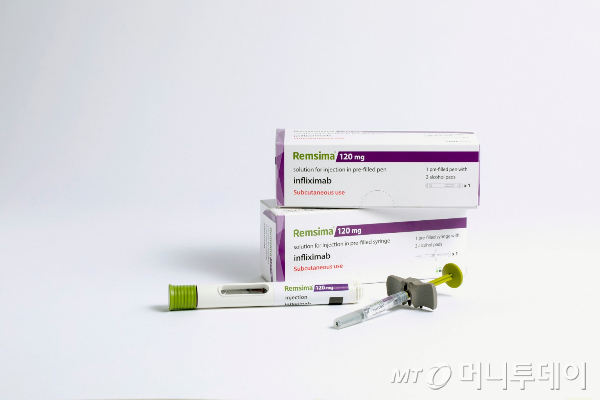
Celltrion said Friday that it presented 44-week results from a Phase 3 clinical trial of Remsima SC, an autoimmune disease treatment containing infliximab (development code CT-P13 SC), in Japan at the 17th annual meeting of the Japanese Society for Inflammatory Bowel Disease (JSIBD 2026), which opened in Fukuoka on the same day. The two-day conference runs through Friday.
At a symposium on the morning of the opening day, Dr. Ken Takeuchi of Tsujinaka Hospital Kashiwanoha presented the findings under the title "Subcutaneous Infliximab as Maintenance Therapy for Crohn's Disease in Japan: Safety and Efficacy over 44 Weeks."
The study evaluated the safety and efficacy of switching 60 Japanese patients with Crohn's disease who had achieved clinical remission after receiving standard-dose intravenous (IV) infliximab for at least six months to Remsima SC, a subcutaneous (SC) formulation. The patients were followed for 44 weeks.
The results showed that patients who switched to Remsima SC maintained stable clinical and endoscopic remission throughout the maintenance treatment period.
The treatment was also well tolerated, with no new safety concerns. Notably, none of the 60 participants discontinued treatment or required a dose increase during the study, indicating a relatively high rate of treatment persistence.
The trial demonstrated Remsima SC's efficacy and safety. Its greater convenience compared with the existing IV formulation is also expected to expand treatment options for local doctors and patients.
Celltrion aims to use the presentation to strengthen Japanese medical professionals' awareness of and confidence in Remsima SC. The company plans to launch the product in Japan next year.
Celltrion is strengthening its position in Japan by combining cooperation with local partners and its direct sales capabilities.
According to IQVIA, a pharmaceutical market research firm, and local data, Remsima captured a 48 percent share of Japan's infliximab market in July, overtaking the original drug to rank first in prescriptions among four competing products.
The company attributed its performance to a sales strategy tailored to local market conditions.
Celltrion has expanded to three products that rank first in prescriptions in Japan, including its cancer treatments Herzuma, containing trastuzumab, and Vegzelma, containing bevacizumab.
Yuflyma, an autoimmune disease treatment containing adalimumab, leads prescriptions among biosimilars with a 21 percent market share. The company has also recently expanded its portfolio with the IV formulation of Steqeyma, a follow-on product with high profitability.
Celltrion expects Remsima SC to maximize synergy between formulations by leveraging Remsima's existing market leadership and its local sales infrastructure.
The company has recently stepped up its expansion across Asia, beyond Japan. Its tailored supply strategies, backed by direct sales capabilities and a broad product portfolio, are gaining traction in local markets.
In the second quarter of this year, Remsima ranked first in prescriptions in Singapore with a 95 percent market share, Hong Kong with 83 percent and Malaysia with 75 percent.
Herzuma also maintained its leading position in Hong Kong with a 67 percent share, Thailand with 59 percent and Malaysia with 52 percent.
"Japan is a key strategic market where Remsima ranks first in infliximab prescriptions," a Celltrion official said. "It is significant that we have shared clinical trial results involving Japanese patients at a local inflammatory bowel disease conference."
The official added, "We will use this presentation to further strengthen the trust of local medical professionals. With thorough launch preparations and differentiated product competitiveness, we aim to lead the global autoimmune disease market, including Japan."

 in THEBIO
