

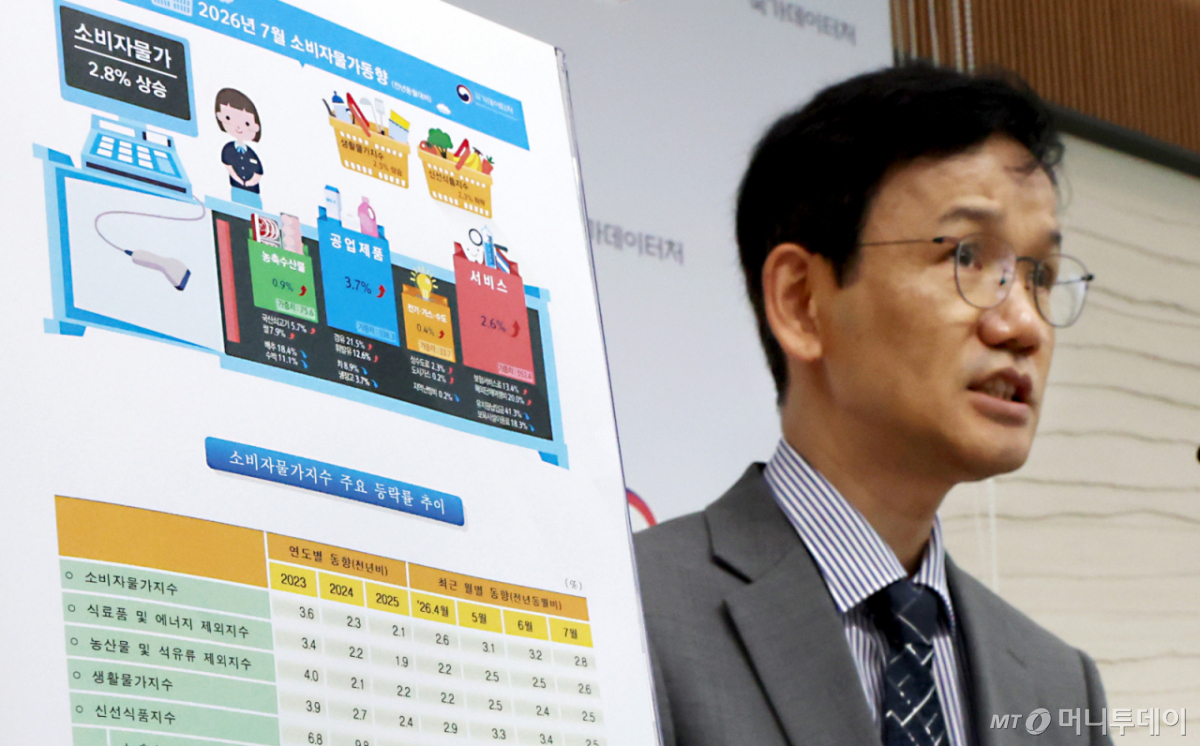
Although consumer prices entered the 2nd% range last month, concerns remain high. This is due to volatility in international oil prices caused by the Middle East war and the potential for processed food price hikes in the second half of the year driven by rising petroleum product costs. In particular, a base effect from SK Telecom’s 50% telecom fee discount offered as compensation for a personal data breach in August last year is expected to push inflation up by 0.6 percentage points (p).
According to the 'July 2026 Consumer Price Trends' released by the Data Agency on the 4th, the year-on-year increase rate of the consumer price index this year was as follows: the 2.0%, the 2.0%, the 2.2%, the 2.6%, the 3.1%, the 3.2%, and the 2.8%. This marks a return to the 2nd% range for the first time in three months since April.
Notably, despite factors driving price increases such as supply-demand volatility in agricultural products due to adverse summer weather, agricultural products recorded a -2.2% decline, helping to lift the overall increase rate of livestock and aquatic products to 0.9%. This is a significant drop from the 3.2% increase recorded in June. The increase rate for livestock products also fell from 6.2% to 4.4%. Officials explained that entry into the 2nd% range was made possible through government discount support policies and the petroleum price cap system.
However, since the Middle East war situation has not been fully resolved, uncertainty remains regarding international oil prices, which continues to fuel anxiety. If tensions in the Middle East region escalate again, petroleum product prices could surge once more. The increase rate for petroleum products had been soaring at 21.9% in April, 24.2% in May, and 24.7% in June before moderating to a 15.5% rise. Rising oil prices also create instability for processed food prices in the second half of the year. Processed food prices rose by 1.0%, with a slight expansion in the upward trend due to industry price hikes.
Most importantly, there is a high probability that prices will surge again this month. This follows the aftermath of SK Telecom’s 50% telecom fee discount provided to 20 million people last August as compensation for a personal data breach incident.
The Data Agency explained that the telecom fee discount last year caused overall inflation to fall by approximately 0.58 percentage points. In August last year, the price index for telecommunications services dropped by 21%, marking the largest decline since October 2020, when a 20,000 won telecom fee support program was provided to all citizens during the COVID-19 pandemic (-21.6%).
The weight assigned to telecommunications services is 29.8, which is relatively high compared to other items. Considering even the pure increase in mobile phone fees over the past year, a rise of at least 0.6 percentage points is expected this month.
A Ministry of Economy and Finance official stated, "July prices were favorable due to the implementation of the price cap system and the livestock and aquatic product discount support program," but added, "Prices are expected to spike temporarily in August before declining again from September onward."
Meanwhile, the government’s forecast for this year’s inflation rate, presented in last month’s second-half economic growth strategy, stands at 2.6%. Considering that the first-half increase rate was around 2.5%, the average increase rate in the second half must be kept below 2.7% to meet the target. To manage prices, following the largest-ever livestock and aquatic product discount support policy announced in June, the government will also unveil the 'Chuseok Livelihood Stability Measures' in September.
Addressing criticism that these are merely temporary measures to control inflation, a Ministry of Economy and Finance official said, "The Chuseok measures are released annually, and we are drafting them in coordination with relevant ministries." The official added, "Please understand that this year is unique due to the Middle East war, and the government is paying unusually close attention to livelihood issues as a result."

 in ECONOMY
