

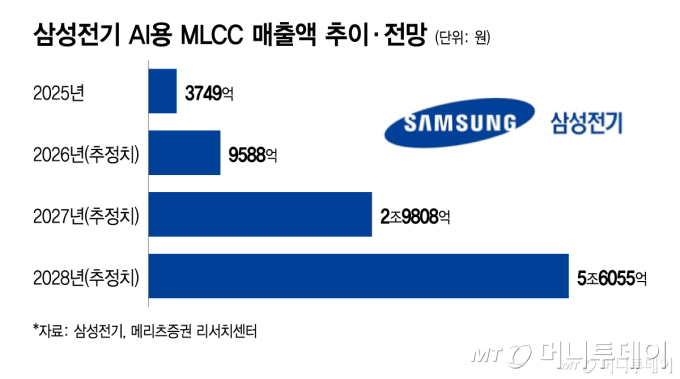
The supply shortage of multilayer ceramic capacitors (MLCCs) for artificial intelligence servers is expected to reach its peak in the first half of next year.
This is because demand for graphics processing units (GPUs), central processing units (CPUs), and memory modules has surged, intensifying the supply-demand imbalance. MLCCs are core components that store and supply electricity while maintaining stable voltage within electronic devices.
According to market research firm TrendForce on the 2nd, major AI accelerator manufacturers such as NVIDIA and AMD have begun mass production of their products and procuring components, with high-performance MLCC supply shortages projected to hit a peak in the first half of next year. Currently, MLCC lead times (the period from order to delivery) are known to be around 35 weeks, roughly three times longer than the typical level of 12 weeks.
The surge in demand for high-performance MLCCs is driven by increased power consumption in AI semiconductors. The estimated power consumption per chip for NVIDIA's "Rubin" AI GPU, scheduled for release in the second half of this year, is 1,800 watts (W).
In contrast, the next-generation AI GPU "Rubin Ultra," slated for release next year, is expected to consume 3,600 W per unit, doubling power consumption in just one generation. As chip power consumption increases, so does the demand for high-capacity MLCCs required to maintain stable voltage.
MLCC demand is also expanding beyond GPUs to CPUs and memory modules. TrendForce analyzed that "as AI applications expand from training to inference and AI agents, CPU demand is increasing," adding that "demand for high-capacity MLCCs is rising significantly across CPU motherboards and DDR5 (Double Data Rate 5) memory modules." The firm predicted that as the supply-demand imbalance worsens, the bargaining power of MLCC manufacturers will also increase.
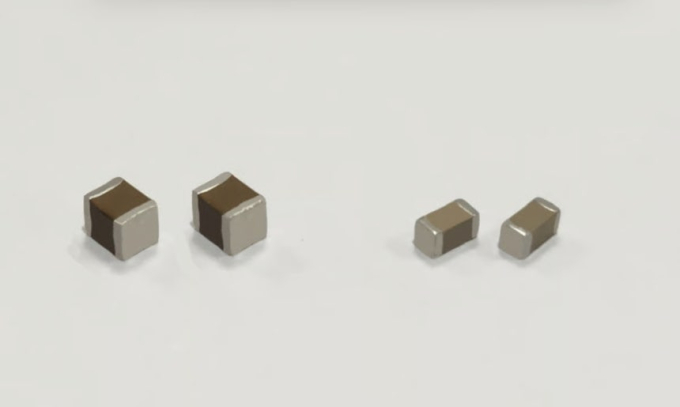
As the shortage of high-performance MLCCs persists, a favorable market environment is being created for Samsung Electro-Mechanics. The company holds a market share of over 40% in the global AI server MLCC market. In particular, because MLCCs for AI servers must achieve high capacity and stability while reducing size, the number of suppliers capable of providing them is limited.
Park Gyu-tae, executive vice president of Samsung Electro-Mechanics' Component Business Division, stated during the earnings announcement conference call on the 28th that "due to the nature of high-value-added products, capacity erosion is also occurring."
Indeed, market research firm Future Electronics estimated Samsung Electro-Mechanics' MLCC lead time at 52 weeks. This means it takes approximately one year from order to product delivery.
Long-term supply agreements (LTAs) have also improved medium- and long-term demand visibility. Park disclosed that "we have signed or are negotiating LTAs with approximately 50 customers." More than half of MLCC revenue is expected to come from LTAs. On the 30th of last month, Samsung Electro-Mechanics also signed an LTA worth 879.3 billion won with a major global company. This was the second-largest MLCA LTA signed this year.
Expansion of production capacity is also being pursued based on customer requests. Global big tech companies are paying upfront fees required for capacity expansion to secure future production volumes in advance.
Samsung Electro-Mechanics is constructing its third MLCC factory in Calamba, Laguna Province, Philippines, with operations targeted for the first quarter of next year. The company also plans to expand MLCC production lines at its Busan plant to increase production capacity by up to 20% annually.
An industry official said, "While MLCC manufacturers such as Samsung Electro-Mechanics and Japan's Murata are expanding production capacity, a significant increase in supply will not be possible until at least 2028," adding, "We expect the upward trend in MLCC prices to continue for the time being."

 in INDUSTRY

