

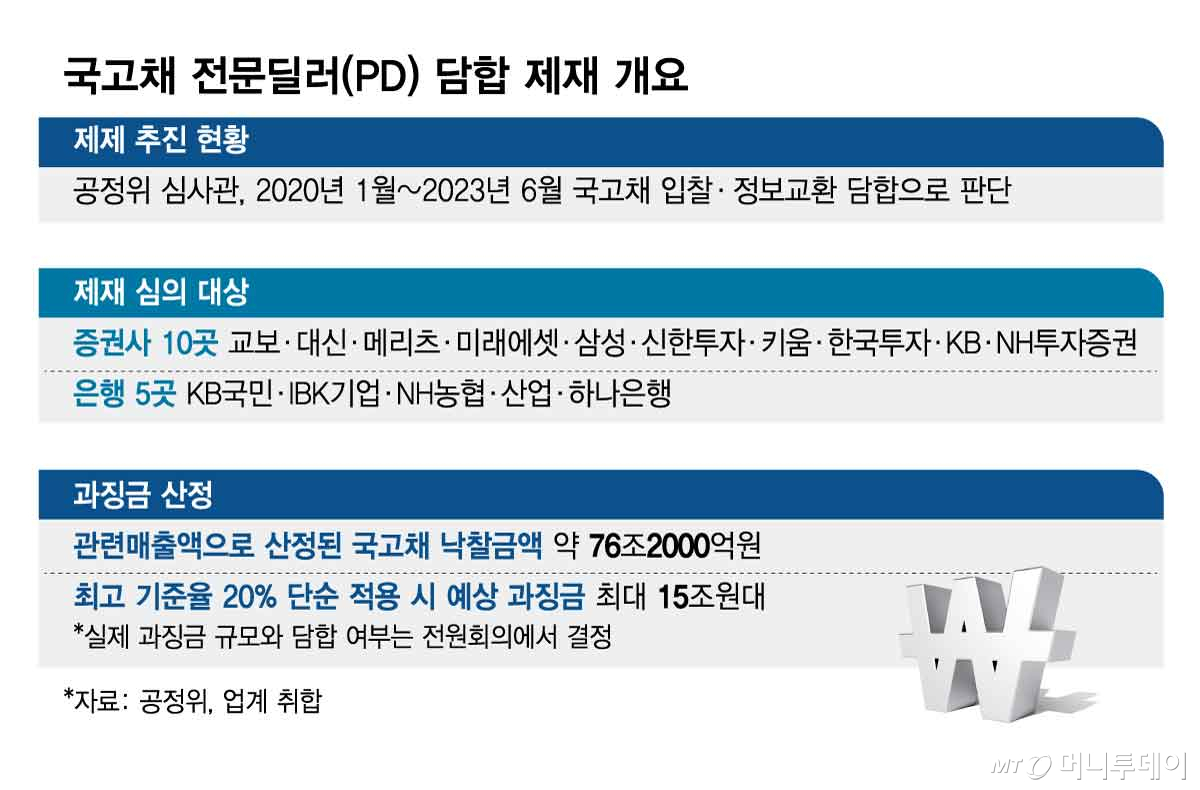
The Fair Trade Commission sent a prosecution report, equivalent to an indictment, containing findings on illegality and proposed measures against 15 Treasury Bond Professional Dealer (PD) firms in March last year. It took one year and five months after the submission of the prosecution report for the Treasury bond collusion case to reach the Korea Fair Trade Commission's adjudication panel, underscoring the complexity of issues surrounding this case.
It is reported that the actual volume of the Korea Fair Trade Commission's prosecution report reached 12,000 pages. To ensure the protection of the defense rights of the respondents, the Korea Fair Trade Commission also granted an opinion submission period of about six months, including extensions upon request.
As a result, the Korea Fair Trade Commission determined that PD firms colluded to share information such as interest rates, prices, and bid volumes ahead of Treasury bond auctions and rigged bids to form interest rates at specific levels. It is explained that concrete and frequent collusion and information exchanges occurred regarding bid interest rates, which cannot be viewed as customary communication.
Treasury bonds are the most actively traded among bonds and sensitively reflect market interest rates, making them a key indicator for showing the state of funds in the private sector. They are mostly issued through competitive bidding.
The Ministry of Economy and Finance grants professional dealer qualifications to specific businesses that meet certain criteria, allowing them to participate in Treasury bond auctions. In exchange for being granted priority rights for underwriting in the Treasury bond issuance market, they are assigned the obligation as market makers to continuously provide buy and sell quotes in the distribution market to facilitate trading.
A Korea Fair Trade Commission investigator calculated the winning bid amounts of the colluding Treasury bonds, approximately 76.2 trillion won, as relevant sales revenue in the prosecution report. Furthermore, it judged their collusion behavior as a 'very serious violation.' According to regulations on fine announcements, a levy rate of '10.5% to 20%' of relevant sales revenue is applied for 'very serious violations' in collusion cases. In principle, this means fines up to the 15th trillion won range can be imposed.
However, it is reported that the Korea Fair Trade Commission investigator presented a levy rate of '10.5% to 15%' in the prosecution report, which falls within the lower evaluation tier among very serious violations. This is why the industry expects fines in the range of approximately 8 trillion to 11 trillion won.
The Korea Fair Trade Commission maintains a cautious stance. This is because the prosecution report does not bind the final judgment of the commission.
A Korea Fair Trade Commission official stated, "The numbers currently reported in the media regarding (expected fines) are based on estimates," and added, "Specific measures will be decided through deliberation by the full committee, and market conditions, ripple effects, and the financial status of respondents will be comprehensively considered during the deliberation process."
Nevertheless, industry concerns remain. Even if the fine level is lowered during the full committee process, there is a high possibility it will become the largest fine in history. The largest fine ever imposed by the Korea Fair Trade Commission to date was 1.301 trillion won in the Qualcomm case.
In this regard, the industry argues that relevant sales revenue should be recalculated. They contend that relevant sales revenue should be calculated based on actual operating profits rather than winning bid amounts.
A Korea Fair Trade Commission official said, "Treasury bond collusion is a purchase collusion, and calculating relevant sales revenue based on winning bid amounts is the principle under the law," while also stating, "The final judgment will be made by the commission."
Meanwhile, some voices are raising concerns that this sanction could have ripple effects on the national economy. There are worries that delays in future Treasury bond issuance could occur amid the inflow of foreign investment funds following its inclusion in the World Government Bond Index (WGBI) last April. Critics point out that this will ultimately lower South Korea's external creditworthiness in the financial market.
In this regard, the Ministry of Economy and Finance also conveyed concerns to the Korea Fair Trade Commission regarding the need to comprehensively consider the importance of the PD system in the Treasury bond market and the impact of sanctions on that market.
A Korea Fair Trade Commission official stated, "The commission can consider (concerns such as a decline in external creditworthiness due to sanctions)," but added, "(This sanction) aims to correct market misconduct, so I believe it will not have a negative impact on the market."

 in ECONOMY
