

The government's tax reform plan related to the stock market, which sparked fierce backlash from young people and investors, is finally being put on the operating table. For the second consecutive year following last year, the government's tax reform proposal has found itself in a situation requiring internal revision.
According to political circles and relevant ministries on the 9th, the Ministry of Economy and Finance has begun reviewing amendments related to ISA (Individual Comprehensive Asset Management Account) restructuring and the Stock Price Suppression Prevention Act following instructions from President Lee Jae-myung.
The key issue is whether the government will withdraw its plan to reduce tax benefits for ISAs, which drew particularly strong opposition from young investors.
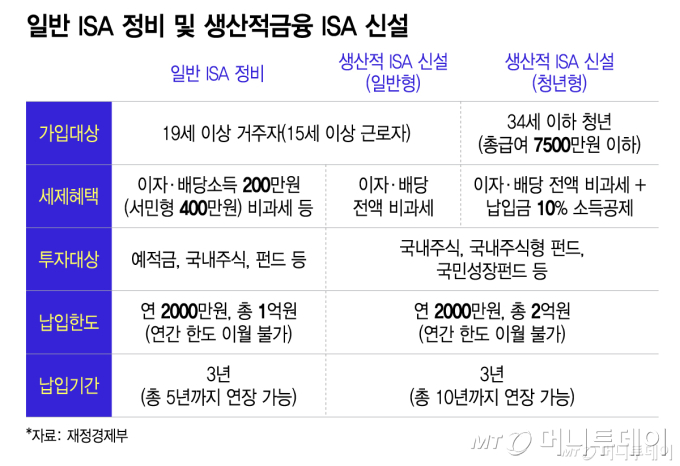
The problem began when the government introduced a new 'Productive Finance ISA' that allows investment only in domestic stocks, domestic stock-type funds, and National Growth Funds—so-called 'National Directors'—while simultaneously reducing existing ISA benefits. This included limiting contract periods, which were previously extendable indefinitely, to a maximum of five years, and eliminating the function of carrying forward unused contribution limits to the following year.
Despite the intention to achieve two goals at once: activating the domestic stock market and increasing national assets, complaints arose among investors that existing ISA benefits were reduced to highlight the Productive Finance ISA. Moreover, as the domestic stock market recently exhibited extreme volatility, growing investor concerns about long-term investment in domestic stocks further fueled negative public opinion.
Given that President Lee himself intervened to order a review, there is a high probability that the reduction of existing ISA tax benefits will be completely withdrawn. The ruling party also opposes reducing existing ISA benefits.
The 'Stock Price Suppression Prevention Act' included in the government's tax reform plan has also entered the review process. Its core provision imposes an additional 30% surcharge on stock values and higher taxes if stock prices are deliberately suppressed to reduce inheritance and gift taxes.
The government defined criteria for companies suspected of 'stock price suppression' as those whose cumulative PBR (Price-to-Book Ratio) over 12 out of the most recent 13 semi-annual periods fell within the bottom 25% by industry (KOSPI) or 10% (KOSDAQ). Cases also include companies that engaged in dual listings or issued exchangeable bonds within the past year, or whose market valuation dropped more than 30% compared to three years ago.
Critics have repeatedly pointed out numerous loopholes, such as the possibility for companies to manipulate their PBR rankings only during specific periods.
Real estate taxation is also a 'landmine.' As of 3:30 p.m. on the 9th, 2,488 opinions had been submitted regarding the proposed amendment to the comprehensive real estate tax law currently under public notice. Additionally, 1,632 opinions were received concerning amendments to the Income Tax Act, which include measures such as converting the special deduction for long-term holdings into a deduction for long-term residence income.
In particular, a flood of opinions emerged regarding 'non-resident single-homeowners,' whose tax burden would significantly increase under this tax reform plan. They are requesting recognition of cases where they were unable to reside in their homes due to unavoidable circumstances.
The government's proposal considers enrollment in school, job changes and transfers, illness, school transfers, overseas stays, and caring for parents as unavoidable reasons, recognizing a residence period of up to three years. In response, citizens are demanding that exceptions also be made for moves undertaken to care for grandchildren or provide family care, as well as periods during remodeling construction under the Housing Act.
Meanwhile, in last year's tax reform plan—the first year of the Lee Jae-myung administration—the government had already made a sudden revision to stock market-related proposals.
At that time, the government announced plans to strengthen the major shareholder threshold for capital gains tax on listed stocks from 5 billion won per stock (based on market capitalization) to 1 billion won. Lowering the major shareholder threshold to 1 billion won raised concerns that it could negatively impact the stock market due to year-end mass selling by large investors, often referred to as 'big hands.' Moreover, critics pointed out that this move directly contradicted the Lee Jae-myung administration's emphasis on 'money movement' into the stock market.
As controversy continued, President Lee stated that there was no need for the government to insist on its proposal, and ultimately, the government decided to drop the adjustment of the major shareholder threshold for stock transfer taxes entirely.

 in ECONOMY
