

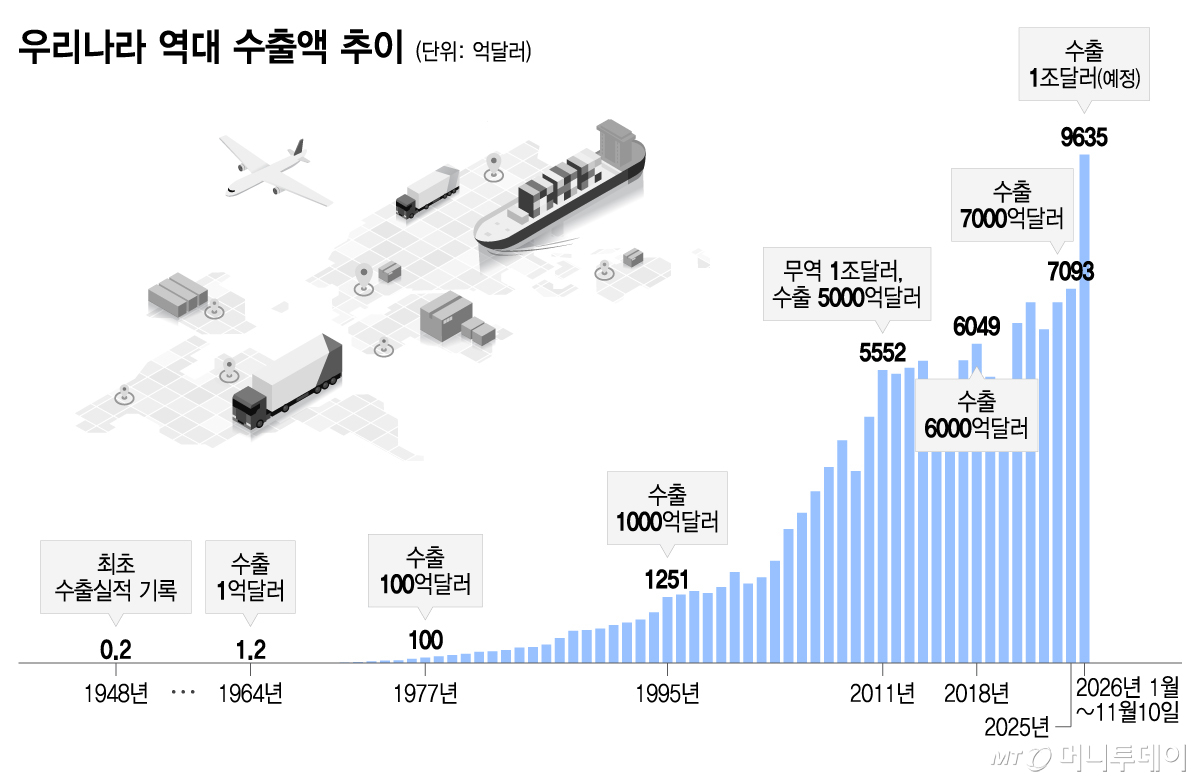
South Korea, which began its first exports alongside its founding in 1948, has since continued an unprecedented steep growth trajectory worldwide, rising to become a trade powerhouse on the verge of reaching $1 trillion in exports in approximately 80 years.
Export goods, once centered on light industry such as squid, wigs, and clothing, shifted to heavy industry and advanced industries as the economy grew, and the country has now established itself as a key exporter in major sectors including semiconductors, automobiles, and shipbuilding. Major global institutional investors and experts evaluate that Korea’s dazzling economic growth was underpinned by its high export growth rate.
According to the Korea Trade-Investment Promotion Association on the 15th, South Korea’s formal export history began when “Aengdo Hwan,” the country’s first trade vessel flying the national flag in 1948, exported dried seafood and agar to Hong Kong and Macau.
At the time, due to a fragile industrial base immediately following the Korean War, South Korea had nothing to export other than low-value-added light industrial products such as squid, clothing, and wigs. The country’s total exports in its first year amounted to only $19 million.
Even until 1960, South Korea’s exports accounted for only 1% of its gross domestic product (GDP), and imports relied heavily on U.S. aid. However, following the government’s shift toward industry cultivation policies and export promotion policies, export performance began to grow rapidly.
While major export items were centered on light industry, such as squid, live fish, and pig bristles, trade volume expanded dramatically as the country actively pursued resource exports like iron ore, anthracite, and graphite. In 1964, exports surpassed $100 million for the first time.
The 1970s were a critical period when South Korea’s export structure transitioned from light industry to heavy industry. The era of formal automobile exports began in June 1976, when Hyundai Motor exported six domestically produced Pony sedans to Ecuador. Semiconductors, which are now a major export item for the country, also started with Anam Semiconductor exporting $210,000 worth of products to the United States in 1970.
Subsequently, due to the government’s aggressive heavy industry cultivation policies, exports of steel and ships began to increase substantially from the 1980s. At that time, although clothing exports accounted for the largest share at approximately 16% of total exports, steel sheet and ship part exports each accounted for 5.4% and 3.5%, respectively, making them top 10 export items.
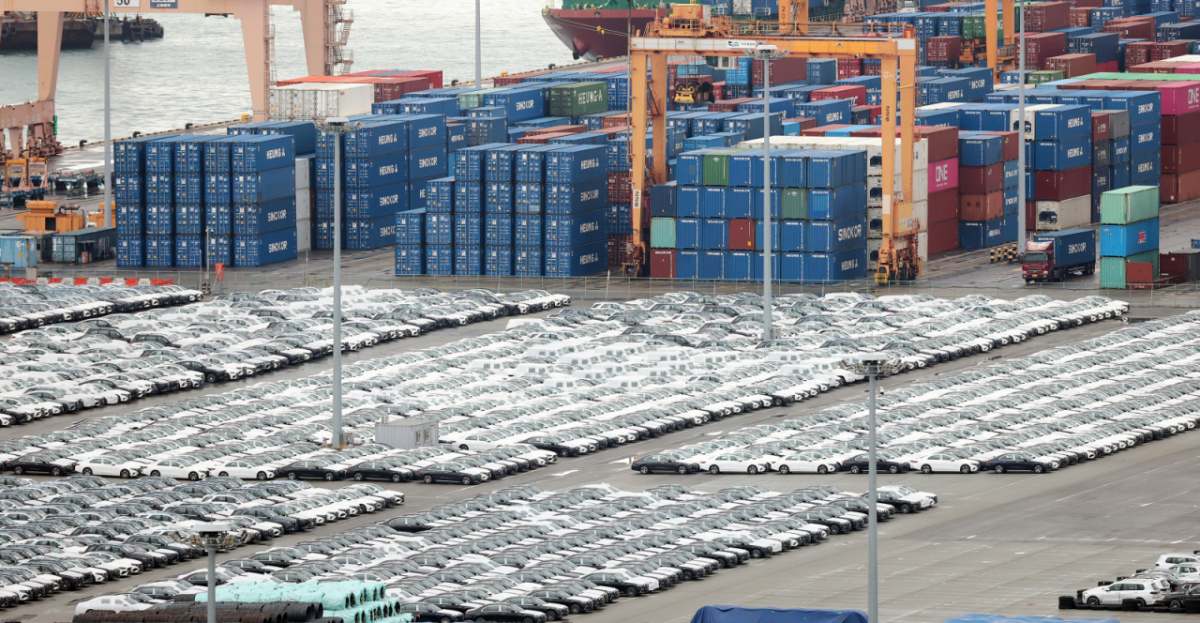
From the 1990s onward, an export structure centered on semiconductors and automobiles began to solidify. In 1992, semiconductors accounted for approximately 9% of total exports with $6.8 billion in sales, ranking first in export share for the first time. In 1995, automobiles held the second-largest share with $8.4 billion in exports, following semiconductors ($17.7 billion). This structure, with semiconductors in first place and automobiles in second, has continued to the present day.
As export growth centered on semiconductors and automobiles continued, South Korea surpassed $100 billion in exports for the first time in 1995. Entering the 2000s, the export growth rate accelerated thanks to the dot-com boom and high growth in the IT industry. In 2011, along with surpassing $500 billion in exports, the country set a record of $1 trillion in total trade volume (exports + imports) for the first time. Following the crossing of the $600 billion export mark in 2018, it also surpassed the $700 billion high ground last year.
Recently, not only semiconductors and automobiles but also K-content, K-food, and K-beauty are seeing a spread of export momentum driven by the global Hallyu wave. Export regions, which had been concentrated in the United States and China, are expanding to ASEAN countries and India.
This year’s export outlook was not very good until the end of last year. Forecasts emerged suggesting that export growth could slow or turn negative due to U.S. high tariff policies and global recession concerns. The Middle East war that erupted in early this year further expanded uncertainty in global trade.
However, despite multiple adverse factors such as strengthening global protectionism, U.S. tariff policies, and inflation caused by the Middle East war, South Korea’s exports continued a high-flying trajectory centered on semiconductors. In September last month, cumulative exports reached $812.7 billion, surpassing $800 billion for the first time, and in October, they even crossed the $900 billion mark. If this trend continues, there is a high possibility of breaking through $1 trillion within this week.
Major global institutional investors and experts also explain that such export growth has been the driving force behind creating the “Miracle on the Han River.” Professor Douglas Irwin of Dartmouth College analyzed in last year’s paper, “From Hidden Kingdom to Miracle on the Han River,” stating, “Today, Korea is an economically successful country and an export powerhouse,” and adding, “It is generally acknowledged that among the various factors driving Korea’s transformation, export promotion policies were a key element of success.”

 in ECONOMY

