

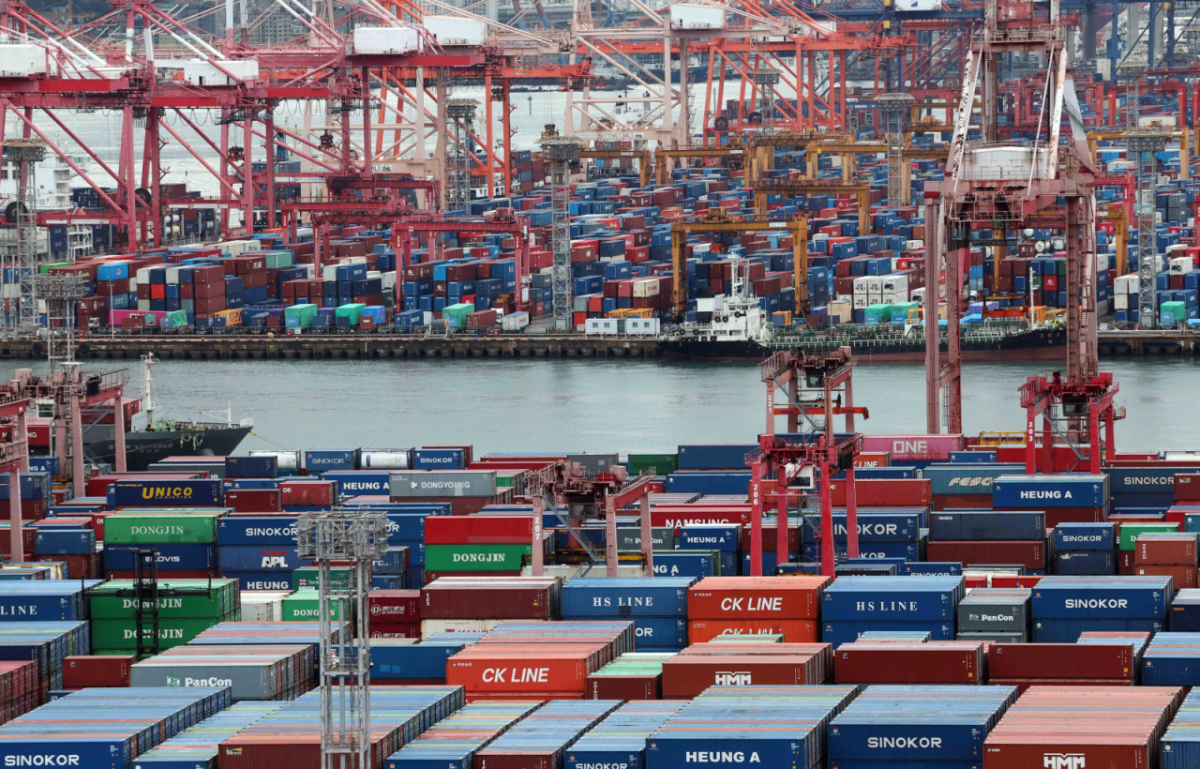
South Korea's export value is projected to surpass 1 trillion dollars this week. This will be a historic first for the country and will place it fourth in the world, after the United States, China, and Germany, in joining the "1 trillion dollar export club."
A nation that once sustained itself through exports of light industrial products such as squid and wigs has now risen to become an export-centric country in key industries including semiconductors, automobiles, and shipbuilding. This is a dazzling achievement accomplished over 80 years of South Korea's export history. However, concerns remain regarding export volatility caused by concentration in specific items like semiconductors, as well as the deepening trade friction between major countries, including the United States, which are cited as challenges to be resolved.
According to the Ministry of Trade, Industry and Energy and the Korea Customs Service on the 15th, cumulative exports for this year through the 10th reached $963.464 billion, a 62% increase compared to the same period last year. This has already surpassed last year's total export performance ($709.3 billion), which was previously the highest on record, leaving only about $36.536 billion short of the annual 1 trillion dollar mark.
Given recent trends in export values, there is a high possibility that exports will surpass 1 trillion dollars this week. Based on the daily average export value for the 1st to 10th of this month ($4.46 billion), it is highly likely that the 1st trillion dollar mark will be crossed on the 20th. Considering the general tendency for export values to increase from the beginning to the end of a month, the milestone could be reached one or two days earlier than expected.
If South Korea achieves 1 trillion dollars in exports, it will become the fourth country in history to do so, following the United States, China, and Germany. Even Japan, a major export power, has never achieved 1 trillion dollars in exports. Starting with the first trade vessel of our country, "Aengdo-hwan," which exported dried seafood and agar to Hong Kong and Macau in 1948, it has taken approximately 80 years to rise to become one of the world's four major trading powers.
South Korea is also likely to enter the top five in global export rankings for this year. According to International Monetary Fund (IMF) data, the global export value ranking for January through July this year is: 1st China ($2,523.2 billion), 2nd United States ($1,436.5 billion), 3rd Germany ($1,109.9 billion), 4th Netherlands ($611.9 billion), followed by South Korea in 5th place ($595.3 billion).
Based on the trade balance, which is exports minus imports, South Korea ranks second in the world with a surplus of $167.8 billion (as of January through July), following China ($719.2 billion). This means that not only are exports high in volume, but they are also qualitatively profitable.
Semiconductors were at the center of this year's record export performance. Semiconductor exports from January to October this year reached $396.8 billion, a 193.1% increase compared to the previous year. Their share of total exports also rose to 42.7%. This is due to the surge in demand for memory semiconductors driven by global investment enthusiasm for AI (artificial intelligence).
The milestone of surpassing 1 trillion dollars in exports is significant given that it was achieved amid a strengthening global trend toward protectionism and heightened geopolitical crises such as the Middle East war. However, there are also considerable concerns. The trade structure, which remains concentrated in specific items and countries, acts as a factor increasing export volatility. Record trade surpluses can induce trade deficits in trading partners, potentially leading to demands from those countries to maintain trade balance.
Park Min-jun, Director of the Trade and Investment Research Center at the Korea Trade-Investment Promotion Agency (KOTRA), stated, "We must diversify export markets, products, and companies, and foster future industries such as advanced manufacturing and physical AI." He added, "It is also necessary to actively respond to supply chain risks and trade risks from the perspective of economic security."

 in ECONOMY
