

The government plans to simultaneously advance the temporary relocation of the Gwangju military airfield, which is designated as the planned site, and the groundbreaking of the Mu'an military airfield, with the goal of completing the first phase of the Honam semiconductor industrial complex by 2029. To ensure stable power supply, combined heat and power (CHP) and LNG (liquefied natural gas) power generation will be operated alongside renewable energy within the industrial complex.
For the Yongin semiconductor industrial complex, the government aims to complete power supply equivalent to the final electricity demand of 14.7 gigawatts (GW) by 2041 and establish a 5 trillion won semiconductor fund to nurture materials, components, and equipment (so-bujang) companies.
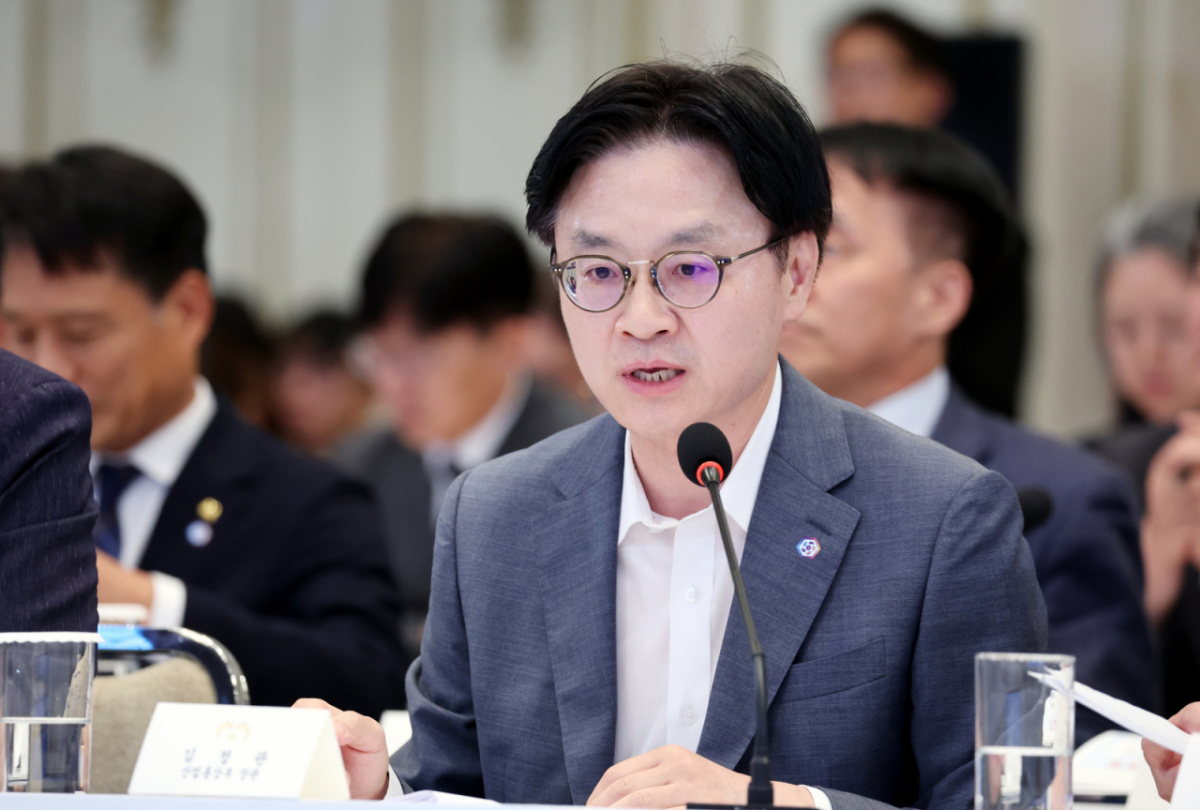
Kim Jeong-kwan, Minister of Trade, Industry and Energy, announced the results of the second joint government-business inspection meeting on the mega-project containing the above content at the State Council meeting on the 11th. Kim (Minister) stated, "In last month's first inspection meeting on the 6th, we discussed measures to accelerate the Yongin semiconductor project and decided on the Gwangju Air Force base site for the Honam semiconductor project." He added, "Yesterday (the 10th), we discussed mutual growth plans that allow large corporations, small and mid-sized companies, and so-bujang firms to participate together, as well as inspection and support plans for the progress of mega-projects by region."
The government plans to construct large-scale semiconductor factories in the Honam region through three major mega-projects and build artificial intelligence (AI) data centers with a total capacity of 18.4 gigawatts nationwide.
To ensure timely operation of the Gwangju semiconductor industrial complex, the government will push for the early relocation of the planned site, the Gwangju military airfield. Simultaneously advancing the temporary relocation of the Gwangju military airfield and the groundbreaking of the Mu'an military airfield, the plan is to complete the Mu'an military airfield as soon as possible to minimize the duration of the temporary relocation operation period.
To support the relocation of the military airfield, relevant ministries including the Ministry of Economy and Finance, Ministry of National Defense, Ministry of Land, Infrastructure and Transport, and Ministry of Planning and Budget are expected to actively implement necessary measures such as securing budgets and revising laws and regulations.
The development of the Gwangju national industrial complex will be completed by 2027 through preliminary surveys and exemption from preliminary feasibility studies. Construction will begin immediately upon transfer and handover of the military airfield site, with a target of first-phase completion in 2029.
The industrial complex will stably supply electricity and water using renewable energy and reclaimed sewage water. In addition to renewable energy and energy storage systems (ESS), combined heat and power and LNG generation will be included to support stable power supply. To accelerate the early construction of the power grid, efforts will be made to shorten the construction period of the 23rd-kilometer first-phase underground line connecting the Shinjangseong/Shin Gwangju substation to the industrial complex.
Power supply has been underway since last month for the general industrial zone where SK Hynix's factory will be built in the Yongin semiconductor cluster. The completion date for semiconductor factories in the general industrial zone has been advanced from the original 2045 to 2033, and for the national industrial complex (Samsung Electronics), from the original 2047 to 2039.
The plan is to supply 14.7 gigawatts of power corresponding to final electricity demand until the Yongin semiconductor cluster reaches its maximum production capacity in 2041, utilizing combined heat and power/LNG generation within the industrial complex and power from the central region, eastern coast, and Honam region. To achieve this, new short-distance lines will be constructed, and in the medium to long term, existing line capacities will be expanded.
The government also plans to promote measures to expand investments so that mega-projects can create an ecosystem where large corporations and SMEs (small and medium-sized enterprises) can thrive together.
A 5 trillion won semiconductor fund will be newly established to nurture semiconductor materials, components, and equipment companies and SMEs. The semiconductor fund will be created through capital contributions from large corporations, the Ministry of Trade, Industry and Energy's industrial growth fund, and matching with financial institutional investors. Additionally, through projects such as the "Growth Together" project with a scale of 1 trillion won over 10 years, R&D (research and development) support will be provided for major technology proposals from so-bujang firms, demonstration fab provision, and procurement-Yangsan linkages.
A 5 trillion won mutual growth trade finance fund will also be established for export-oriented so-bujang companies. Trade finance will be operated with a scale of 20 times the initial contribution, where demand-side large corporations and financial institutional investors contribute at least 250 billion won, and the Korea Trade Insurance Corporation (K-SURE) and others will manage it.
To activate physical AI (artificial intelligence), the government will take responsibility for creating initial demand. The plan includes significantly expanding public procurement of humanoid robots and quadruped robots, as well as establishing dedicated R&D for robot components. Along with the construction of large-scale AI data centers, support for a co-growth package will also be promoted.
The government plans to support the smooth progress of investment plans in the Chungcheong and Yeongnam regions. In the Chungcheong region, eight companies have announced an investment plan totaling 392 trillion won. To support the groundbreaking of six companies this year, the government is operating a High-Tech Strategic Industry Leap Forward Task Force (TF) for the Chungcheong region.
In the Yeongnam region, twelve companies have announced an investment plan totaling 312 trillion won. The plan is to begin groundbreaking for eight companies this year and complete them sequentially by 2028. The government will operate a Yeongnam Region Super-Differentiation Government-Business Joint TF to provide close support for the project.
To ensure the smooth progress of mega-projects, the government plans to establish an inter-ministerial support council and inspect necessary matters such as regulatory innovation and inter-departmental collaboration. The government will also promote the enactment and revision of relevant laws, including the Mega Special Zone Act.
Kim (Minister) said, "Starting with the joint government-business inspection meeting for mega-projects, all ministries including the Office of the President's Secretary for Economic Affairs and the Ministry of Trade, Industry and Energy will collaborate closely to continuously inspect and support the mega-projects to ensure their success."

 in ECONOMY
