

Despite the government's clear stance that operational decisions such as the distribution of corporate operating profits and the establishment of factories cannot become subjects of labor disputes, confusion persists on the ground. This is because the competent ministry, the Ministry of Employment and Labor, is judging the matter using 'administrative guidelines (administrative interpretations),' which are internal organizational standards without legal binding force. The reason for calls to present clear standards within 'laws and regulations' rather than temporary guidelines is to reduce on-site confusion.
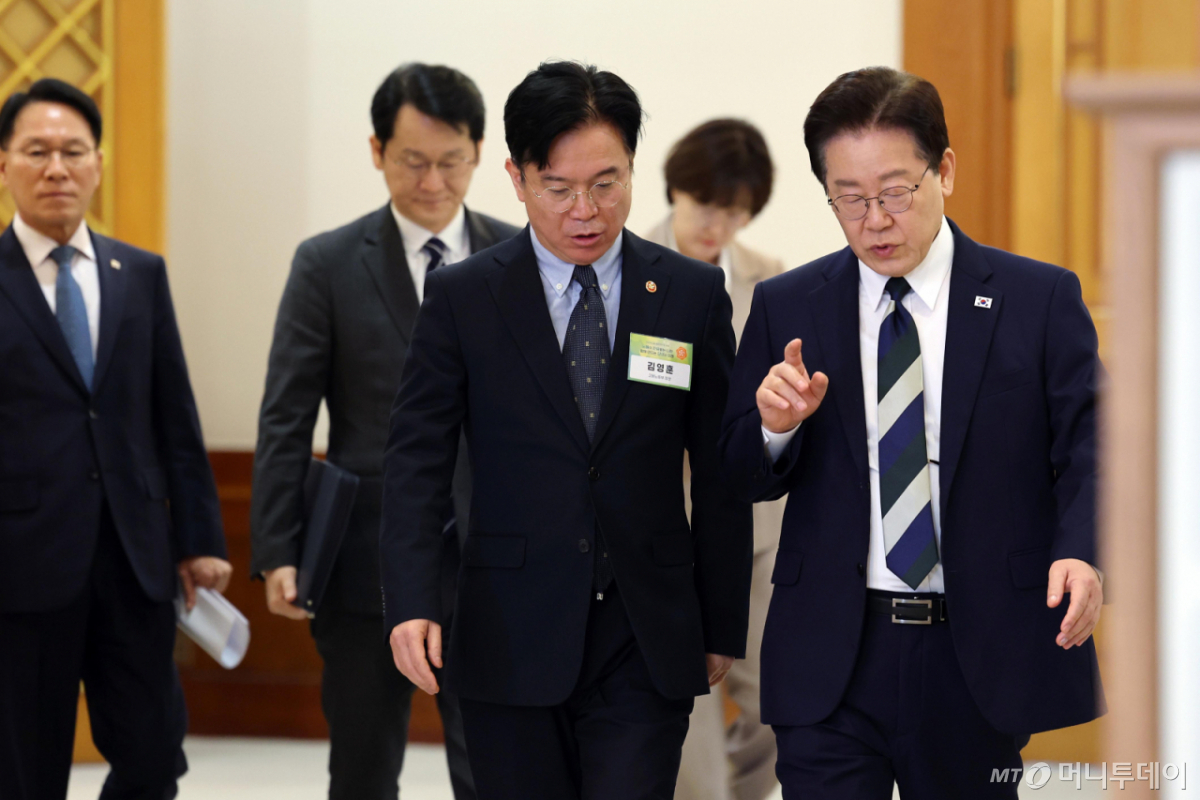
President Lee Jae-myung pointed out at a State Council meeting he chaired at the Sejong Government Complex on the 11th that there was criticism saying, "The Ministry of Labor has not created regulations," after he stated, "Shouldn't we establish clear provisions, such as specific cases, regarding whether something is subject to dispute under the Yellow Ribbon Act?"
Following the implementation of the Yellow Ribbon Act (an amendment to the Trade Union and Labor Relations Adjustment Act), some have argued that corporate operating profit distribution and the establishment of new factories should be subjects of negotiation and disputes with labor unions. In response, the Ministry of Labor has consistently maintained its position that operational decisions, which are inherent rights of companies, cannot in principle become subjects of dispute.
However, the Ministry of Labor's transmission of its stance and method of presenting standards remained merely 'administrative guidelines.' Administrative guidelines fall under 'internal administrative rules' rather than laws and regulations, including instructions, precedents, notices, and guidelines.
Unlike 'laws and regulations,' which possess external binding force such as laws enacted by the National Assembly and administrative legislation like presidential decrees, prime ministerial decrees, and ministry orders (enforcement decrees and enforcement rules), administrative guidelines are merely 'internal organizational standards' with only internal binding force. In principle, they have no legal effect that directly binds citizens or courts (the judiciary).
This is why President Lee pointed out that "providing interpretations and standards set by law are different," stating, "For example, saying 'this case is not a subject of dispute' via a Ministry of Labor order is entirely different from stating 'this is the Ministry of Labor's interpretation.'"
Until now, the Ministry of Labor has considered supplementing administrative guidelines instead of enacting enforcement decrees and rules with legal binding force, citing insufficient explicit delegation clauses in higher-level laws. While this was a measure taken considering the procedural burdens of enacting laws and limits on legislative delegation, these 'temporary measures' ultimately led to discrepancies with judicial rulings and increased legal uncertainty on the ground.
In response, President Lee criticized the Ministry of Labor's lukewarm response by citing the executive branch's constitutional authority to issue execution orders. President Lee stated, "Defining detailed matters necessary for the implementation of laws is within the executive branch's authority as defined by the Constitution, and it can be done for implementation even without explicit delegation, provided it does not contradict the law," and urged actively considering the establishment of clear standards in the form of legal orders such as Ministry of Labor orders.
It remains to be seen whether initiating the creation of specific standards at the level of laws and regulations (such as Ministry of Labor orders) pursuant to President Lee's instructions could partially resolve the tug-of-war between labor and management over whether operational judgments are subjects of dispute, as well as judicial risks. A Ministry of Labor official stated, "We have continued to consider the form regarding legal interpretations and standards," adding, "We will explore measures to minimize on-site confusion."

 in ECONOMY
