

The employment situation for young people (aged 15–29) is growing increasingly frozen. The employment rate has fallen while the unemployment rate has risen. The number of employed persons has declined for 45 consecutive months, heightening concerns over a deepening crisis.
According to the 'July 2026 Employment Trends' released by the National Data Administration on the 12th, the number of employed individuals aged 65 and older increased by 333,000 compared to the same month last year, while those aged 15–64 decreased by 226,000. The employment rate for those aged 15 and above (63.3%) recorded the second-highest level in history, while the labor force participation rate (65.0%) and the employment rate for those aged 15–64 (70.3%) both reached record highs.
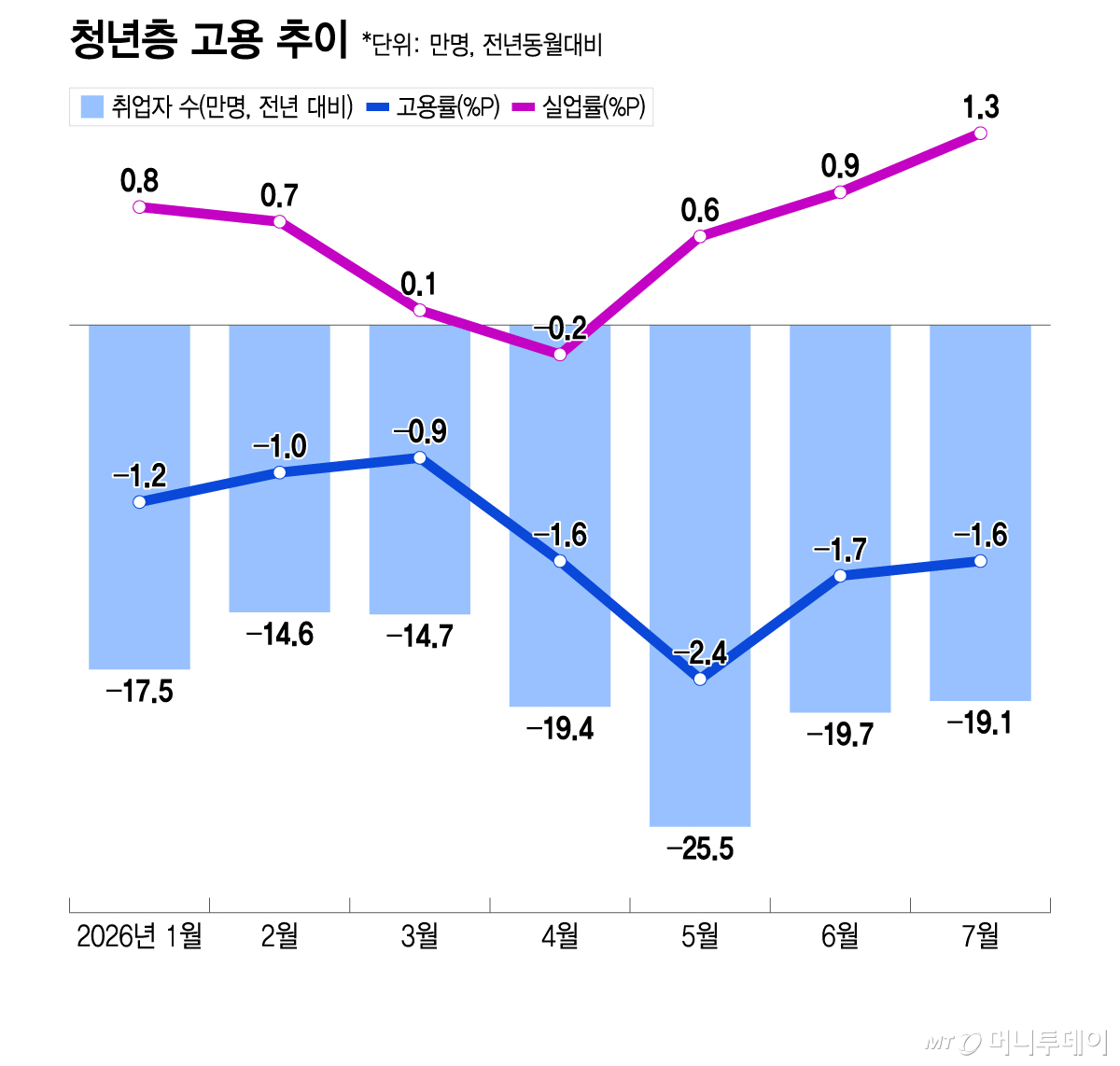
Employment indicators for youth continue to deteriorate. The employment rate (44.2%) has fallen for 27 consecutive months since May 2024, and the number of employed persons (-191,000) has declined for 45 consecutive months.
The number of unemployed youth increased by 41,000. The unemployment rate is now at its highest level since July 2022 (6.8%). Notably, the unemployment rate rose by 1.3 percentage points—the largest increase since January 2021 (1.8 percentage points).
Kim Byun-hoon, head of the Social Statistics Bureau at the Data Administration, stated, "The expansion of public sector recruitment—including civil service exams, tax arrears management teams, land surveyors, and public interns—has contributed to the rise in youth unemployment." He added, "The four-month consecutive increase in new job postings on Worknet has also had an impact."
The number of youth classified as 'resting'—those not actively seeking jobs and taking a break without special reasons—has declined for six consecutive months. According to the Ministry of Economy and Finance, among the youth population, the combined share of 'unemployed,' 'job seekers,' and 'resting' individuals was 13% (1.012 million) in July, lower than the 2021–2025 average of 13.8%. This reflects a significant drop of approximately 69,000 in the 'resting' youth category.
Despite the decline in the 'resting' youth population, the youth unemployment rate has risen because some young people who were previously outside the labor market have begun job-seeking activities and are now classified as unemployed. This can be interpreted as an increase in the number of people seeking jobs despite a lack of available positions.
The government emphasizes that even if the unemployment rate rises, it is crucial to prevent these individuals from losing motivation for economic activity or labor participation and giving up entirely. Government policies are also being directed toward increasing labor demand while encouraging youth to enter the labor market from the supply side.
Meanwhile, the government had planned to announce 'Youth Job Recovery Measures' at a State Council meeting held on the 11th but suddenly postponed it. Reports indicate there was a shared understanding that in light of worsening youth indicators, more refined and tangible policies—rather than rigid, formulaic ones—should be introduced. The government plans to unveil concrete measures by the end of this month, including specific plans from the second-half economic growth strategy such as training 200,000 workers and creating 300,000 jobs in both private and public sectors.

 in ECONOMY
