

The government, which has taken steps to improve its tax reform plan, is now seeking expert opinions. Experts voiced concerns that under the government's proposed tax reform, non-residents owning a single home would face significantly increased tax burdens.
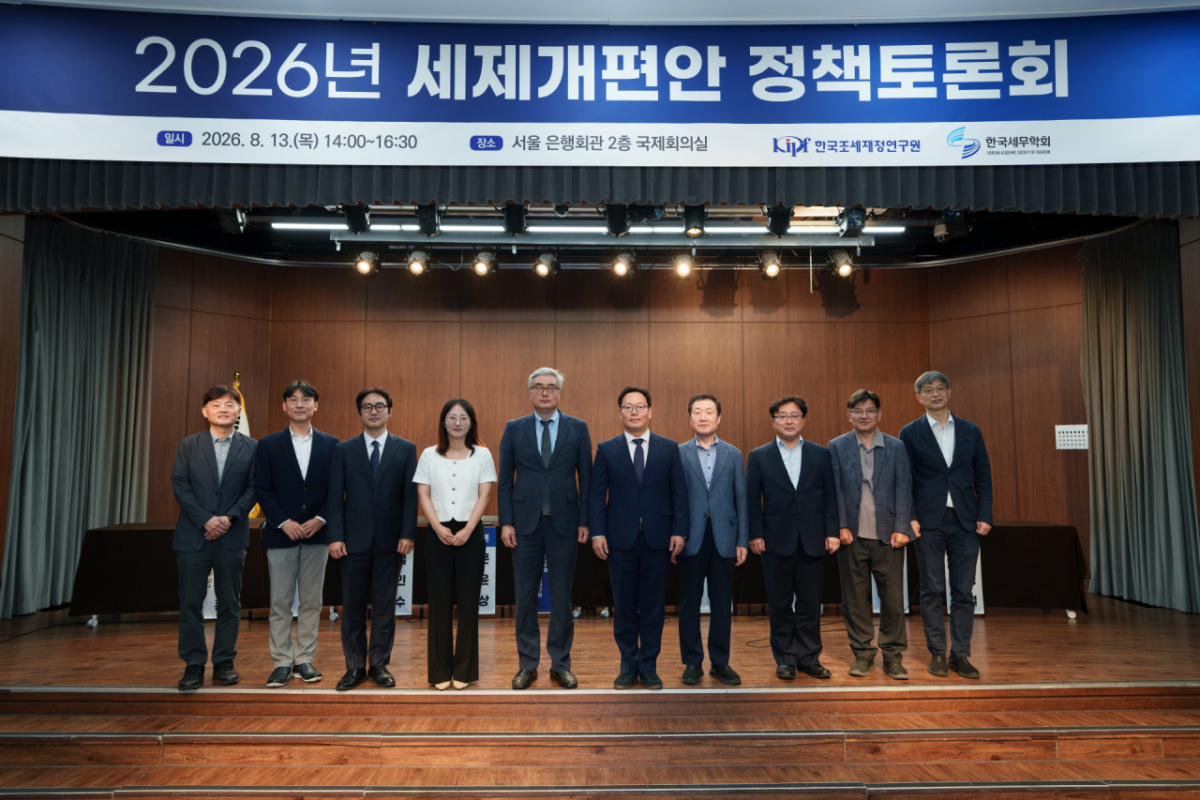
On the afternoon of the 13th, the Korea Institute of Fiscal and Debt Management held a '2026 Tax Reform Policy Seminar' at the Bankers Hall in Seoul Myeong-dong.
The government plans to submit a revised version to the National Assembly early next month, incorporating public opinions received during the legislative notice period for the tax reform plan announced on the 3rd. As of 2 p.m. today, the National Participation Legislation Center has received over 8,600 comments on these bills alone: 5,875 regarding amendments to the Comprehensive Real Estate Tax Act and 2,769 regarding amendments to the Income Tax Act.
Concerns about real estate tax reform continued at the seminar today. A key issue is 'non-resident single-homeowners,' whose tax burdens would increase significantly under the proposed tax reform plan.
Moon Yoon-sang, head of the Real Estate Research Team at the Korea Development Institute (KDI), stated, "It is not easy to determine whether a property is occupied or unoccupied, or whether it is used by an actual resident." He added, "While changing the long-term holding special deduction for capital gains tax into a long-term residence tax credit makes it possible to provide deductions based on how many years the owner actually lived in the home after the fact, applying residency requirements prospectively could cause confusion."
He further noted, "If we ease the comprehensive real estate tax by applying residency requirements beforehand, there may be confusion. Since residency requirements will be included when granting basic deductions, there is room for debate over whether a residence registration submitted just one day ago would be accepted."
Suggestions were also made regarding the reform of the long-term holding special deduction.
Lee Jung-gyo, a law professor at Yonsei University, said, "The purpose of the long-term holding special deduction for capital gains tax, which preserves nominal value increases for those who have held properties for a long time, should be preserved to some extent." He added, "It may be necessary to adjust the ratio to 20% for ownership and 60% for residency during the one-year grace period." The professor also stated that the deduction limit of 1 billion won needs to be raised.
There were also voices expressing concern about side effects from strengthening tax burdens on so-called 'ultra-high-value homes,' another target of this tax reform plan.
Kang Sung-hoon, a professor at Hanyang University, said, "As holding taxes are strengthened primarily for ultra-high-value homes, instability could arise in the rental market." He added, "Additionally, a so-called balloon effect may occur where homes below ultra-high-value properties face upward price pressure."
Criticism was also raised regarding tax policies that change completely with each administration. The professor stated, "Expectations when acquiring a home under changed tax laws are not legally protected." He continued, "Even if the government cannot legally protect the expectations of transaction parties, it should adopt an attitude aimed at protecting those expectations to some extent when formulating policies."
Kim Byung-cheol, Chief Policy Officer for Taxation at the Ministry of Economy and Finance, said, "Many opinions are being submitted regarding reasons that should be recognized as residency even in cases of unavoidable circumstances." He added, "We will strive to reflect reasonable opinions when revising the Enforcement Decree."
Meanwhile, at today's seminar, opinions were also raised regarding the revision of ISA (Individual Comprehensive Asset Management Account) and the Stock Price Suppression Prevention Act, which were ordered for review by President Lee Jae-myung.
Oh Jong-moon, a professor in the Department of Accounting and Taxation at Dongguk University, argued that the eligibility requirements for ISA should be abolished entirely. He criticized the government's rationale for preparing this revision to check whether individuals are subject to comprehensive taxation on financial income every five years. Oh stated that ISA was introduced to help citizens grow their assets, and even those classified as subject to comprehensive taxation on financial income often have relatively low actual incomes. He advocated abolishing eligibility requirements similar to those in the UK and Japan.
The professor said, "As of 2023, among the 330,000 individuals subject to comprehensive taxation on financial income, slightly more than 30%—over 100,000 people—had remaining income (excluding interest and dividends from financial income) below 1 billion won." He added, "This group mainly consists of retirees."
The policy officer stated regarding the ISA revision, "We aim to gather opinions during the legislative notice period and prepare a reasonable plan."

 in ECONOMY
