

Education grants viewed from the perspective of the Ministry of Planning and Budget
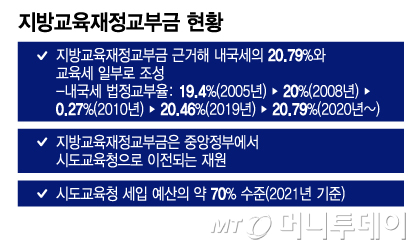
From the perspective of fiscal authorities, the Local Education Fiscal Grant is an unusual 'budget pocket.' It automatically allocates 20.79% of domestic taxes regardless of tax revenue conditions. In terms of a household budget analogy, it is similar to automatically transferring 20.79% of one's monthly salary into an education account, no matter how much income comes in.
In the past, this structure posed no problems whatsoever. During a period when educational demand exploded, with schools operating morning and afternoon shifts, the linkage between domestic taxes and education grants was actually a virtue. The institutional mechanism that ensured stable acquisition of education budgets was precisely the education grant system.
However, the situation has changed. Most significantly, the number of students has decreased sharply. Over the past decade, the school-age population has declined by 1.75 million. During this period, education grants increased by approximately 40 trillion won (78%). As tax revenues inevitably trend upward with economic growth, education grants have consequently risen as well.
Moreover, education grants are trapped in a 'partitioned structure.' Since they are utilized as budgets for local education offices, they cannot be used for universities and lifelong education programs that fall outside the jurisdiction of these offices.
Consider this scenario, similar to what Kim Hak-soo, senior researcher at the Korea Development Institute (KDI), mentioned during last month's education grant reform seminar: Assume a parent has two high school children attending private academies.
Automatically transferring academy fees monthly is not strange at all. However, it would be odd if one child graduates from high school and no longer needs to pay academy fees, yet the automatic transfer amount increases simply because the salary has risen.
The situation becomes even more complicated when performance bonuses are received. Regardless of base salary, an additional 20.79% of the performance bonus must be automatically transferred for academy fees. Under current law, excess tax revenues become education grant allocations at a rate of 20.79%. With expectations of large-scale excess tax revenue this year, education grants are projected to surge dramatically.
The increased amount automatically transferred for academy fees cannot be used for university tuition for children who have now become college students. While this may seem like an extreme analogy, it is a problem that the Ministry of Planning and Budget, responsible for managing the national household budget, cannot afford to ignore.
Park Hong-geun Gi Hoek-cheo (Minister) stated on the 13th, "As fiscal authorities, we have a responsibility to efficiently allocate limited national resources, which is why we are raising concerns about the domestic tax linkage structure."
Various alternatives are being discussed. A bill has also been proposed that would calculate education grants by reflecting economic growth rates, inflation rates, and changes in the school-age population, while setting the lower limit of education grants at 95% of the previous year's budget amount. The Ministry of Planning and Budget maintains its position that education grants will not be reduced compared to current levels, regardless of the method adopted.
Combinations utilizing a future response fund for excess tax revenues are also under review. The Ministry of Education fundamentally opposes abolishing the domestic tax linkage structure.
The Ministry of Education appears to accept breaking the partitioned structure to some extent. The Ministry of Planning and Budget and the Ministry of Education are currently conducting final negotiations. The results of these negotiations are expected to be released soon.
Education grants viewed from the perspective of the Ministry of Education
"If the domestic tax linkage rate for Local Education Fiscal Grants (grants) is abolished, can the Gyeonggi Provincial Office of Education maintain its Education Rights Protection Bureau next year to pursue 'true education'? I believe it will not be easy as budgets become tighter."
Lee Sun-ho, future education Yeon Gu-bon-bu (Head) at the Korea Educational Development Institute, stated, "Abolishing the domestic tax linkage rate aims to reduce grants," and added, "Projects necessary in each region will be scaled back."
A prime example is the specialized organizations for protecting educational rights that have recently been established across various education offices following the recent drama 'True Education.' The Gyeonggi Provincial Office of Education was the first to act, completing the selection of 300 dedicated officials for educational rights protection just two months after Governor An Min-seok announced his intention to establish the organization. In contrast, the Ministry of Education, which must undergo budget review by the central government, has been 'considering' establishing a dedicated team for educational rights protection for two months now. Beyond differences in job classifications, there is a clear disparity in the speed and autonomy of education policies depending on where budget authority lies.
Beyond this, education office-specific policies are diversifying, including ONLINE schools operated in mountainous and island regions with many remote areas to prevent regional extinction, after-school activity support, and assistant teachers to improve basic academic skills. If the Ministry of Planning and Budget's proposal is adopted—calculating necessary budgets by factoring school-age population into formulas—these supplementary projects for socially vulnerable groups are most likely to be cut first. Director Lee pointed out, "The educational gap between areas with many students and those with few will widen further," and noted, "We sacrifice too much value for fiscal efficiency."
In the education sector, it is also explained that personnel cost increases for civil servants and educational public employees have reached 3%, resulting in an annual increase of 2.5 trillion won just in personnel costs alone. Although Park Hong-geun Gi Hoek-cheo (Minister) stated that even if the linkage rate is abolished, "the total amount of grants will not decrease compared to previous years," the total grant amount should increase if the government pays only legitimate salaries. As the government implements the high school credit system, demand for secondary school teachers has increased. Additionally, with the introduction of free school meals, extended care programs, and student psychological counseling, educational public employees such as Jo Lisa, extended care practitioners, and professional counselors have all become burdens on the grants.
The National Assembly Legislative Research Service's report 'What is the Future of the Local Education Fiscal Grant System?' published last October also stated that an average annual ordinary grant fiscal demand of at least approximately 90 trillion won will be needed over the next decade. This year's total grant amount is 76.4381 trillion won (reflecting the first supplementary budget), and even if it exceeds 80 trillion won due to a semiconductor boom, it remains insufficient. In reality, education offices are drawing funds from reserves to cover shortfalls, resulting in actual usage exceeding 80 trillion won this year. Furthermore, the Ministry of Education is adding the 'Artificial Intelligence (AI) for All' project starting at the elementary level, meaning next year's budget must increase further.
An education office official pointed out, "If budgets become tight, we cannot reduce personnel costs, so school facility expenses will likely be cut first," and warned, "Children's educational environments could become hazardous." There are 8,461 school buildings nationwide that have been constructed more than 40 years ago, with approximately 1.5 trillion won in reconstruction and remodeling budgets being invested annually.

 in ECONOMY
