

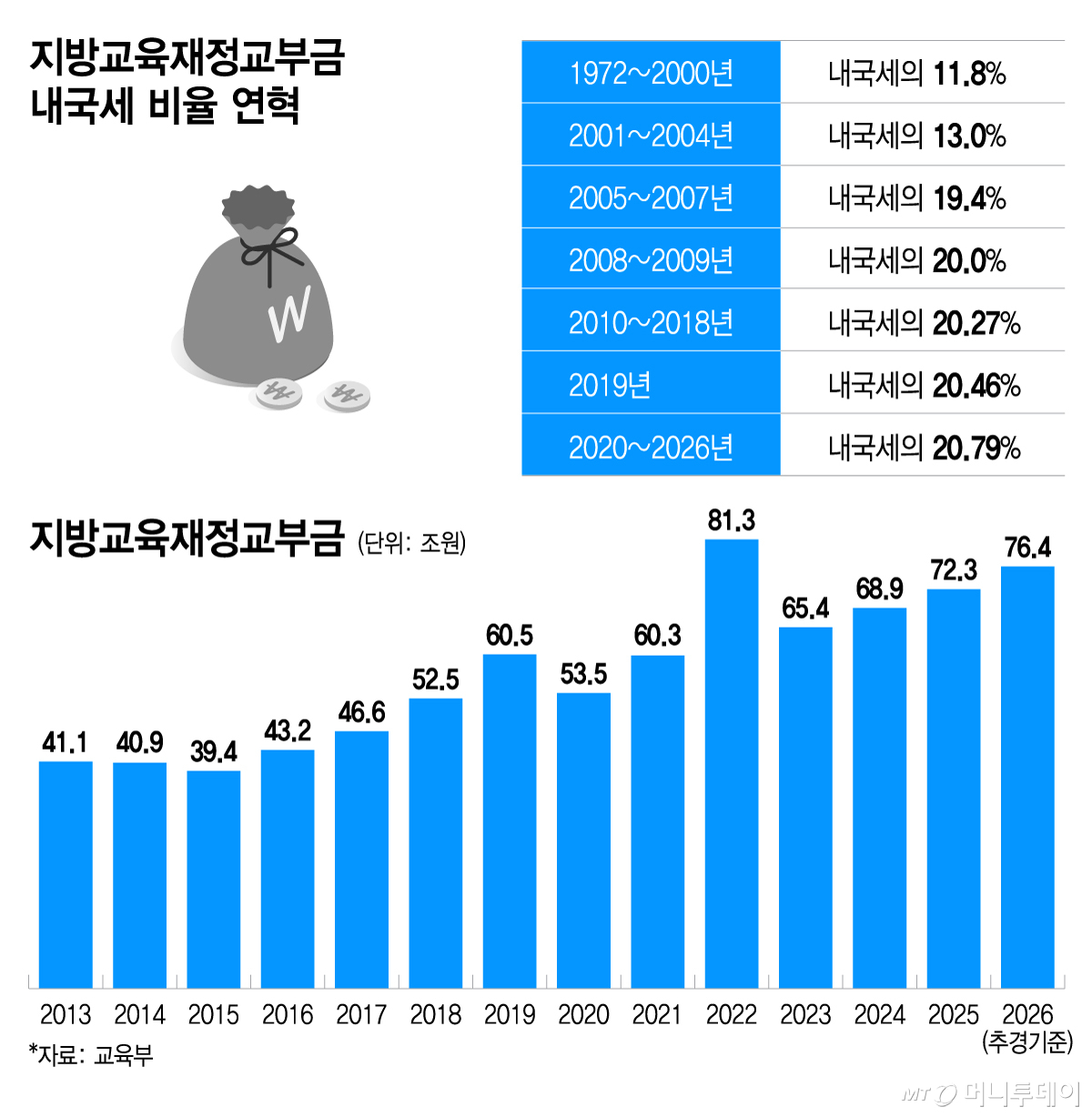
The government has decided to abolish the structure linking the National Education Fiscal Grant (education grant), which has been maintained for 54 years, to domestic taxes.
Plans are also underway to dismantle the "barrier" of education grants by utilizing surplus tax revenues for a future response fund. However, final negotiations have been fraught with difficulties as the Ministry of Planning and Budget and the Ministry of Education hold divergent positions on the details. Consequently, the release of the reform plan has been delayed beyond initial expectations.
According to relevant ministries on the 16th, the Ministry of Planning and Budget and the Ministry of Education are in final negotiations over the education grant reform plan. It is expected that the domestic tax linkage structure, which was a core issue, will be abolished, and a new formula for calculating education grants reflecting economic growth rates and school-age population will be introduced.
Education grants are budgets allocated to local education offices, funded by 20.79% of domestic taxes and part of the education tax. When the domestic tax linkage structure for education grants began in 1972, the grant rate was only 11.8%, but it has steadily risen since then to reach the current level of 20.79%.
The Ministry of Planning and Budget maintains that the domestic tax linkage structure must be abolished given the declining school-age population. The Ministry of Education, which has consistently argued for maintaining this structure whenever education grant reform discussions have arisen, has now decided in principle to agree to its abolition.
Accordingly, the two ministries are currently discussing a new formula for education grants that reflects growth rates and the school-age population. Choi Gyo-jin, Minister of Education, stated on the 14th at the National Assembly Education Committee: "There has been significant agreement regarding the formula on which approach would reduce volatility more and ensure substantive support."
However, another aspect remains at an impasse. It is reported that the Ministry of Education requested that while abolishing the domestic tax linkage structure, a legal safety clause be explicitly written to ensure the total amount of education grants under the current '20.79% rule' is consistently secured each year.
Furthermore, positions diverge on how to utilize the future response fund planned for establishment using surplus tax revenues. The Ministry of Planning and Budget plans to create a "Talent and Education Account" within the future response fund and allocate it to higher (university) education and lifelong learning, areas previously inaccessible to education grants.
Since education grants are budgets managed by local education offices, they could not in principle be used for higher or lifelong education outside their jurisdiction. However, contrary to the Ministry of Planning and Budget's plan, the Ministry of Education is demanding that the future response fund also be usable for elementary and secondary education.
As the two ministries have failed to reach a final agreement, it remains uncertain whether the education grant reform plan will be finalized at all, or even if finalized, whether it can be completed before the government's budget proposal is submitted to the National Assembly in early September. The Ministry of Planning and Budget had originally planned to finalize the reform plan by mid-month.
A Ministry of Planning and Budget official stated: "Negotiations on the details are continuing."

 in ECONOMY
