

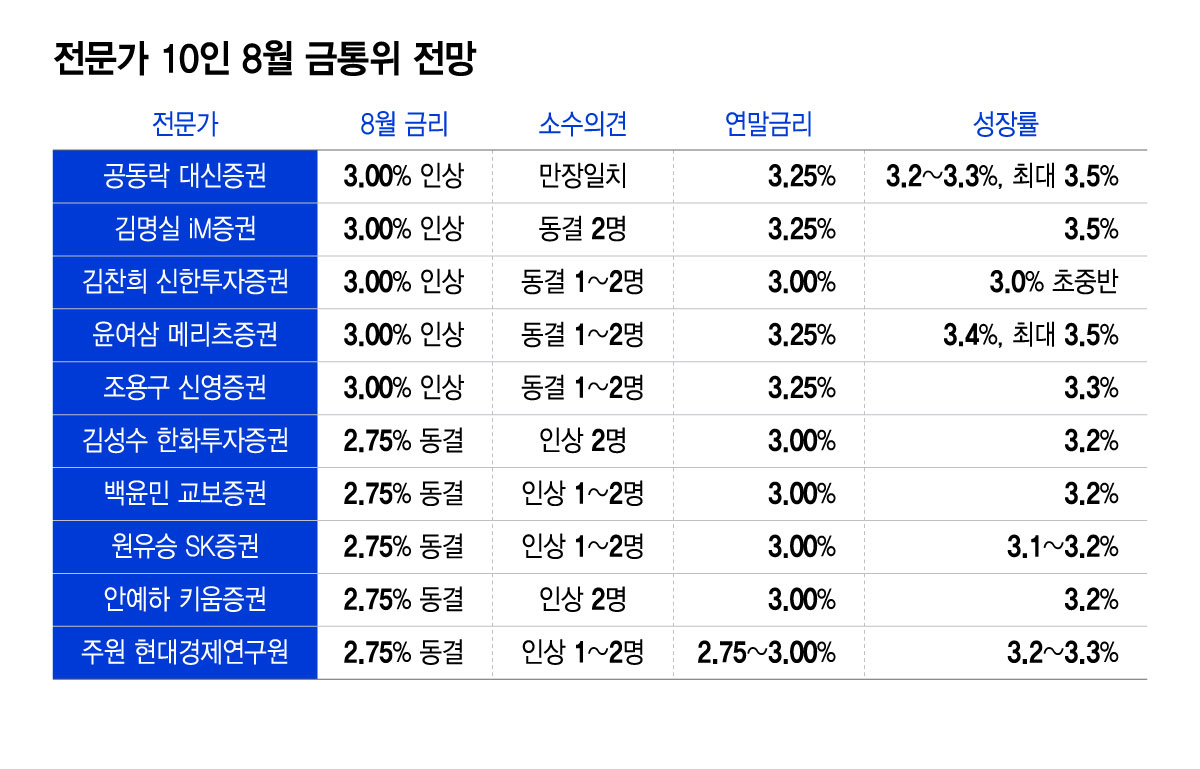
Market forecasts are sharply divided on whether the Bank of Korea will raise its base rate for a second consecutive month this month. While some argue that proactive measures are needed to address growth and inflation pressures, others contend that with recent inflation and exchange rates stabilizing, the effects of the July hike should be confirmed first. However, even among those expecting a hold, most anticipate an additional rate increase in the fourth quarter, leading to a prevailing forecast that the year-end base rate will reach 3.0% to 3.25%.
According to a survey conducted by MoneyToday on the 23rd involving 10 economic and bond market experts, five predicted that the Bank of Korea's Monetary Policy Board would raise the base rate from an annual 2.75% to 3.0%, an increase of 25bp (1bp=0.01 percentage point). The remaining five expected the rate to be held at an annual 2.75%.
It is also observed that opinions within the Monetary Policy Board will likely be sharply divided. Among the experts who forecasted a hike, only Kwon Dong-rak, an economist at Daishin Securities, anticipated a unanimous decision. The other four expected one to two dissenting votes in favor of holding the rate. All five experts who predicted a hold also forecasted that one to two members would express a minority opinion in favor of a hike.
Proponents of a hike cited faster-than-expected economic recovery, demand-side inflationary pressures, and financial stability risks such as real estate and household debt as common grounds.
Economist Kwon Dong-rak stated, "The conditions of the real economy are improving so rapidly that they are significantly raising growth rate forecasts," adding, "Export growth rates have consistently remained at high levels exceeding expectations, and domestic indicators are also improving consecutively." He forecasted an additional increase in the fourth quarter and first quarter of next year following the August hike, projecting a final interest rate reaching 3.5%.
Economist Kim Myeong-sil from iM Securities said, "With growth fundamentals taking shape, demand-side inflationary pressures are high, and international oil prices have recently risen again," noting, "There are also risks regarding financial stability such as real estate prices, necessitating a proactive rate hike." Economist Kim also forecasted 3.25% by year-end and 3.5% in the first quarter of next year.
Meritz Securities economist Yoon Yeo-sam said, "Looking only at current inflation, it is difficult to see an urgent need for consecutive hikes, but there is a high possibility of proactively responding to future risks such as war and oil prices," adding, "I expect rates to be raised once more in November and the first quarter of next year following the August increase."
Shinyoung Securities economist Jo Yong-gu stated, "Considering that both gross domestic product (GDP) and gross domestic income (GDI) were strong, it is appropriate to bring forward a rate hike," forecasting, "Rates will be raised in August; even if they are paused in October, the base rate will reach 3.25% by year-end through an additional increase in November."
Shinhan Investment Corp economist Kim Chan-hei said, "There is too much uncertainty to wait until October, so a proactive response in August would be more convenient from the perspective of monetary policy management," while also stating, "I expect that after one hike this time, rates will be held until year-end."
On the other hand, proponents of holding the rate pointed out that given the recent stability in inflation and exchange rates, there is no urgent need to tighten policy by raising interest rates for two consecutive months. They explained that time is also needed to observe the effects of the July rate hike on household loans and the real estate market.
Hanwha Investment & Securities economist Kim Sung-soo said, "Looking at inflation in June and July, it appears we have passed the peak, and inflation conditions are not expected to worsen further," adding, "Since the effects of the July rate hike have not yet been reflected in indicators, the Bank of Korea needs time to observe." He continued, "It is also uncertain whether a semiconductor boom or stock market asset effects will significantly boost overall consumption," forecasting a hold in August followed by an increase in October.
Kyobo Securities economist Baek Yun-min stated, "Considering the recent downward trends in inflation and exchange rates, it is not urgent enough to raise interest rates consecutively," confirming, "I maintain my previous forecast that rates will be held in August and increased additionally in October."
Kiwoom Securities economist Ahn Ye-ha also said, "Although back-to-back hikes are being discussed, the exchange rate has fallen more than expected, so inflationary pressure has not immediately risen," adding, "While maintaining a hiking trend, there is a high possibility of sending signals through minority opinions in favor of a hike."
Won Yu-seung, an economist at SK Securities who predicted a hold in August, said, "Market interest rates are more influenced by the median of forward guidance for the next six months than by this base rate decision," noting, "Even if held, if the median rises to 3.5%, it could become an additional factor for rising market interest rates."
Generally, there was consensus in the market that there is a high possibility of additional rate hikes independent of the August decision. Regarding the year-end base rate, five experts projected 3.0% and four projected 3.25%. Joo Won of the Korea Institute for Economic Research Gyeong Je-yeon-gu (Head) noted that since the Federal Reserve System (Federal Reserve) is unlikely to raise its base rate rapidly, he expects rates to remain at current levels through year-end or see at most one additional increase.
In the revised economic outlook released alongside the interest rate decision, the prevailing forecast was that this year's growth rate would be significantly raised from the previous 2.6% to between 3.2% and 3.5%. While the headline consumer price inflation forecast is expected to remain largely at the previous 2.7%, the core inflation forecast is expected to be revised upward by 0.1 to 0.2 percentage points to reflect demand pressures from economic improvement.

 in ECONOMY
