

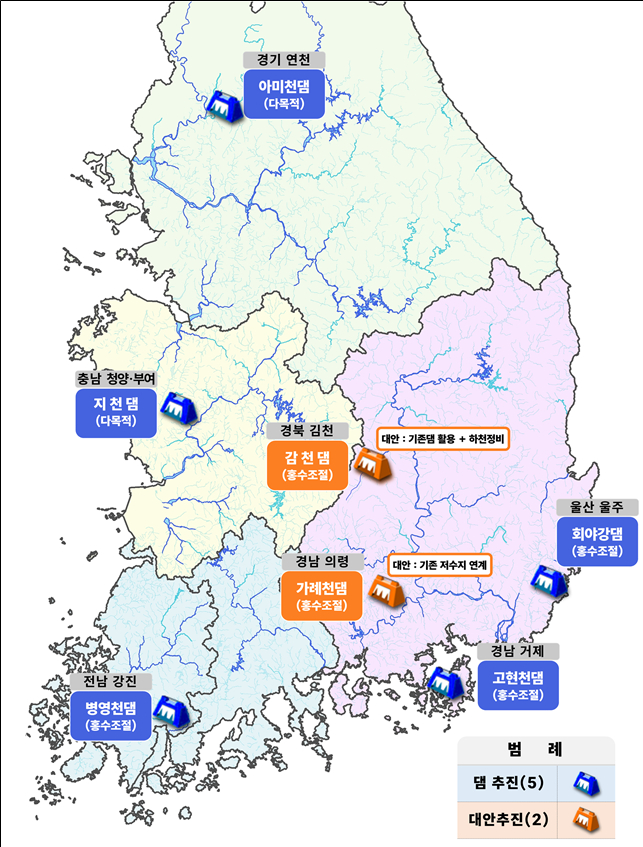
As extreme rainfall becomes more frequent due to climate change and the need for water resource management grows with the establishment of new semiconductor factories in the Honam region, construction of five new dams capable of securing a total water reservoir capacity of 130 million tons is being pursued.
These are sites deemed necessary based on a review of 14 new dam projects initiated under the Yoon Suk-yeol administration, where the need for flood and drought preparedness and new water supply through mega-projects was judged essential. Previously, construction of seven new dams was halted, and plans remain to explore alternatives for the remaining two new dams.
The Ministry of Climate, Energy and Environment announced on the 27th that it has decided to proceed with the construction of five dams among the seven sites re-evaluated for necessity: Jicheon Dam (Cheongyang/Buyeo), Amicheon Dam (Yeongcheon), Byeongyeongcheon Dam (Gangjin), Huiyanggang Dam (Ulsan), and Gohyeoncheon Dam (Geoje). For Gamcheon Dam (Geumcheon) and Garichon Dam (Uiyeong), the ministry has decided to pursue effective alternatives.
Previously, in July 2024, the Ministry of Environment under the Yoon Suk-yeol administration announced plans to construct 14 new dams aimed at addressing climate crises. However, as controversies over the flood and drought prevention effects of new dams persisted alongside conflicts among local residents, the Ministry of Climate, Energy and Environment launched a detailed re-evaluation of the feasibility of pursuing new dam projects after the Lee Jae-myung administration took office.
As a result of the re-evaluation, construction was cancelled last September for seven of the 14th new dams deemed to have low necessity and strong local opposition: Suyeopcheon Dam, Danyangcheon Dam, Okcheon Dam, Dongbokcheon Dam, Sanggicheon Dam, Unmuncheon Dam, and Yongducheon Dam. For the remaining seven dams, where public opinion was divided or further alternative review was needed, the decision on whether to proceed was finalized after expert-led public deliberation and conceptual planning.
The five dams for which project implementation has been decided share common characteristics: high necessity for water management in their respective regions and the need to respond to new water demand. The total reservoir capacity of these five dams is 128 million tons.
Jicheon Dam will be built as a multipurpose dam due to emerging new water demands from mega-projects in the Chungcheong region, among others. The Jicheon Dam Public Deliberation Committee determined that considering water shortages in the Geum River basin and additional demand from Chungcheong mega-projects, Jicheon Dam would not only serve as a new water source but also aid flood defense in Cheongyang and Buyeo areas, which have been designated as special disaster zones for four consecutive years.
If the 59th million ton reservoir capacity of Jicheon Dam is constructed, it can supply 180,000 tons of water daily to the Geum River basin, including Cheongyang and Buyeo. It is expected to be capable of responding even to maximum rainfall with a 100-year recurrence interval experienced in 2023.
Amicheon Dam, which was reviewed due to recognized necessity for flood countermeasures, will be built as a multipurpose dam to defend against urban flooding in Yeongcheon city while also meeting water demand in the Imjin River basin areas such as Yeongcheon and Paju, which lack their own water reservoirs. The total reservoir capacity is 45 million tons.
If Amicheon Dam is constructed, it can supply 80,000 tons of water daily to Yeongcheon and Paju in the Imjin River basin and enable response to 100-year frequency floods for Yeongcheon city, which frequently suffers damage from heavy rainfall.
Byeongyeongcheon Dam will be newly constructed below the existing dam to ensure safety of the downstream Byeongyeongcheon. It is planned to be built at a level capable of responding to maximum rainfall recorded in September 2024. For Huiyanggang Dam, sluice gates will be installed at the existing Yeosu dam site to secure a flood control capacity of 8.1 million tons.
In Geoje City, which recently suffered significant damage including river flooding due to extreme rainfall, Gohyeoncheon Dam will be raised and sluice gates installed to strengthen flood control functions, securing a maximum flood control capacity of 620,000 tons.
For Gamcheon Dam, where alternative implementation was decided, the ministry agreed to follow the Public Deliberation Committee's proposal that it would be more effective to maximize utilization of the nearby Geumcheon Buhang Dam (multipurpose dam) rather than constructing a new dam, while concurrently carrying out river improvement works.
For Garichon Dam, which had planned to raise an existing agricultural reservoir, the ministry decided to pursue alternatives more effective than raising the reservoir. It plans to secure flood control capacity capable of responding to 100-year frequency floods through coordinated operation with the nearby Gami Reservoir, connected via existing water tunnels.
As a result, among the 14th new dam plans, seven dams have been halted, two will pursue alternatives, and five are confirmed for construction. The estimated project cost required for constructing all 14 dams was 475 billion won, but this has been significantly reduced to approximately 167 billion won following the results of this re-evaluation.
The Ministry of Climate, Energy and Environment plans to finalize the five new dam projects after completing legal procedures including preliminary feasibility studies, feasibility studies, and strategic environmental impact assessments.
Separate from new dam construction, there are plans to actively identify new water reservoirs to respond to recent extreme floods and droughts. The dam operation system, currently segmented by purpose, will be comprehensively reorganized under integrated management to strengthen flood control capabilities of agricultural dams and power generation dams.
Kim Sung-hwan Gi Hu-bu (Minister) stated, "We plan to share the review results and future plans regarding seven new dams with local communities and provide sufficient explanations to residents." He added, "We will prepare optimal utilization methods for water resources, including new dam construction, to reduce flood and drought damage and ensure timely water supply to national advanced industrial complexes."

 in ECONOMY
