

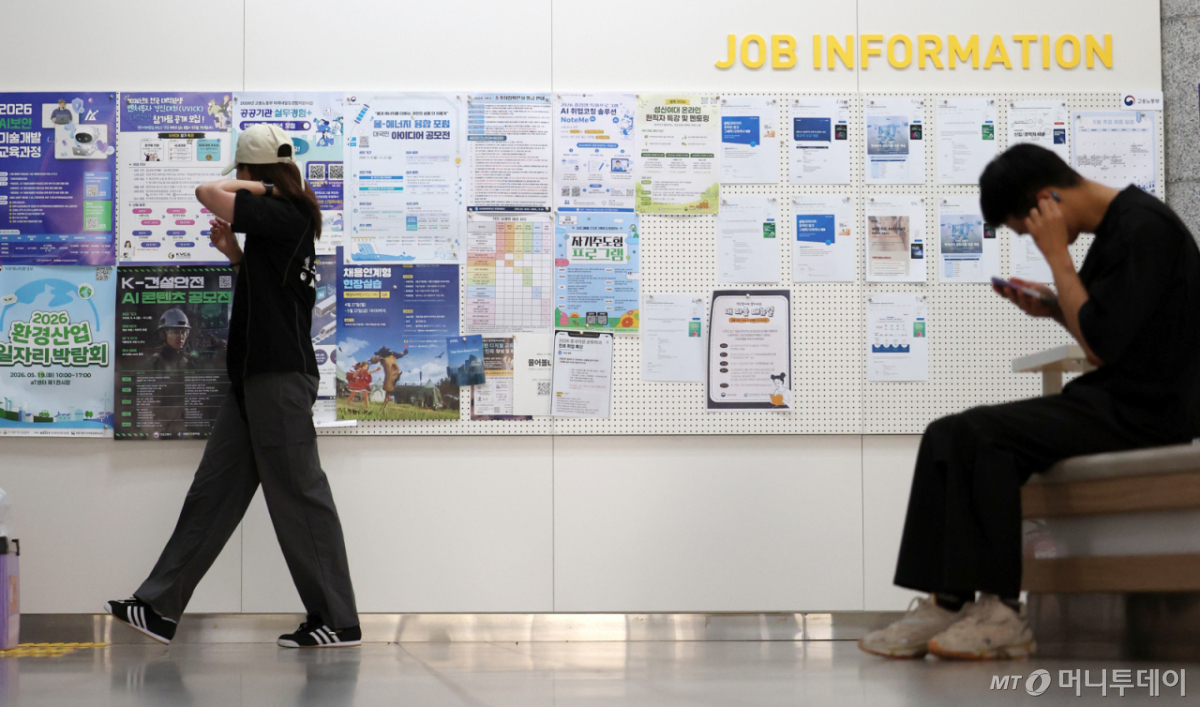
The government unveiled a comprehensive youth employment strategy that links support from job preparation through labor market entry to career growth. Young people who secure jobs at local SMEs (small and medium-sized enterprises) will receive linked support programs designed to increase their monthly income by up to approximately 100 thousand won over two years. Those participating in vocational training will be supported not only for employment but also for career management and growth.
Relevant ministries, including the Ministry of Economy and Finance and the Ministry of Employment and Labor, announced the 'Youth Job Recovery Plan' on the 28th. The government plans to support the entire cycle of youth employment—job preparation, hiring, and career growth—with the goal of improving the youth employment rate and reducing the number of "NEET" (not in education, employment, or training) youths. The youth employment rate fell from 46.6% in 2022 to 45.0% in 2025, dropping further to 43.6% in the first half of this year.
Under this plan, the scale of support for young people through the Youth Job Growth Incentive will expand from a maximum of 7.2 million won over two years to a maximum of 18 million won. The target group for youth support, previously focused on those employed outside the capital region, will be expanded to include those employed in the Seoul metropolitan area. Corporate support will also be broadened: companies that hire young people who have completed job competency programs will receive incentives whether they are mid-sized companies in the capital region or large corporations outside the capital region.
Support for young people employed at local SMEs (small and medium-sized enterprises) will also be strengthened. A preferential track for employees of local SMEs will be newly established in the Youth Future Savings Account, with the government's matching contribution rate increased from 12% to 25%. The Youth Culture and Arts Pass will expand its target age range from 19–20 years old to 19–34 years old and allow usage annually instead of just once in a lifetime.
Through these measures, the government plans to support young people employed at local SMEs (small and medium-sized enterprises) so that their income increases by up to approximately 100 thousand won per month during the first two years of employment.
This is achieved by combining benefits: up to 750,000 won per month from the Youth Job Growth Incentive, up to 200,000 won per month from the Youth Future Savings Account, and approximately 10,000 won per month from the Youth Culture and Arts Pass. Rather than directly paying 100 thousand won per month as a single allowance, the government links various support programs to supplement young people's income and living conditions.
Training for personnel in advanced industries will also be significantly expanded. By 2030, the government aims to train more than 300,000 specialists in advanced industries such as AI and semiconductors, as well as fields preferred by young people. Next year, it plans to train approximately 80,000 more people than this year. This includes training for 20,000 individuals in vocational programs, 12,000 high-level professionals with master's or doctoral degrees, and 7,000 practical workers from vocational high schools and polytechnic colleges.
Youth New Deal projects such as the K-New Deal Academy and university boot camps will also be expanded. The K-New Deal Academy, which expands participation by large corporations, foreign companies, and financial institutional investors, will increase its target from 10,000 people this year to 50,000 next year. University boot camps will grow from approximately 13,000 participants this year to 25,000 next year.
A new 'Youth Playground' will be established to connect training with actual employment. It will link young people who have participated in government workforce development programs but are still unemployed with the labor demand of companies and public institutional investors, providing opportunities such as projects, mentoring, internships, entrepreneurship, and job creation, and supporting their transition into employment or startup ventures.
After employment, career mentoring and training for current employees will be expanded. A 'Career Bank' will be established that adds information on freelance activities and work experience to existing job competency data such as national technical qualifications and training records. This will enable integrated management of young people's training, work experience, and employment history, supporting their use in job changes or re-employment.
Job creation initiatives will also be pursued. The government plans to create more than 200,000 jobs in the private and public sectors by 2030 and train over 100,000 young entrepreneurs. Next year, it aims to increase private and public jobs by approximately 50,000 compared to this year, expanding job opportunities in new industries, small and mid-sized companies, science and technology, culture, agriculture, finance, and internships at public institutional investors.

 in ECONOMY
