

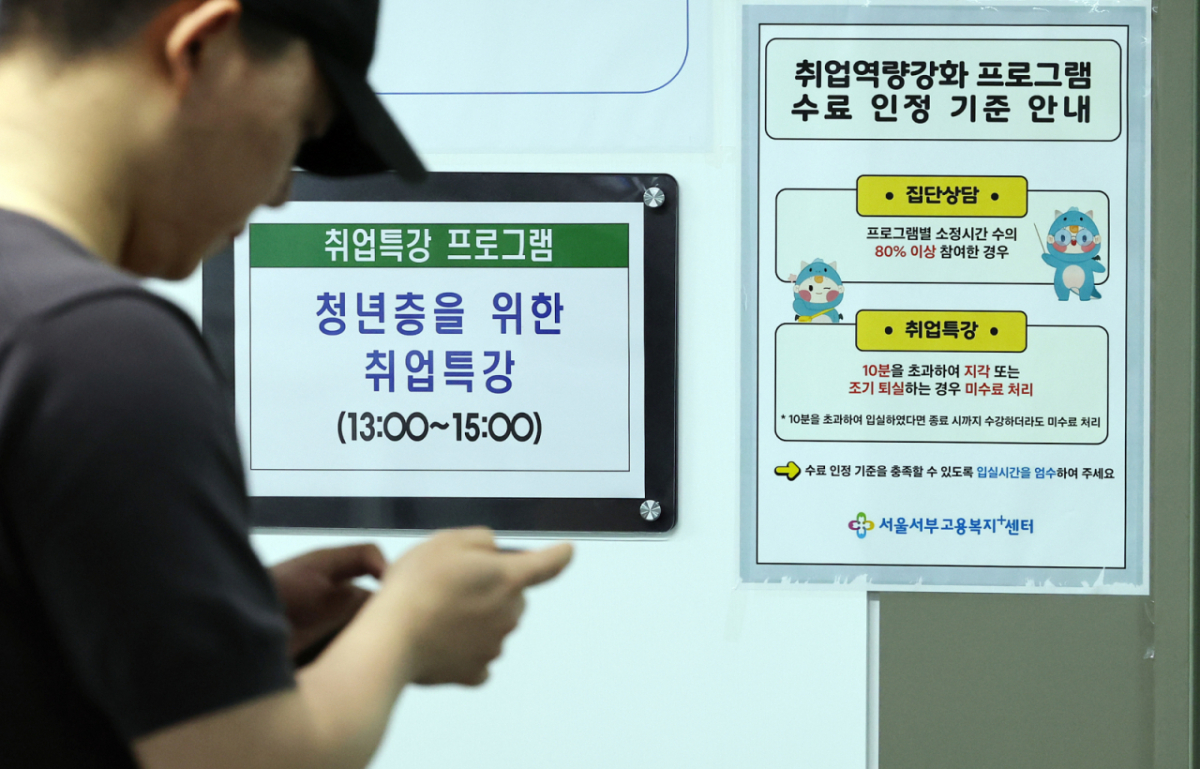
The government's announced 'Youth Employment Recovery Plan' focuses on concentrated support for young people living in local regions and those seeking employment at SMEs (small and medium-sized enterprises), aiming to resolve disparities. The plan addresses the deepening dual structure of the labor market caused by gaps between the capital region and non-capital regions, as well as between large corporations and SMEs, identifying this as a fundamental cause of the 'resting youth' problem and presenting countermeasures accordingly.
The plan aims to create 300,000 jobs for young people while simultaneously promoting career growth after employment and improving working conditions. Whether these measures succeed in creating quality jobs and resolving the dual structure of the labor market is expected to be the key to the policy's success or failure.
714,000 'Resting Youth' Aged 20s-30s Hit Record High… Deepening Dual Structure of Labor Market
According to the Economic Activity Population Survey by the National Data Administration on the 28th, the number of resting youth aged 20 to 30 reached 717,000 last year, surpassing 700,000 for the first time in history. This is the highest level since statistics began being compiled in 2003. 'Resting' refers to a state of not preparing for employment and resting without special reasons such as housework, childcare, or illness.
The government believes that the fundamental causes of youth unemployment are the dual structure of the labor market and the long-term extension of career gaps. Due to the problem of the dual structure of the labor market, where differences in wage levels and working conditions between large corporations and SMEs (small and medium-sized enterprises), as well as between capital region companies and non-capital region companies, continue to widen, the job search period for young people to directly secure quality jobs is gradually expanding.
Even when young people lower their expectations and find employment at SMEs (small and medium-sized enterprises), they often resign due to dissatisfaction with wages and working conditions. Last year, 285,000 'resting youth' had work experience within the past year; of these, 92.7% (264,000) resigned from SMEs (small and medium-sized enterprises) with fewer than 300 employees. Additionally, 47.1% (134,000) were transferred into the 'resting youth' category from temporary or daily wage jobs.
As the job search period lengthens in pursuit of quality jobs, career gaps widen; as career gaps grow, it becomes increasingly difficult to find quality jobs, creating a vicious cycle that repeats itself.
Analysis suggests that the slowdown in corporate hiring capacity due to the COVID-19 pandemic has significantly contributed to the long-term extension of career gaps among current resting youth. Those currently aged 25 to 29 are the generation that experienced the pandemic during their entry into the labor market. The Korea Research Institute for Vocational Education and Training (KRI-VET) analyzed that corporate avoidance of hiring due to prolonged unemployment after COVID-19, along with a loss of job-seeking self-efficacy, are causes of the increase in resting youth.
Income Support of '100 thousand won Per Month' for Local SME Youth
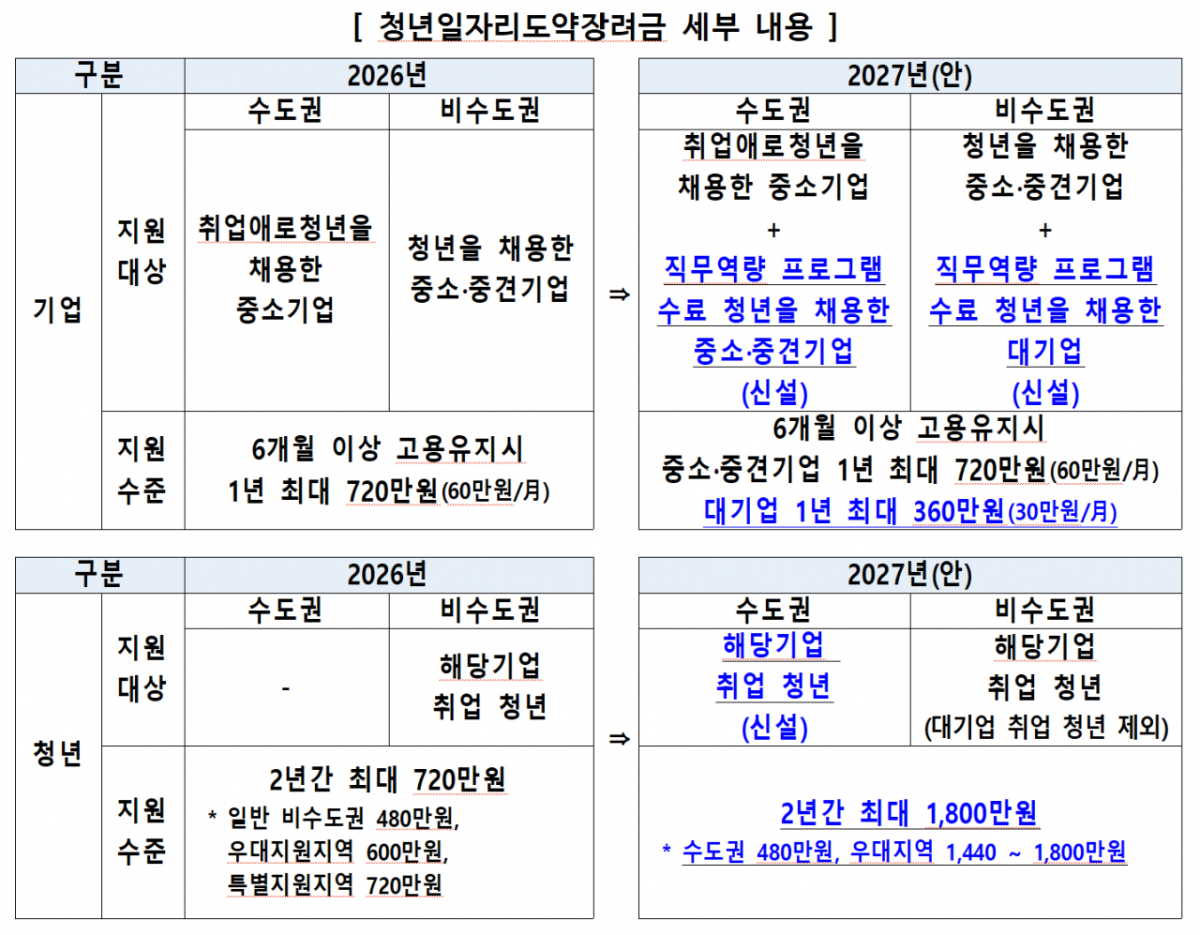
The government's latest measures also focus on resolving the dual structure of the labor market and filling career gaps. Through government support, the plan aims to resolve wage gaps between companies and regions, strengthen vocational training, and establish a career ladder that allows young people to move to their desired workplaces through employment linkage.
One of the wage support policies is the Youth Employment Growth Incentive Grant. This policy provides up to 7.2 million won over two years for young people employed in non-capital regions; next year, the target will be expanded to include young people employed in the capital region as well. The grant amount will more than double to a maximum of 18 million won over two years. Support amounts are differentiated: 4.8 million won for the capital region and 14.4 million to 18 million won for priority areas.
Measures are also being prepared to support asset formation for young people employed at local SMEs (small and medium-sized enterprises). A 'Local SME Employee Type' will be newly established in the Youth Future Savings Account, with a government matching contribution rate of 25%. Under this system, if young people deposit a fixed amount monthly into the Youth Future Savings Account, the government adds an additional 25% of that amount.
Furthermore, to allow all young people to join the Youth Future Savings Account and receive benefits, income requirements for the general type product will be abolished, and the government matching contribution rate for the priority type product will be raised from the existing 12% to 25%.
To improve working and living conditions for youth in local areas, the Youth Culture and Arts Pass will also be expanded. The target age range will be expanded from currently 19-20 years old to 19-34 years old, and the usage frequency will increase from once in a lifetime to annually. Support amounts are set at 100,000 won for the capital region and 150,000 won for non-capital regions.
As a result, young people working at local SMEs (small and medium-sized enterprises) will be supported to achieve an income increase of approximately 100 thousand won per month over two years through measures such as the Youth Employment Growth Incentive Grant (up to 750,000 won per month), Youth Future Savings Account (up to 200,000 won per month), and Youth Culture and Arts Pass (10,000 won per month).
Reducing Career Gaps and Activating Job Transitions from SMEs to Large Corporations
Policies are also being promoted to minimize career gaps and support job transitions to better employment. First, during the job preparation stage, support will be provided for cultivating talent that meets corporate needs through advanced industry vocational skills training using AI (artificial intelligence) and by expanding specialized graduate schools and universities focused on advanced industries. As companies have recently shown a stronger preference for 'new hires with experience,' the plan is to strengthen educational curricula that enhance young people's professional capabilities from before they enter the job market.
The 'K-New Deal Academy' program, where large corporations directly operate educational courses and students can link their training to employment, will also be expanded. While education was conducted for 10,000 participants this year, the number will increase to 50,000 next year. Companies operating the curriculum will receive training cost support, and young people participating in the education will be paid a monthly attendance allowance of 300,000 won in the capital region and 500,000 won in non-capital regions.
After employment, the Ministry of Employment and Labor will provide mentoring services to support future career paths and career development. For young people employed at SMEs (small and medium-sized enterprises), job capabilities will be enhanced by providing educational programs utilizing companies, schools, and associations. The Large-SME Mutual Prosperity Fund will support job transitions based on experience. Through strengthening job capabilities and fund support, the plan is to reinforce a career ladder that allows young people employed at SMEs (small and medium-sized enterprises) to transition to large corporations.
Creation of 300,000 Youth Jobs by 2030… Importance of 'Quality Jobs'
The government plans to create more than 300,000 youth jobs by 2030 through the creation of 200,000 public and private sector jobs and the training of 100,000 young entrepreneurs. The key lies not simply in increasing the number of jobs, but in strengthening effectiveness so that young people can actually return to the labor market through the creation of quality jobs and support for career transitions.
The business community believes that to make youth employment measures effective, it is necessary to increase employment flexibility. The Federation of Korean Industries (FKI) stated in a report released last April: "Due to the rigidity of Korea's labor market, young people tend to pursue long-term job searches with the goal of entering the primary labor market from the start, rather than building careers in the secondary labor market." It further pointed out that "relieving labor market rigidity should support easier entry for young people into the labor market, and wage gaps should be alleviated by establishing a wage system based on job performance and results."
It is also analyzed that customized policies are needed to support young people who seek employment with lowered expectations. The Bank of Korea stated in its 'BOK Issue Note' released earlier this year: "Resting youth show a high proportion of preference for SMEs (small and medium-sized enterprises); compared to other unemployed youth who prefer large corporations and public institutions the most, their expectations are actually lower." It added that "incentives must be prepared to allow young people with education below a bachelor's degree who have left the labor market to re-enter it."

 in ECONOMY

