

The issue of long-term non-construction at national industrial complexes is difficult to resolve solely by terminating occupancy contracts. Even if a contract is terminated, if there is no company willing to take over the land, the industrial site will remain in an unused state. This is why measures are needed to secure new investment demand.
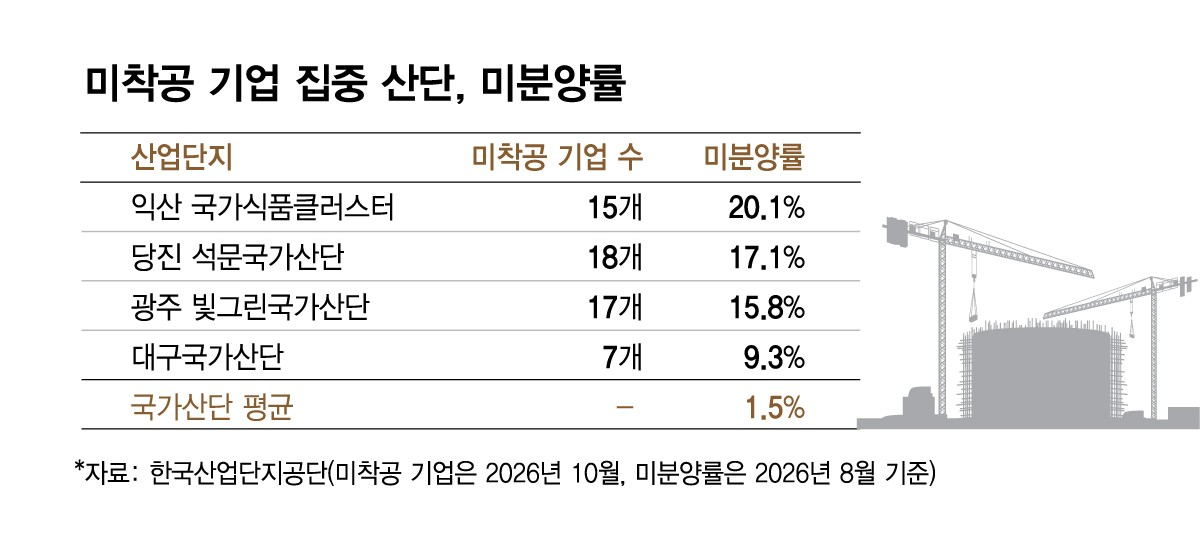
According to the Korea Industrial Complex Corporation on the 14th, the unsold rates at four industrial complexes—Seokmun, Bitgreen, National Food Cluster, and Daegu—where 81.4% of unstarted companies are concentrated stood at 9.3% to 20.1% as of August 2026, significantly exceeding the national average for national industrial complexes (1.5%).
At the Daegu Industrial Complex, there have been cases where public auctions were postponed twice after disposal applications, failing to secure buyers. The corporation also views that terminating occupancy contracts offers little practical benefit, citing the difficulty of finding companies willing to purchase.
The reasons behind companies’ hesitation to invest vary by industrial complex. At the Seokmun Industrial Complex, the access railway project is delayed, and it has been pointed out that residential and educational conditions are insufficient for a complex of 12 million square meters in scale. At the Bitgreen Industrial Complex, investment (wait-and-see) continues due to uncertainty in the electric vehicle market, and it is assessed that the ripple effects of anchor company Gwangju Global Motors have not sufficiently translated into investments by partner companies.
The National Food Cluster is managed by the Ministry of Agriculture, Food and Rural Affairs, limiting eligible industries primarily to agricultural and food products. The fact that companies are reluctant to locate in the Honam region due to the logistics characteristics of the food industry is also cited as an obstacle to attraction. The Daegu Industrial Complex faces difficulties in securing personnel due to its distance from urban areas, and new investments by related parts manufacturers have shrunk due to the electrification transition in the automotive industry, according to analysis.
However, there are also arguments that long-term non-construction cannot be explained solely by location conditions at each industrial complex. Experts have raised the possibility that the method of selling industrial land itself is intertwined with the non-construction issue.
Kang Seong-jin, a professor at Korea University, said, "Even if companies intended to conduct business when purchasing, there may be cases where they postpone investment because profitability does not meet expectations when they actually try to start operations."
Professor Kang proposed that industrial land should be supplied through leasing rather than sales. He explained, "If sold, ownership transfers even if the company does not actually start business, making it difficult to terminate the contract and recover the land later," adding, "It is necessary to include conditions such as recovering the land at the sale price if a factory is not built within a certain period."
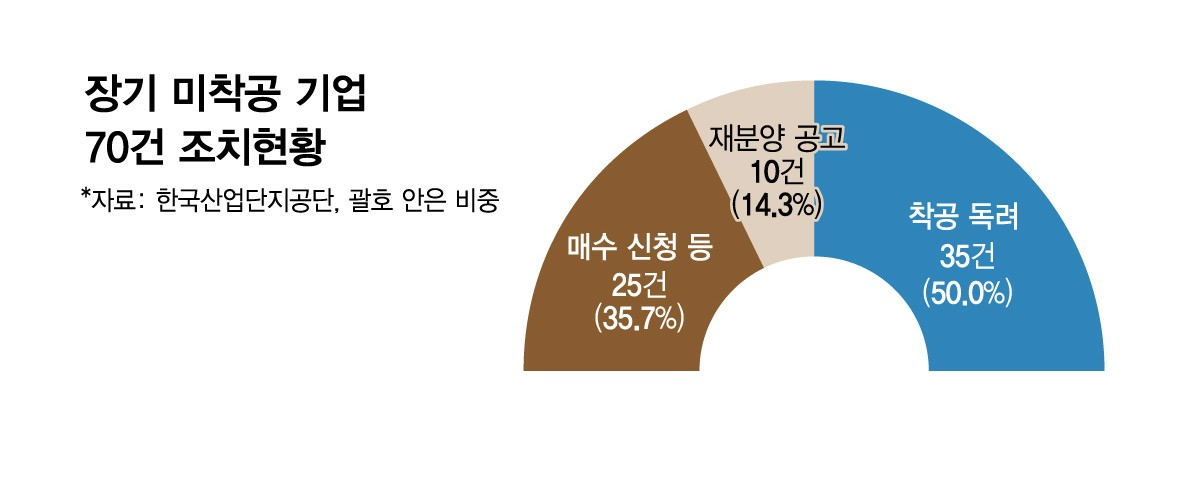
The corporation has revised the basic management plan after non-construction occurred, expanding eligible industries: eight times for the National Food Cluster, five times for the Seokmun Industrial Complex, four times for the Daegu Industrial Complex, and twice for the Bitgreen Industrial Complex. However, since various factors such as labor supply and demand, market accessibility, and residential conditions influence companies’ location decisions in addition to industry type, it is not easy to resolve unsold inventory solely by expanding eligible industries.
There are also institutional limitations. While adding some industries is possible through changes to the basic management plan, if infrastructure changes are required, a change to the development plan under the jurisdiction of the Ministry of Land, Infrastructure and Transport must precede it. Related procedures such as environmental impact assessments may be necessary, and land use changes are followed by procedures to recover the increase in land value. Because the procedures for changing development plans and basic management plans are separate, the managing institutional investor finds it difficult to change occupancy conditions in a short period.
Terminating occupancy contracts is also difficult to implement uniformly. When imposing penalties on companies, the corporation must compare public interest with private interest and review whether there are justifiable reasons for non-construction according to relevant laws and regulations. Even if contracts are terminated, the issue of unused land may persist if new companies cannot be secured.
The corporation is considering expanding food and beverage manufacturing sites at the National Food Cluster and introducing some industry special zones at the Seokmun Industrial Complex. However, it remains uncertain whether expanding eligible industries and improving conditions at each industrial complex will be sufficient to secure new investment demand.
To resolve the long-term non-construction issue, it is necessary to manage companies’ investment execution while securing demand for industrial land. In addition to terminating occupancy contracts, efforts must be made simultaneously to manage investment plans so that they lead to actual factory construction and to create conditions that allow new companies to move in.

 in ECONOMY

