

Although June recorded a "triple increase" with growth in production, consumption, and investment, indicators slowed down within a month. While investment increased, production remained flat and consumption declined. This reflects the base effect following the strong performance of June's data.
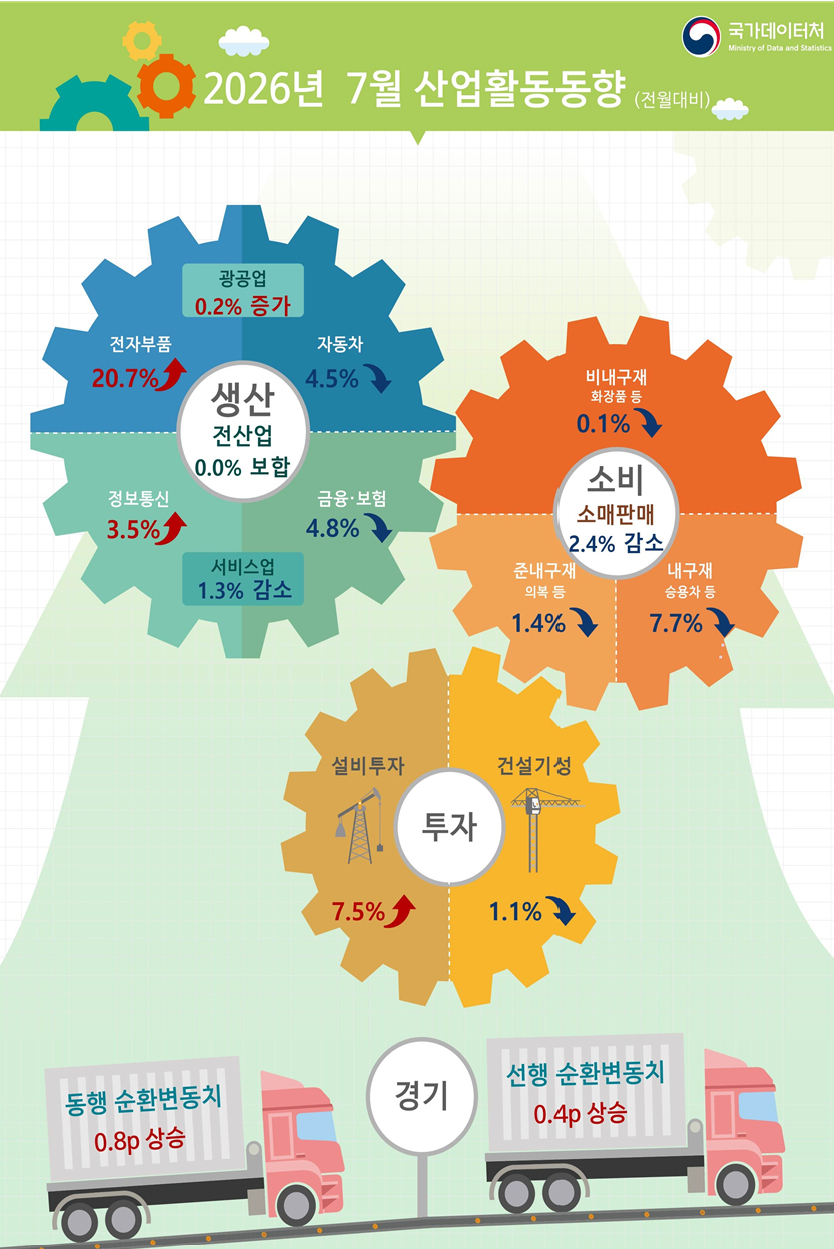
According to the "July 2026 Industrial Activity Trends" released by the National Data Administration on the 31st, total industrial production in July remained unchanged compared to the previous month (hereafter same basis). Compared to the same month last year, it increased by 3.1%. Retail sales fell by 2.4%, while equipment investment rose by 7.5%. After recording a "triple increase" in June with growth across production, consumption, and investment, all categories except investment showed weak performance in July.
Manufacturing production declined in sectors such as automobiles (-4.5%) but increased in electronic components (20.7%) and primary metals (4.2%), resulting in a 0.2% overall increase. The growth rate remained flat due to the base effect from June's significant 6.7% surge.
Service sector production increased in information and communications (3.5%) but declined in finance and insurance (-4.8%) and professional, scientific, and technical services (-2.7%), leading to a 1.3% overall decrease. The decline was influenced by reduced stock trading volume and transaction amounts in July, which negatively impacted the finance and insurance sector.
Retail sales, representing goods consumption, saw declines across durable goods such as passenger cars (-7.7%), semi-durable goods like clothing (-1.4%), and non-durable goods including cosmetics (-0.1%), resulting in an overall 2.4% decrease. This reflects the base effect after a significant increase in durable goods following the resolution of supply shortages caused by a fire at an auto parts factory in June. Consumption is divided into goods consumption and service consumption, but industrial activity trends only cover goods consumption.
Equipment investment increased by 7.5%, driven by growth in transportation equipment (15.4%), centered on other transport vehicles, and machinery such as semiconductor manufacturing equipment (4.2%). This marks the highest increase rate in five months since February (15.0%).
Construction orders decreased by 1.1%, with civil engineering projects increasing by 18.5% while building construction declined by 7.4%. After two consecutive months of growth, the trend reversed to decline.
The coincident composite index, reflecting current economic conditions, rose by 0.8 points to 101.2. The leading composite index, used to forecast future economic trends, increased by 0.4 points to 104.2.

 in ECONOMY

