

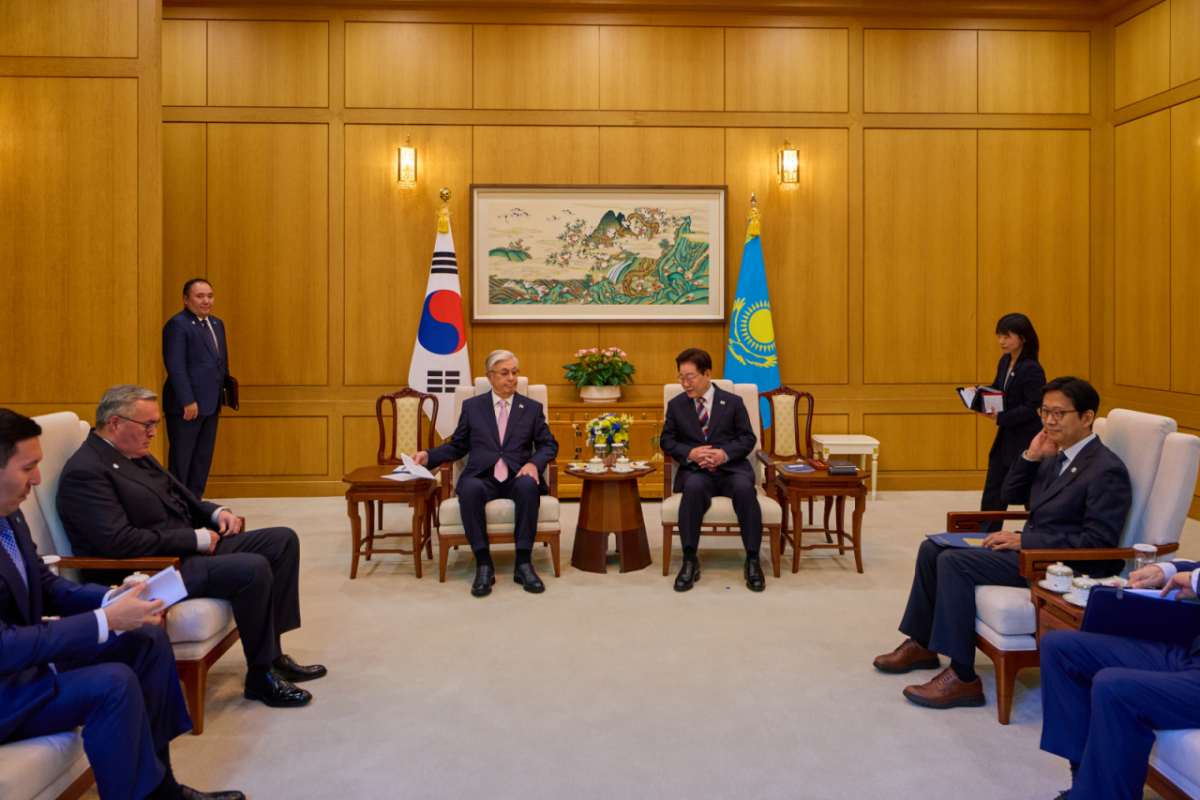
The government has decided to strengthen cooperation with Turkmenistan and Kazakhstan in water resources, renewable energy, and nuclear power sectors through high-level meetings. This is expected to serve as an opportunity for domestic energy and resource-related companies to expand their presence into Central Asia.
The Ministry of Climate, Energy and Environment announced on the 15th that it signed three memorandums of understanding (MOUs) with Turkmenistan and Kazakhstan at Cheong Wa Dae to enhance intergovernmental cooperation in climate, energy, and environmental fields.
An MOU on water resource management cooperation was signed with the Water Resources Committee of Turkmenistan, while an MOU on renewable and clean energy transition cooperation was concluded with Kazakhstan's Ministry of Energy, and another MOU on nuclear power cooperation was signed with its Nuclear Regulatory Authority.
Through the MOU with Turkmenistan, concrete cooperative projects such as an AI-based flood forecasting system and a three-dimensional water management platform utilizing digital twin technology (which replicates real-world objects in virtual space) are expected to be actively developed. It is anticipated that domestic water-related companies will gain expanded opportunities to participate in modernization projects of the KARA Kum Canal, Turkmenistan's major canal.
With Kazakhstan, the two countries plan to combine Kazakhstan's abundant renewable energy potential with South Korea's renewable energy systems and technological-industrial capabilities in energy storage through strengthened renewable energy cooperation. In the future, both nations will discuss exchanging technical information and best practices, holding corporate expos, and supporting feasibility studies for promising cooperative projects.
The nuclear power cooperation MOU aims to establish a foundational framework for nuclear power collaboration with Kazakhstan. As the world's largest uranium producer, Kazakhstan will expand cooperation with South Korea in various areas including nuclear policy, human resource development, research and development, and radioactive waste management through this MOU.
Kim Sung-hwan Gi Hu-bu (Minister) stated, "I hope that the signing of these three MOUs will serve as an opportunity to strengthen mutually beneficial cooperation aimed at addressing climate crises and accelerating the transition to a low-carbon green economy."

 in ECONOMY
