

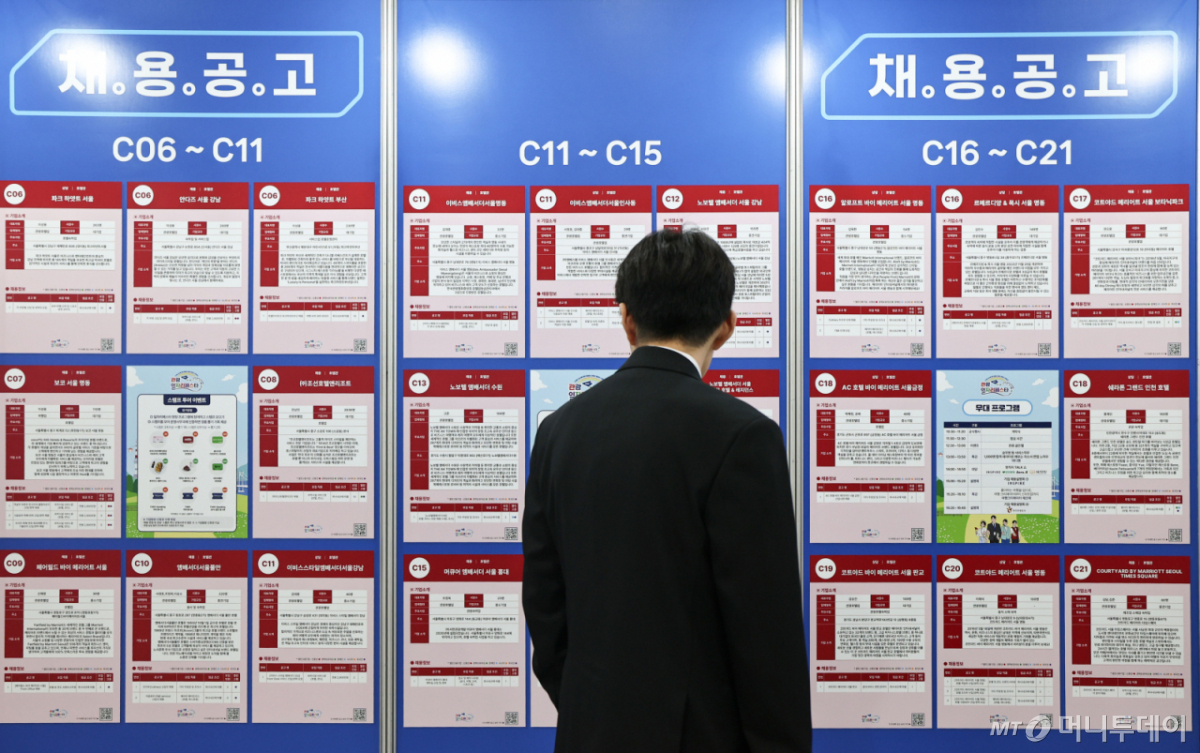
While the number of young people who have "given up" is decreasing, youth employment rates are actually falling. This means that even if young people who were not previously active in the labor market start seeking jobs again, it is not easy for them to secure actual employment. Barriers preventing young people from entering the labor market remain high due to a mismatch between job seekers and companies caused by lack of experience and qualifications.
According to the National Data Office on the 16th, the number of youth (ages 15–29) who have "given up" in August was 395,000, down by 51,000 from the same month last year. This marks a seven-month consecutive decline since February compared to the same period last year. In contrast, the youth employment rate fell to 44.1%, a drop of 1.0 percentage points from the same month last year. Even as more young people attempt to re-enter the labor market, there remains a significant gap before they can secure actual employment.
At the center of this issue is "first work experience." Even if young people acquire necessary skills through vocational training, it is difficult for them to demonstrate their capabilities during the hiring process without actual work experience. From the company's perspective, it is also challenging to determine whether a candidate can perform actual tasks based solely on completion certificates or qualifications. While employment leads to gaining experience, those without experience find it hard to get hired, creating a vicious cycle of "lack of experience → difficulty finding jobs → employment gaps." The core problem lies in the fact that although more young people are receiving training, there is no clear pathway for their training experiences to be recognized in hiring processes.
The mismatch between job seekers and companies follows the same logic. Companies want talent they can immediately deploy, but young people lack opportunities to gain relevant experience. This gap widens further due to disparities in wages and working conditions between large corporations and SMEs (small and medium-sized enterprises), increasing the divide between jobs desired by youth and talents needed by companies.
This gap is especially pronounced in fields involving new technologies. While the number of young people learning new technologies like AI is growing rapidly, personnel with actual experience applying these technologies in real work settings remain scarce. Ultimately, what young people need is not just completing training but gaining actual job experience that allows them to demonstrate their capabilities in the hiring market.
In this context, vocational training is shifting from ending at education to connecting directly with companies and jobs. Representative examples include K-New Deal Academies, where companies participate in curriculum design and teach job competencies needed in industrial settings, and K-Digital Training (KDT), which focuses on building digital and AI practical skills through project-based, on-site education. The focus is shifting from a model where educational institutions predict industry demand and train personnel to one where companies directly specify required roles and cultivate talent accordingly.
However, if young people complete training but still cannot find jobs, the barrier of "first work experience" reappears. This is why the Ministry of Employment and Labor plans to launch a pilot program called 'Youth AI First Job Experience Support' starting next year. The program will provide salaries for up to two years to youth who have completed AI vocational training but remain unemployed, allowing them to participate in companies' AI transformation (AX) projects. This aims to reduce the burden on companies while enabling young people to gain actual work experience and build their first career records. The support scope has been expanded to cover employment gaps even after training.

 in ECONOMY
