

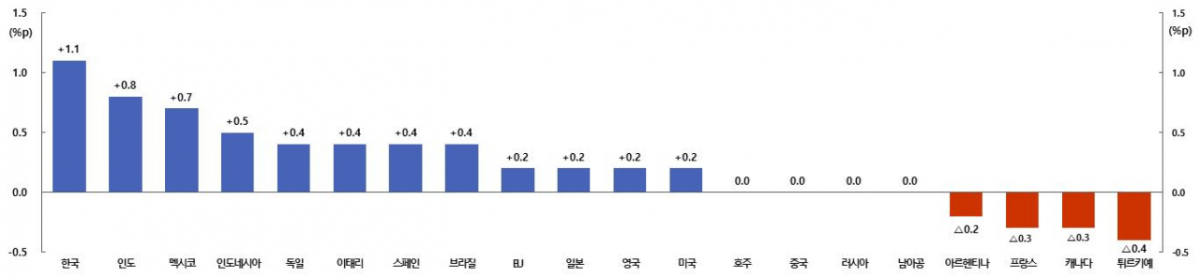
The OECD raised its growth forecast for South Korea this year by 1.1 percentage points compared to three months ago, the largest upward revision among the Group of Twenty (G20) nations.
In its economic outlook released on the 23rd, the OECD projected South Korea's growth rate for this year at 3.7%, up 1.1 percentage points from its June forecast of 2.6%. This projection is higher than those of major institutional investors, including the government (3.0%), the Bank of Korea (3.3%), and the International Monetary Fund (2.6%).
Notably, considering that the OECD had projected South Korea's growth rate for this year at 1.7% in March, the forecast was revised upward by 2.0 percentage points within just six months. This reflects a heightened assessment of upside factors driven by a boom in the semiconductor industry.
If the OECD's forecast holds true, South Korea's growth rate this year will outpace that of major advanced economies. The OECD projected global and G20 growth rates for this year at 2.9% and 3.1%, respectively. By country, it provided forecasts including 2.2% for the United States, 0.8% for Japan, and 4.5% for China.
The OECD stated, "This year, strong export and production growth is driving South Korea's expansion, and a moderate recovery in consumption is expected to continue into next year."
In fact, while the OECD had projected South Korea's growth rate for next year at 1.9% in its June forecast, it now presents a figure of 2.6%, also the largest upward revision among G20 nations. The OECD's projected growth rate for the G20 next year is 3.0%.
The OECD projected South Korea's inflation rates for this year and next year at 3.0% and 2.7%, respectively, representing upward revisions of 0.4 percentage points and 0.5 percentage points compared to three months ago.
The Ministry of Economy and Finance explained that the upward revision in the inflation forecast appears to be primarily driven by the significant upward adjustment in the growth forecast and higher international energy price projections compared to June.
Meanwhile, regarding recent trends in the global economy, the OECD noted that "substantial oil inventories and support measures by governments around the world are mitigating a significant portion of the negative impact from the Middle East war," adding that "many countries are maintaining resilience."
In particular, it is expected that the current high international energy prices will gradually stabilize after the fourth quarter of this year.
Downside risks to the global economy include sustained rises in energy prices, supply shocks due to worsening weather conditions, and further increases in long-term government bond yields. Conversely, an early resolution of the Middle East war is anticipated as an upside factor.

 in ECONOMY
