

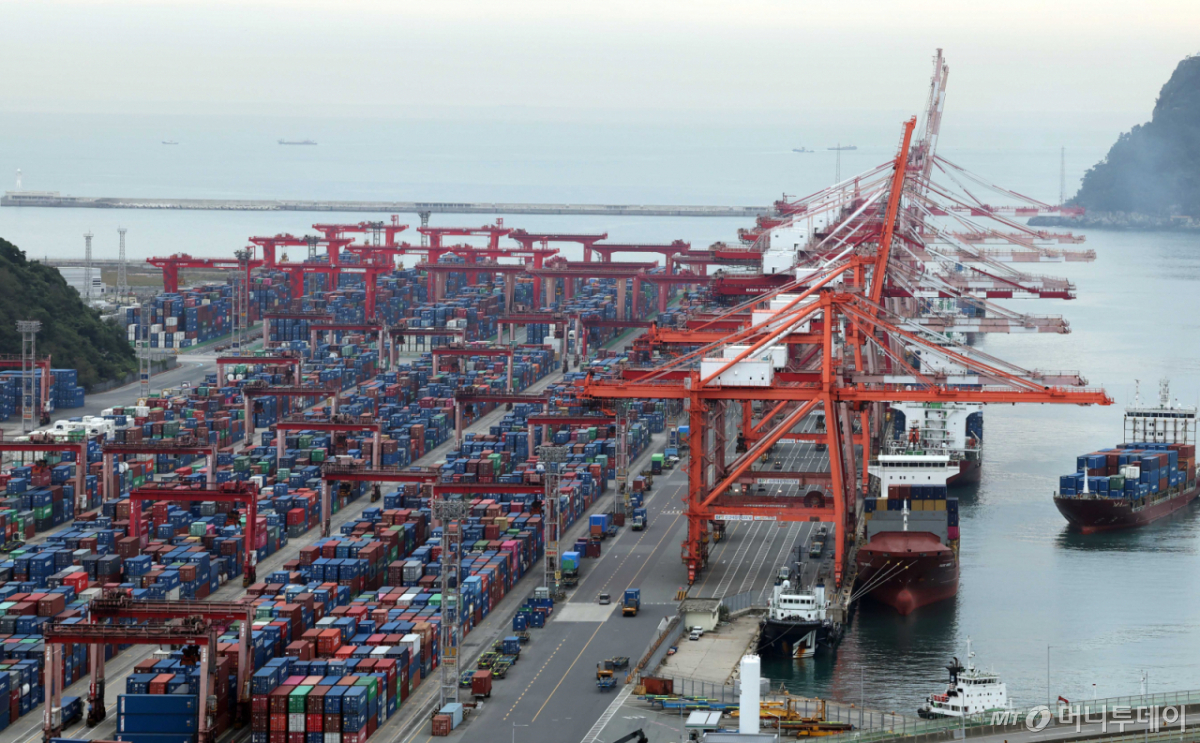
Driven by a sharp increase in exports centered on semiconductors, South Korea's current account balance recorded a surplus of $61.46 billion in September last month. This marks the first time in history that the monthly current account balance surplus has exceeded $60 billion. The goods trade surplus also set an all-time high.
According to the "Preliminary Balance of Payments for September 2026" released by the Bank of Korea on the 5th, the current account balance in September last month was recorded at a surplus of $61.46 billion. This surpassed the previous record set in June last year ($49.73 billion) within three months. Compared to the previous month ($46.11 billion), the size of the surplus expanded by $15.34 billion.
The expansion of the current account balance surplus was driven by strong exports of information technology (IT) items, including semiconductors. The goods trade balance recorded a surplus of $62.75 billion, surpassing the previous record set in June last year ($47.89 billion).
Goods exports reached $130.72 billion, surging 92.4% year-on-year. This marked the fourth consecutive month exceeding $100 billion, setting an all-time high. While IT item exports increased by 195.8%, non-IT items also rose by 13.4%.
On a customs clearance basis, semiconductor exports surged 260.3% year-on-year to reach $60.5 billion. Exports of solid-state drives (SSDs), which are computer peripherals, also increased by 392.3%. Petroleum products (73.3%), steel products (6.7%), and machinery/precision instruments (6.3%) also saw increases. In contrast, automobile exports decreased by 5.6%.
Goods imports reached $67.97 billion, up 29.4% year-on-year. On a customs clearance basis, raw material imports increased by 21.3%, and capital goods imports rose by 42.3%. In particular, imports of semiconductors and semiconductor manufacturing equipment increased by 92.8% and 49.2%, respectively. Consumer goods imports also rose by 2.0%.
The services balance recorded a deficit of $3.35 billion. The size of the deficit expanded compared to the previous month (-$1.68 billion). Although the transportation balance posted a surplus of $130 million, the surplus narrowed as charter fees paid increased compared to the previous month.
The intellectual property services balance recorded a deficit of $770 million, with the deficit widening. The travel balance remained unchanged from the previous month at a deficit of $770 million.
The primary income balance recorded a surplus of $2.65 billion, expanding the surplus compared to the previous month ($1.92 billion). This was influenced by a dividend income surplus of $2.24 billion.
Net assets in the financial account increased by $54.34 billion, recording the largest increase on record. This surpassed the previous record set in June last year ($46.71 billion).
Domestic residents' overseas securities investment increased by $16.63 billion. Among this, overseas stock investment rose by $9.91 billion, while overseas bond investment increased by $6.72 billion, setting an all-time high. It was explained that the scale of investment expanded as the attractiveness of overseas bonds increased.
In contrast, foreign residents' domestic securities investment decreased by $13.81 billion. In particular, there was a net sale of domestic stocks worth $13.74 billion. Foreign selling pressure expanded, centered on large-cap semiconductor stocks.
Direct investment saw an increase of $11.43 billion in domestic residents' overseas investment and $6.52 billion in foreign residents' domestic investment, respectively.

 in ECONOMY
