

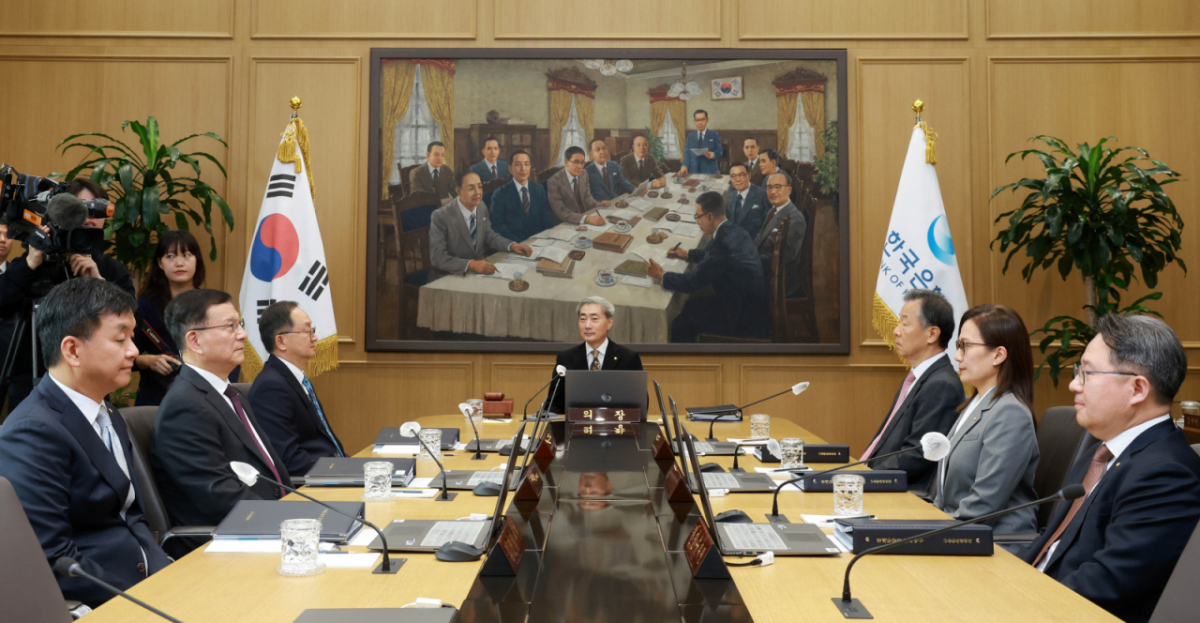
The Bank of Korea's Monetary Policy Board (MPB) kept the base rate at 3.0% per annum. This is interpreted as a pause to assess the effects of the two consecutive rate hikes implemented previously.
On the 22nd, the Bank of Korea held its monetary policy direction decision meeting in the MPB conference room at the headquarters in Jung-gu, Seoul, and decided to maintain the base rate at the current level of 3.0% per annum. All seven members of the Financial Supervisory Commission voted for a hold.
Previously, the Bank of Korea entered a monetary tightening cycle by raising the base rate, which had been frozen at 2.5% per annum for about a year and two months, by 0.25 percentage points in July. Following this, it proceeded with "back-to-back hikes" in August, opening the "era of a 3% base rate" for the first time in a year and nine months.
It is analyzed that the Bank of Korea has slowed its pace of rate hikes based on the judgment that it is necessary to verify the effects of the two previous increases. This is because there is a time lag before monetary policy affects the real economy, necessitating time to check economic conditions, prices, and financial market environments before any additional hikes.
Additionally, the fact that interest repayment burdens for households and corporations are increasing due to steep rate hikes is also cited as a background factor for the rate hold.
In its monetary policy direction statement, the MPB stated, "Given heightened uncertainty related to the Middle East situation, monetary and fiscal policies of major countries, etc., we judged it necessary to maintain the base rate at the current level while monitoring the development of domestic and external risk factors and the ripple effects of the two hikes."
However, the Bank of Korea's tightening stance itself has not changed. This is because price burdens remain. The consumer price index increase rate last month was 2.9%, down from the previous month (3.1%), but it still significantly exceeds the Bank of Korea's price stability target of 2%.
In addition to supply-side inflationary pressures due to geopolitical instability in the Middle East region, demand-side upward pressures stemming from strong exports centered on semiconductors and a recovery in domestic demand are being added, with future price burdens expected to continue further.
The MPB stated, "Going forward, prices are expected to show an upward trend exceeding the target level for a considerable period as the transmission of heightened cost pressures continues and demand-side pressures gradually grow," adding, "We judge that uncertainty is high regarding the future price path, related to movements in international oil prices and exchange rates, the speed of domestic demand improvement, and the extent of wage increase diffusion."
Accordingly, if inflationary pressures and the current economic improvement trend continue, there are observations that the Bank of Korea may proceed with additional rate hikes at the November MPB. Previously, in August, the median of the six-month conditional base rate forecasts by MPB members released by the Bank of Korea was 3.25% per annum. Out of a total of 21 forecasts, 16 were distributed at levels higher than the current interest rate level of 3.0% per annum.
The MPB stated, "Going forward, we will operate monetary policy with attention to financial stability while checking the growth trend and ensuring that the inflation rate stabilizes at the target level in a medium-term perspective," adding, "Future monetary policy will determine the timing and speed of additional hikes by closely examining price and economic trends as well as the financial stability situation."

 in ECONOMY
