

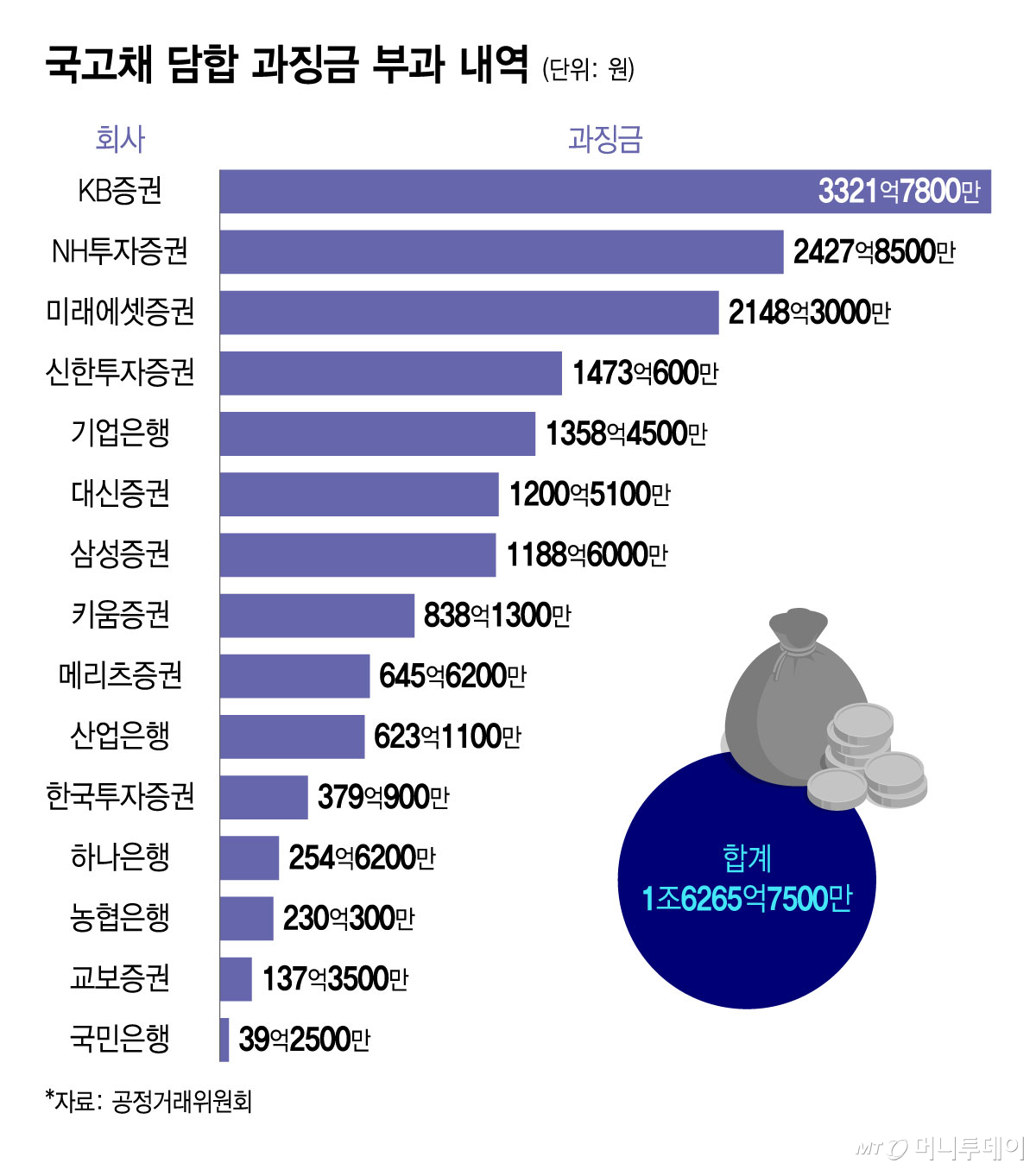
The Fair Trade Commission decided to impose a total of approximately 1.6 trillion won in surcharges on 10 securities firms and 5 banks suspected of exchanging information and colluding on bids during the competitive bidding process for government bonds over a period of about three years and six months. This is the largest surcharge in the history of the Korea Fair Trade Commission.
On the 11th, the Korea Fair Trade Commission announced that it had decided to impose corrective orders and a total surcharge of 1 trillion 626.575 billion won on 15 government bond primary dealer (PD) operators for violations of the Monopoly Regulation and Fair Trade Act.
This surpasses the record-high surcharge of 1 trillion 31.1 billion won imposed by the Korea Fair Trade Commission on U.S. semiconductor company Qualcomm in 2016. In terms of cartel cases, it is more than double the scale of the previous record-high surcharge (747.6 billion won) imposed on four starch and starch sugar manufacturers and sellers.
The 15 PD companies are 10 securities firms including Kyobo Securities, Daishin Securities, Meritz Securities, Mirae Asset Securities, Samsung Securities, Shinhan Investment Corp, NH Investment & Securities, KB Securities, Korea Investment & Securities, and Kiwoom Securities, and 5 banks including KB Kookmin Bank, NH NongHyup Bank, IBK Industrial Bank of Korea, Hana Bank, and Korea Development Bank.
The Korea Fair Trade Commission decided to refer seven companies—Mirae Asset Securities, NH Investment & Securities, Industrial Bank of Korea, KB Securities, Kiwoom Securities, Korea Development Bank, and Korea Investment & Securities—to the Serious Crime Investigation Agency for prosecution due to their long participation periods in the cartel and high number of bidding cases.
According to the Korea Fair Trade Commission, the 15th PD companies exchanged bid interest rate (price) information or colluded on bid interest rates and volumes via phone calls and messengers up until one to two minutes before the deadline in a total of 150 competitive government bond bids from January 2020 to June 2023. In 145 of these bids, they went beyond information exchange to engage in bid collusion (agreement) on specific bid interest rates or volumes.
The Korea Fair Trade Commission explained that the companies engaged in cartel behavior routinely and habitually, exchanging information without even a greeting on bidding days or reaching agreements within seconds. These companies also handed over contact details of competitors' bidding personnel to successors when staff were transferred, or created and utilized manuals detailing methods of communication with competitors by bidding time slot.
The Korea Fair Trade Commission determined that such cartels restricted competition in the government bond bidding market, ultimately increasing the government's burden on debt financing costs.
The Korea Fair Trade Commission assessed that the scale of bids affected by the cartel reached approximately 54 trillion won. This is a reduction of more than 20 trillion won compared to the related sales amount (approximately 76.2 trillion won) in the original review report (equivalent to an indictment from the Prosecution Service). The number of bidding cases determined to have actually involved cartels was reduced by about 20 cases from the approximately 170 cases claimed by the initial reviewers, taking into account factors such as the number of companies that actually participated in each individual bid.
However, it did not accept the industry's argument that related sales should be calculated based on actual operating revenue rather than the winning bid amount.
Instead, considering the Ministry of Economy and Finance's opinion to minimize shock to the government bond issuance market, a surcharge rate of 4.5% was applied. The initial reviewers had argued that this cartel constituted a "very serious illegal act," in which case the law allows for a surcharge of 10.5% to 20% of related sales.
Additionally, it partially accepted the argument from the 15th PD companies that not all related sales constitute unfair gains, and applied a uniform reduction of 30%.
Kim Geun-seong, a Korea Fair Trade Commission Commissioner, explained, "The final sanction was determined after comprehensively considering the Ministry of Economy and Finance's opinion to consider the impact on the government bond market, as well as the respondents' opinions regarding unfair gains."

 in ECONOMY
