

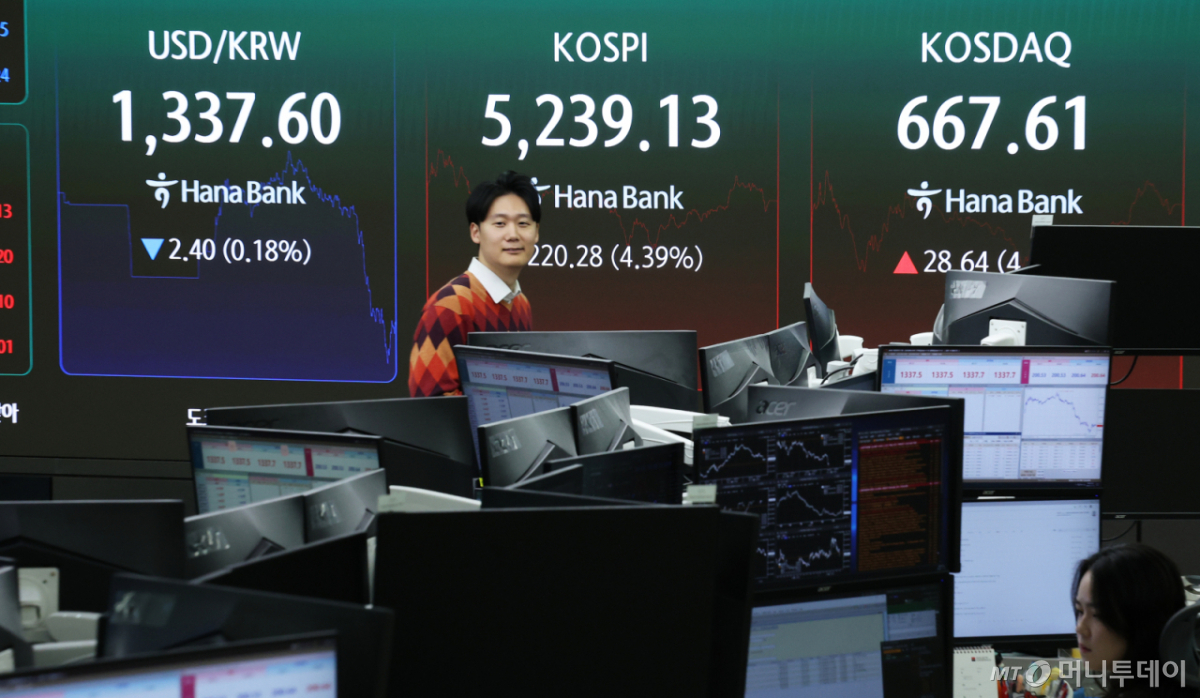
The dollar-won exchange rate fell for the second consecutive day, entering the 1,330-won range for the first time this month. This was driven by a recovery in risk-on sentiment as concerns over shrinking artificial intelligence (AI) investment, which had spread following the U.S. midterm elections, eased. Exporters' nego (dollar selling) volumes, coupled with additional dollar selling pressure, led to the decline in the exchange rate.
In the Seoul foreign exchange market on the 10th, the dollar-won exchange rate ended weekly trading at 1,337.5 won, down 9.6 won from the previous session. This was the lowest weekly closing price since the 30th (1,334.3 won). Following a drop of 9.5 won the previous day, the rate fell by a total of 19.1 won over two days.
During intraday trading, the exchange rate dropped to as low as 1,335.1 won, marking its lowest level since the 2nd (1,331.3 won). This meant that the rate, which had spiked to 1,365.0 won intraday the previous day, fell by nearly 30 won in a single day.
On this day, the exchange rate widened its decline as dollar selling from exporters concentrated in the afternoon. Market participants who had previously been buying dollars also joined in additional selling, expanding downward pressure.
The recovery in investor sentiment was also clear in the stock market. KOSPI closed at 5,239.13, up 220.28 points (4.39%) from the previous session. KOSDAQ also recorded a gain of 28.64 points (4.48%) to reach 667.61. The activation of buy-side sidecar (futures market circuit breaker) in both major markets during intraday trading was the first time since July 31.
Foreign investors made net purchases of approximately 370 billion won on the Korea Exchange, returning to a buying stance for the first time in eight trading days. The reduction in pressure from foreign capital outflows also supported the strength of the won.
Min Gyeong-won, an economist at Woori Bank, analyzed that "AI semiconductor investment sentiment, which had been dampened by concerns over data center regulations, recovered on the back of bargain hunting, and the sharp drop in international oil prices due to expectations for resumed negotiations between the U.S. and Iran worked in favor of the won."
Going forward, the exchange rate is expected to be influenced by U.S. inflation indicators and monetary policy outlooks from the Federal Reserve (Fed). While further declines are possible if risk-on sentiment persists, expectations of U.S. interest rate hikes serve as a factor limiting the downside.
Min said, "If the trend of weakening foreign selling pressure continues, nego volumes centered on semiconductor companies will lead the decline in the exchange rate," while adding that "expectations for a Federal Reserve interest rate hike in December and dollar demand from real-economy buyers are factors supporting the lower bound of the exchange rate."

 in ECONOMY
