

The government has presented 'growth for all' as the core objective of next year's economic policy. It will focus on resolving polarization to ensure that expanded exports and investment driven by the semiconductor boom lead to a recovery in domestic demand, while also challenging itself to achieve a 3% potential growth rate through the diffusion of artificial intelligence (AI).
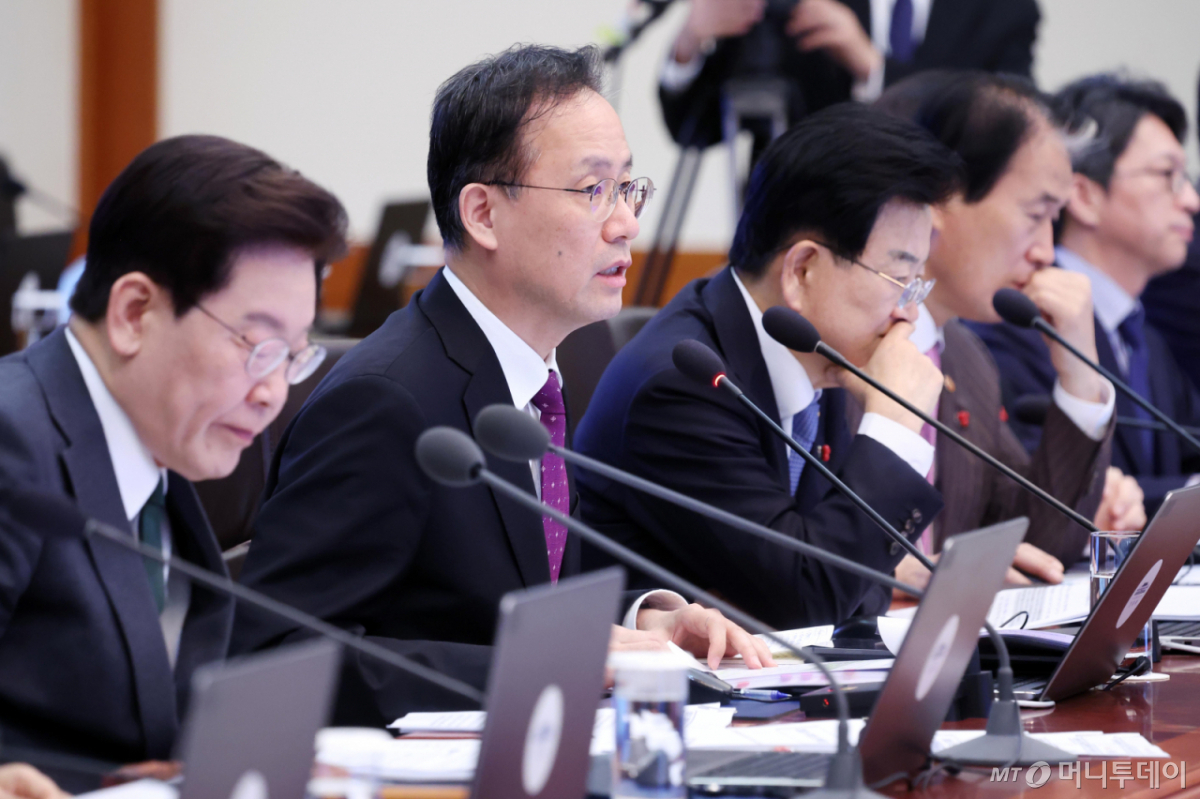
Deputy Prime Minister and Minister of the Ministry of Economy and Finance Lee Hyoung-il stated at the State Council meeting on the 24th, while reporting on the 'Key Points Draft for the 2027 Economic Policy Direction,' that "we intend to make every effort to realize growth for all, where every citizen can equally enjoy the opportunities and results of growth."
Previously, the International Monetary Fund (IMF) forecast that South Korea's potential growth rate would rebound from 1.9% last year to 2.5% in 2029–2031. Deputy Prime Minister Lee said, "If AI diffuses throughout the entire economy, we can expect additional productivity improvements," adding, "There is room for it to rise further."
Deputy Prime Minister Lee diagnosed that structural issues such as disparities among industries, companies, regions, and generations, and the dual structure of the labor market, remain despite the semiconductor boom, emphasizing that "it is necessary to proactively prepare for the period after the semiconductor boom."
Accordingly, the government will strengthen integrated management of financial, foreign exchange, and real estate markets while concentrating its efforts on three major policy directions: livelihood stabilization, expanding growth drivers, and strengthening global competitiveness.
Along with next month's economic policy direction, the government will also announce three major livelihood projects covering employment, housing, and finance for low-income households. Key tasks include supplying 1.19 million public housing units, expanding the supply of low-interest funds, and reducing the burden on diligent repayors.
It also presented measures to improve the dual structure of the labor market, including the diffusion of agreements on mutual benefit between original equipment manufacturers (OEMs) and subcontractors and joint transition to AX (AI transformation), improvements to wage systems and working hours, and a shift to income-based employment insurance. It is also considering launching the 'Our Children's Independence Fund' and revitalizing fund-type retirement pensions.
Promoting long-term investment, strengthening shareholder protection, improving KOSDAQ system regulations, improving foreign exchange transaction regulations and internationalizing the won, legislating digital asset laws, and institutionalizing cross-border stablecoin transactions were also included as key tasks.
Deputy Prime Minister Lee said, "We plan to develop indicators for the quality of life of citizens to check on the improvement of livelihoods and polarization, and to actively link these with budgets and policies."

 in ECONOMY
