

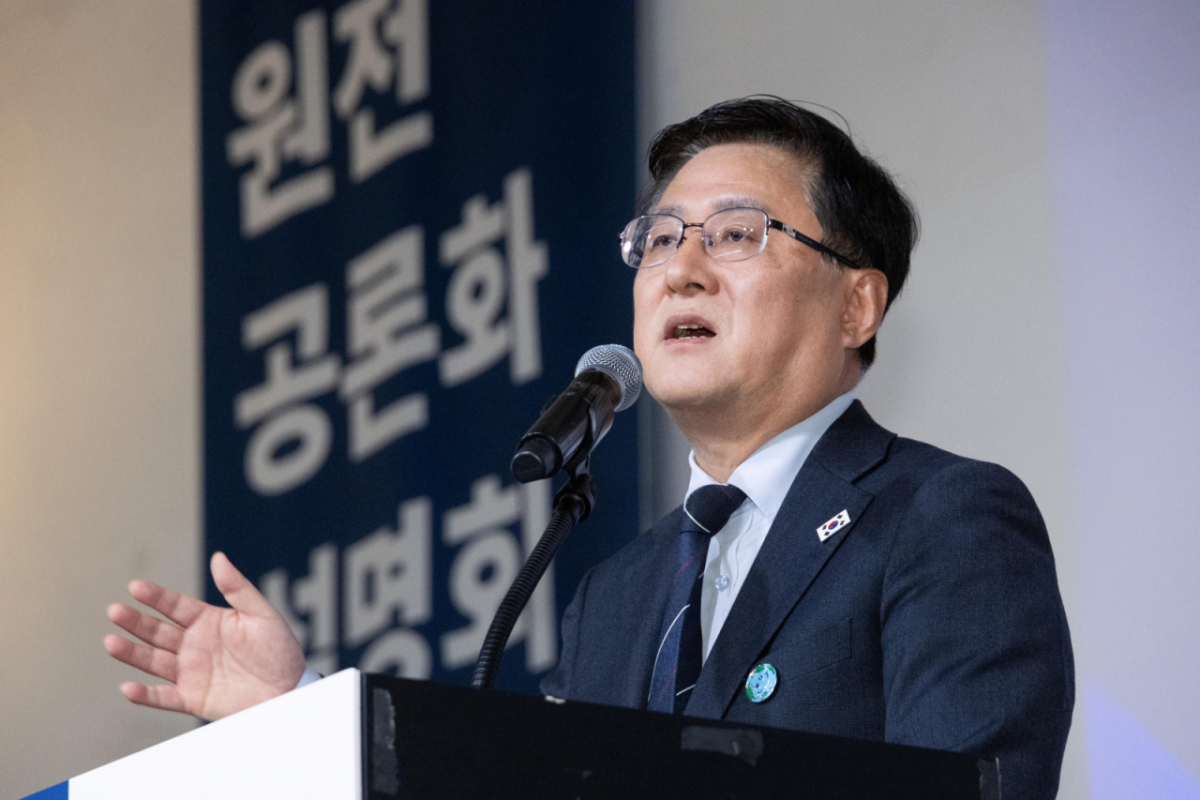
Minister Kim Seong-hwan of the Ministry of Climate, Energy and Environment stated, "In Europe, electricity rates have exceeded 300 won per kWh (kilowatt-hour) following the nuclear phase-out," adding that he is "deeply concerned as the minister responsible for electricity rates."
Minister Kim made these remarks at the "Public Forum on Nuclear Power for the Basic Plan on Electricity Supply and Demand" held on the 25th, saying, "(When discussing future power supply) we must also consider how much electricity cost should be borne and what electricity prices will result from using specific energy sources." The forum was organized to gather public opinion on how to determine the role and proportion of nuclear power in establishing the Basic Plan.
Minister Kim believes that while renewable energy must be rapidly expanded considering climate change and global trends, concerns about rising electricity rates due to a reduction in nuclear power must also be addressed in light of industrial competitiveness. He pointed out, "Before the Russia-Ukraine war, our country's industrial electricity rate was in the 120th-won range per kWh, but it rose to the 180th-won range through the conflict," adding, "There is an issue of having to compete with China, where electricity rates are in the 120th-won range."
He also emphasized that various conditions have changed compared to two years ago when the 11th Basic Plan was established. Minister Kim stated, "While we must reduce fossil fuels and rapidly increase renewable energy to address the climate crisis, past variables have shifted," adding, "Proponents of nuclear expansion say 'what is there to discuss in a two-year plan,' but that is not the issue. Time is passing quickly, and variables have grown."
This was Minister Kim's rebuttal after experts on the side advocating for nuclear expansion declared their refusal to participate, criticizing the determination of the nuclear power proportion by 2040 as merely a "two-year plan" during the public deliberation process. The expansion advocates argue that since the existing 11th Basic Plan has already finalized the power supply plan through 2038, discussing only the nuclear power proportion up to 2040 is meaningless. They contend that the long-term nuclear power proportion should be discussed at least until 2050.
In response, Minister Kim emphasized that a new Basic Plan must be established to match the changed conditions compared to two years ago. He stated, "(Since the establishment of the 11th Basic Plan) the Lee Jae-myung administration has emerged within two years and promised the public to completely phase out coal-fired power generation by 2040," adding, "We must newly plan in the Basic Plan how to supply electricity to replace the 60th coal-fired power plants that will be closed."
He continued, "The second variable is the artificial intelligence (AI) revolution," explaining, "In the 11th Basic Plan, the construction period for the Yongin semiconductor industrial complex was set for 2045 to 2048, but within two years, semiconductor demand has surged due to the AI revolution, bringing the construction period forward to 2040." He noted that a power supply plan must be established to accommodate this, including four additional semiconductor plants in Gwangju.
Minister Kim said, "I hope the public will make an objective judgment on how to structure future power sources by considering all these factors," adding, "We will reflect both pros and cons considered during the deliberation process in the 12th Basic Plan."

 in ECONOMY
